

arts & life
film
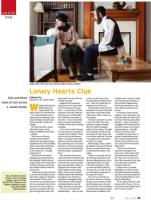
Hadas Yaron (left) and Luzer Twersky (right) in Felix and Meira
Lonely Hearts Club
Felix and Meira
Michael Fox
Special to the Jewish News
looks at love across
a Jewish divide.
Felix and Meira screens
Friday, July 17, through
Sunday, July 19, at the
Detroit Film Theatre in the
Detroit Institute of Arts.
(313) 833-4005;
tickets.dia.org .
ordlessly picking at her
Shabbat dinner, the
young Chasidic wife
clearly wants to be somewhere else.
It's a powerful image, because
Judaism's all-encompassing combi-
nation of family, community and
ritual is typically a comfort and
strength.
But what if her life is a prison
rather than a haven, and an
obstacle to fulfillment rather than
a conduit?
That's the crux of French-
Canadian director Maxime
Giroux's slow-burning and deeply
empathetic drama, Felix and Meira,
which screens at the Detroit Film
Theatre in the Detroit Institute
of Arts Friday, July 17, through
Sunday, July 19.
The film traces the tentative
friendship and romance between
that frustrated Chasidic wife and
mother (Israeli actress Hadas Yaron
of Fill the Void) and a non-Jewish
man (Martin Dubreuil) who's also
at loose ends.
"I didn't want to make a film that
is critical of the [Chasidic] commu-
nity," Giroux explains on the phone
from Montreal. "What I want to
say and show [is] sometimes you're
born in a community where it's not
the one for you. Some people are
raised in a community with a reli-
gion, and ifs good for them. And
other people want more diversity,
and their own path:'
Intrigued by the mysterious,
insular Jews he saw on the streets
and in the shops near his apart-
ment — an area known as "Little
Jerusalem" in the early 1900s and
today home to one of the largest
ultra-Orthodox communities in
the world — the non-Jewish film-
maker set about researching the
Chasidim with the idea of writing a
screenplay.
"Every movie I made is because
I'm curious about a community or
a people Giroux explains. "When
you do a film, you learn about a
subject. I was living in that neigh-
borhood and knew nothing about
that community, and I was curious
about them. [I knew] it was going
to be two years of my life learning
about this subject, reading about
them:'
Felix and Meira starts out as a
wintry portrait of two lonely people
and never veers from the terrain of
a character study. A pensive rather
than a passionate film, it offers no
judgment of the Chasidic world
and scrupulously avoids casting
villains. To the contrary, Meiris
husband, Shulem (the foreboding
yet poignant Luzer Twersky), is
portrayed as unequipped to deal
with his beloved wife's decidedly
unorthodox behavior and, ulti-
mately, deserving of compassion.
"For me, ifs one of the most
beautiful things — when you start
to learn, you also start to learn
there isn't black and white Giroux
says. "That's why I make films, to
understand my world more"
The humanistic world view that
permeates every frame of Felix and
Meira offers no hint that the film-
maker took a while to warm up to
the Chasidim.
"It's kind of natural for me, when
I start to do a film, I have some
prejudice or negative thoughts
about the subject I'm going to
explore," Giroux admits. "I thought
this community was [full of] aus-
tere people who don't want to talk
to me and are really cold. The more
I met people in the community, I
saw that I was wrong:'
Oddly enough, Giroux confides
he originally conceived of Felix and
Meira as a comedy until he came
to understand the delicacy of his
subject.
"When we met people who left
[the Chasidic community], when
they were telling their story, it was
a big thing for them',' he recalls.
"They lost everything. So I told
[co-writer Alexandre Laferriere],
`We cannot do a comedy. The sub-
ject of leaving the community, ifs
too important to them:"
The actor Luzer Twersky was
one of those who lost everything.
He grew up in the Satmar commu-
nity of Brooklyn and, in his early
20s, divorced his wife and opted for
a secular life. His parents promptly
disowned him. In addition to his
excellent work on camera, Twersky
served as technical consultant on
Felix and Meira, helping ensure
that Yaron's performance as well
as the clothes and interiors were
accurate.
In retrospect, Giroux's pivotal
change to a more serious tone was
clearly the right call. Indeed, you'd
never know from his quiet, patient
direction — where every gesture
is freighted with meaning, and the
removal of a wig is an act of heart-
stopping intimacy — that light
romance was his first choice.
In addition to being chosen as
the best Canadian feature at last
fall's Toronto International Film
Festival, Felix and Meira was cho-
sen to close the New York Jewish
Film Festival.
"That was one of the most
important screenings for me
Giroux says. "That's when I really
understood that everything was
fine. There were a lot of ex-mem-
bers of the community [who] came
to me afterward and said how
accurate the film was:'
Perhaps Giroux is naturally
enthusiastic, or maybe he is espe-
cially effusive because he's promot-
ing a film. One's natural skepticism
aside, ifs doubtful he'd voice some-
thing he didn't believe.
"For me, Felix and Meira is more
than just a film," he says. "For me,
ifs one of the most beautiful adven-
tures I've had in my life:'
❑
July 9 • 2015
39