

world
=murk Look Back
Things today are worse than predicted 50 years ago, says retiring ADL chief.
Rap hae l A hren/The Times of Israe l
A
fter 50 years of
service to the
Anti-Defamation
League, retiring national
director Abraham Foxman
expressed passionate
worry to journalist Edwin
Black about the safety and
security of Jews overseas
and Israel's position in the
world. Excerpts from his
exit interview follow, edited
and condensed for continu-
ity, clarity and length.
Edwin Black: Looking
back over a half century,
how does it strike you?
Abraham Foxman: Boy,
how wrong they were! When
I came on this job, I read a
lot of stuff about the future
of the Jewish community.
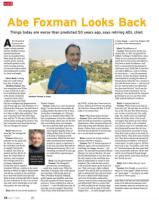
Abraham Foxman in Israel
I wanted to know what I
would be facing. One thing
that the sociologists and prognosticators
Western Europe?
Foxman: Today, it is a clear and present
said 50 years ago was "Anti-Semitism, it's a
historical fact of the past. You don't have to danger. You have Jewish communities dis-
worry about it — we're just going to point
cussing whether they plan to live in Paris,
to it when we fight other prejudices:' Boy,
Amsterdam, Copenhagen, etc. We're get-
how wrong they were! The other thing
ting close to a situation where Hitler will
they said was "In 50 years, Israel will be a
have a posthumous victory for a Judenrein
normal nation among all the nations:' Boy,
[Jew-free] Europe, where Jews, for the first
how wrong they were! Israel has become
time, are thinking about exit strategies.
"the Jew amongst the nations:'
How do we provide safety and security
for Jewish institutions? Jews are
Black: What do you
removing their kippahs. Kids are
mean the "Jew amongst the
taking off their Stars of David. Look
nations?"
at the polls of European Jewish
Foxman: What every-
communities. Half of the Jews have
body else can do, Israel can't
either experienced anti-Semitism
do. Tell me a country in
recently or expect to experience it
the world that can't decide
in the next year. More than half are
its capital? Can't decide
thinking about leaving. This is not
its capital! And where its
something we believed 50 years ago
greatest and best ally for 67
we would still be experiencing in
years, the United States of
Europe.
Edwin Black
America, won't recognize
Special to the
Black: And the governments?
the sovereign choice of a
Jewish News
Foxman: The [European]
sovereign, independent
Jewish state that its capital is
governments are standing up
Jerusalem? Tell me a country in the world
— maybe less, maybe more. When the
that has to defend its right to defend itself? chancellor of Germany calls a rally against
And tell me a country in the world that
anti-Semitism, 5,000 people show up.
has to deal with double and triple stan-
When [President Francois] Hollande,
dards in terms of being told what it should speaks against anti-Semitism, and when
do, how it should do it, who it can do busi- the prime minister of France stands up
ness with, who it should play soccer with,
and says a "France without Jews will not
what person can come and sing.
be France" — wow! We didn't have that 50
years ago. Can you imagine? Remember
Black: How do you see the situation in
Vichy France [Nazi-dominated zone dur-
26 July 9 • 2015
ing WWII]. At that time, France sent out
its Jews. Indeed, all of Europe was getting
rid of its Jews. Having said that, it is still
today a very serious issue.
Black: What about Eastern Europe?
Foxman: There aren't that many Jews
[left]; but still anti-Semitism is a growing
phenomenon. There, the governments are
still trying to keep anti-Semitism alive. In
Russia, I believe there is anti-Semitism.
But Putin has decided it's in his best inter-
est to act and speak out against it.
Black: Contrast the Jewish condition
overseas with that in America.
Foxman: The U.S. Jewish experience is
different. Again, we're not immune here
and things can change. America — not
perfect. You may like the president [Barack
Obama]; you may not like him. You may
like the administration or not. Hey, this is
the only country in the world that man-
dates its ambassadors to report on anti-
Semitism. This is still the only country
in the world that stands up for Israel and
says, "Hey, you've got a right to defend
yourself' Not only do they say Israel has a
right to defend itself, they will send Israel
the arms to defend itself while Europe
won't even let the planes refuel when
America sends its arms to help Israel fight
and defend itself. This is a country that
[in 1939] wouldn't let the [German ship]
St. Louis dock with its cargo of [Jewish]
refugees here ... So that's changed and it's
a major change — even if we disagree with
the policy of this administration.
Black: The difference is?
Foxman: The American Jewish com-
munity then, in 1945, was gornicht [in
Yiddish, "nothing"]. It didn't have a voice.
Today, we are a community that under-
stands that we have power and influence.
Not power as much as influence. And
this is a community that has learned to
understand, since World War II, that they
can make a difference. And so, freedom
for Soviet Jewry — wow, the movement
was here. To have the Jackson-Vanik law
[instrumental in securing the release of
Russian Jewry] when this was a country at
war with the Soviet Union — cold war and
hot war. And our policy was "determine
how they treat the Jews:' And it was the
American Jewish community's "let my
people go" voice that forced the American
government to act in a way that I don't
think anybody believed it would act.
Black: So just how bad is it?
Foxman: While it's the worst that it's
been since the '30s and '40s, it's not like it
was in the '30s and '40s. Why? Because,
one, we have a Jewish state. Yes, under
siege. Yes, maybe under an existential
threat. But today, there is this Jewish
sovereignty that stands up every which
way for Jews. Today, a Jew in Istanbul
or in Buenos Aires or in Timbuktu who
feels threatened because they are Jews
can pick themselves up and go to Israel.
They don't need a cousin or an uncle [to
sponsor them]. They don't need a bureau-
crat. They don't need special permission
and protectzia (in Hebrew, "well-placed
connections") in order to get in. All they
have to do is say, "I'm Jewish, and I want
in." And Israel opens the door, puts their
arms around them and later checks their
tzitzits [sacred knotted threads fringes
on a prayer shawl]. Later, they check just
how Jewish are you?
Black: And to those who say "never
again?"
Foxman: Even though, as a survivor, I
believe in "never again:' I think survivors
say "never again" — but they're not really
sure that it's "never again:'
❑
Edwin Black is the New York Times bestselling
author of the IBM and the Holocaust, and 11
other bestsellers. Black has covered the Anti-
Defamation League and Abraham Foxman for
30 years.