

Photos by Dav id Ca lton
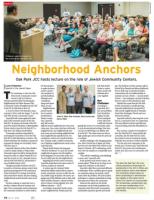
Professor Lupovitch speaks to
the crowd at the Oak Park JCC.
Neighborhoot Anchor
Oak Park JCC hosts lecture on the role of Jewish Community Centers.
Louis Finkelman
Special to the Jewish News
T
he Committee to Save the Oak
Park Jewish Community Center
hosted a talk by Professor
Howard Lupovitch titled "Anchoring the
Neighborhood and Other Reasons Why
Community Centers Strengthen Jewish Life"
at the JCC in Oak Park on June 29.
A crowd of about 180 attended, many
wearing T-shirts with the slogan: "I am the
Oak Park Jewish Community Center:'
Lupovitch's talk comes against the back-
drop of the imminent closure of the Oak
Park JCC. In January, the boards of the JCC
and of the Jewish Federation of Metropolitan
Detroit voted to close the Oak Park JCC to
help close a $1 million annual deficit.
Community members responded by
convening the Committee to Save the Oak
Park JCC to find alternatives to closure. The
Jewish Federation has tendered a request for
proposals for taking over the facility, which
will close Aug. 31.
Lupovitch, director of the Cohn-Haddow
Center for Judaic Studies at Wayne State
University, began his talk by sharing that he
learned to swim at a Metro Detroit JCC, he
rode his tricycle to a JCC, attended nursery
school at the Oak Park JCC and learned to
run a football route at a JCC.
Though personally involved in the JCC,
he spoke as a historian, giving context, back-
ground and perspective to the controversy
of the Oak Park JCC's closing. He built the
talk around three themes: decision-making,
neighborhoods and the Jewish center move-
ment.
Decision-making, as Lupovitch sees it,
involves a balance between emotion and
logic. Every community needs mechanisms
for community members to advise leaders,
14 July 9 • 2015
Oak Park Jewish
for those leaders
to make decisions
Center as a place
and for commu-
where secular and
nity members to
Orthodox Jews
provide feedback,
come together.
although some
New
constituents
always feel dissat-
Challenges
isfied, he said.
According to
Neighborhoods
Lupovitch, JCCs
present a prob-
face new problems.
lem in modern
Even Mordechai
Jewish history.
Kaplan, he said,
John R. Klein, Ron Aronson, Paul Levine and
Rarely in antiq-
did
not anticipate
Aaron Tobin
uity, Lupovitch
a time when Jews
said, did we have
would feel welcome
different Jewish neighborhoods in the same
getting the services of a community center
urban area. Now, many cities have old Jewish in non-denominational settings. Now Jews
neighborhoods, new neighborhoods and
can just as well belong to an athletic club
even newer up-and-coming neighborhoods.
as to the JCC. The center must now have a
Each neighborhood typically has its own
high-quality gym and an attractive pool just
constituency with its own needs and inter-
to compete.
ests. Trying to make a unified community
Another challenge is the changing popula-
out of disparate neighborhoods rarely works,
tion. Metro Detroit has to figure out where
Lupovitch said.
Jews live now and where Jews will live in the
Detroit Jewish history has long gone
future. In Detroit, a JCC could just go north-
"North by Northwest:' As each new Jewish
west. Now the situation is considerably more
complex.
neighborhood appears, the old neighbor-
hood disappears. In most other cities, Jews
"This calls for rethinking, and rethinking
do not totally leave the old neighborhood.
is never easy:' Lupovitch said.
Regarding the Jewish center movement,
At the question-and-answer session, one
Lupovitch noted that in the open society of
woman asked, "What do we do when we no
America, Judaism is voluntary.
longer feel confidence in the elders?"
A century ago, the visionary Rabbi
Lupovitch called that a perennial difficulty
Mordechai Kaplan realized that to retain a
in leadership. When a problem gets too great,
Jewish community, we have to offer the wid-
we sometimes depose our leaders, which
est possible range of options. We need a syn-
rarely solves the problem. We need modern
agogue and a Beit Midrash, and we also need techniques to empower individuals to bring
sports facilities, libraries, cultural activities
their grievances before the community.
and art classes to bring together Jews with
Someone else asked how the Jewish
different interests — a JCC.
community can deal with population loss.
According to Lupovitch, Jewish centers
Lupovitch noted that Jewish communities
anchor neighborhoods. People praise the
periodically experience growth and shrink-
age. The freedom of urban existence allows
Jewish life to flourish and allows disaffected
Jews to drift away. In periods of decline,
communities rely on wealthy families to
maintain services. Detroit — not just Jewish
Detroit — has undergone a period of decline,
but now seems on the rebound, he said.
Yehudis Brea noted that the Oak Park
Jewish community is actually growing.
Lupovitch added that he saw growth of
other Jewish neighborhoods in Ferndale,
Royal Oak, Huntington Woods and even
Downtown Detroit.
Lupovitch ended by observing that we do
best as a community when we compromise.
The most effective policies typically leave
everyone feeling somewhat dissatisfied, he
said.
Ron Aronson, a leader of Committee to
Save the Oak Park JCC, observed that the
committee, like the Oak Park JCC itself,
has created a sense of community among
Orthodox Jews and Jews of other traditions.
"It is the only such community in the
Detroit area',' Aronson said, "and if the Oak
Park JCC isn't preserved, including the
health club, that sense of community will
die:'
❑
The Save the Oak Park JCC com-
mittee presented scholarships for
membership in the JCC to Ethan and
Ashira Solomon and to Sam Molnar.
The committee raised money for
these scholarships to demonstrate
the viability of the center and to
attract the interest of young people.
The scholarships, paradoxically, pay
for one-year memberships in an
organization that plans to close in
two months.