
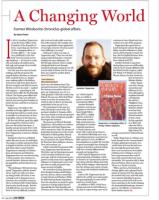

A Changing World
Former Windsorite chronicles global affairs.
By Adam Finkel
1
n 2013, Jonathan Tepperman
wrote the Press Office of the
President of the Republic of
Syria, requesting an interview.
As the managing editor of
Foreign Affairs — the maga-
zine published by the New
York-based Council on For-
eign Relations — it's his job to write,
edit and analyze all matters good,
bad, ugly and corrupt of our world's
international affairs.
Over the next two years, he heard
nothing, and did not pursue the
request further. But then, in January
2015, at about 6:30 a.m., Tepper-
man, making coffee in his kitchen,
received two calls from Syria that he
did not recognize and did not answer.
He then received an email — marked
with urgency — requesting he call
back the Press Office for the Republic
of Syria. The Syrian press officer had
two questions. First, is he still inter-
ested in interviewing the President of
Syria? Second, could he be in Syria in
five days?
Tepperman, who believes the
mandate at Foreign Affairs revolves
around giving readers as much access
as possible to as broad array of views
as possible, said yes to the interview.
He flew into Beirut, spent the night,
and arranged for a Syrian to drive
him over the border into Syria. A
handler and government driver with
a small, beat-up South Korean sedan
drove Tepperman to interview Bashar
al-Assad.
During the interview, published
earlier this year, he saw an individual
who spoke so calmly and greeted him
so happily in the face of such violence
and chaos, that it wasn't hard for
Tepperman to instantly see fabrica-
tions, deviousness and delusions.
Tepperman knew he was interviewing
"a total monster, who continues to
commit barbaric, heinous crimes on
his population and has blood on his
hands."
"The challenges I felt interviewing
Assad," Tepperman told the Jewish
News, "had to do with more than
my being Jewish. Of course, it was
a strange to sit in Damascus as an
American Jew and talk to someone
who is no friend of the United States,
Israel or the Jewish people. But the
real difficulty lay on a more human
level: it was very difficult, emotion-
24 July 20151 RED liffira
ally, to sit and make polite conversa-
tion with someone who is guilty of so
many unspeakable crimes against his
own people, someone who has caused
such suffering to so many."
Getting in to Syria was easy, as
Tepperman said, "There are not that
many people fleeing into a warzone."
Getting out was a nightmare. He
left through Lebanon where a single
checkpoint had to sort through
hundreds of people seeking to exit. He
arrived safely in Beirut, but the route
from one capital to another lasted
about 12 hours.
TEPPERMAN'S
MICHIGAN ROOTS
Syria was a far distance from Tep-
perman's hometown in Windsor and
the Detroit communities where he
grew up. Tepperman, now 43, is a
1989 graduate of Detroit Country Day
School. He was one of the first Wind-
sorites to do that 45-minute drive,
which he did not find to be that bad,
particularly in the pre-9/11 era.
His connections to the area run
deep. His family is part of the Tep-
perman's retailers in Canada, which
have been family-owned and operated
since 1925, when Jonathan's grandfa-
ther began the business.
His parents are Bill and Rochelle
Tepperman. His brothers are Andrew
Tepperman and Noah Tepperman,
who is married to Julie, the director of
leadership development at the Jewish
Federation of Metropolitan Detroit.
Tepperman, now based in Brook-
lyn, is married to Dr. Alexis Wichows-
ki. They have three children, Gerome,
Novi and newborn Leo.
Asked to describe his greatest influ-
ence, Tepperman cites his parents.
His father ran for federal government
in the Canadian Parliament many
years ago, and his involvement in pro-
gressive social causes had a significant
influence on Tepperman's career and
gave him an early perspective into
issues around civil rights.
He remembers having classmates
from foreign locations and feeling a
part of a diverse, ethnic community
in both Detroit and Windsor. While
he didn't find particular inspiration
from his education, he started to gain
exposure to foreign policy focused
journals like the New Republic and
Christian Science Monitor "fairly early
continues to have friends and con-
nections as a part of the program.
Tepperman also spent time in
Israel during law school. His grand-
father moved to Palestine in 1920,
and he still has family in Israel. He
has a BA in English literature from
Yale University and law degrees
from Oxford and NYU.
Another formative experience
during these years was a fellowship
with an NGO, loosely affiliated with
the World Jewish Congress, called
UN Watch. UN Watch was led by
Morris Abram, the first Jewish stu-
dent to become a
Rhodes Scholar.
Today, Tepper-
man has a strong
connection and
Jonathan Tepperman
affection for De-
troit, although he
on," which inspired
considers himself
him, as a child, to
a Windsorite.
pursue a career around
He said he's
international affairs.
"delighted when
Another formative
seeing stories of
experience was his par-
Detroit's rebirth"
ticipation in the Bron-
as he has fond
fman Youth Fellow-
memories of the
ship (BYFI), a highly
Detroit Institute
selective network of
of Arts, where
fellows that recruits
he'd go regularly
high school juniors to
Tepperman is managing editor of as a child, and
participate in transfor- Foreign Affairs magazine.
where he did an
mational experiences
internship during
in North America, and
high school. He
Israel with a select group of peers.
remains connected to Detroit friends
He said the fellowship was a very
as well.
interesting experience as he had very
Today, Tepperman is writing a new
little exposure to Jews of different
book, focused on the "success stories"
denominations as a child. He was able of today's global governments. In a
to spend meaningful time during the
world where he's seen the bad news
program learning in a formal setting
far outweigh the good and where
with Jews of many different back-
there is an enormous set of complex
grounds and perspectives.
problems, he's working to uncover
BYFI exposed Tepperman to the
how 10 governments have solved
contextual study of Judaism, which
issues that seemed otherwise insur-
he found to be "spectacularly interest- mountable. The operative title is Most
ing," along with the debate and study
Favored Nation: How to Survive and
of the Jewish religion, which showed
Thrive in a World in Decline.
him the richness and variety of Juda-
With a newborn, the head job at
ism, along with Judaism's intellectual Foreign Affairs and a planned book
society.
release in spring 2016, he's planning
Later in life, Tepperman has de-
for another busy year. And with inter-
cided to live a little more observantly.
view requests submitted to govern-
His growing family, he said, will be
ments near and far he'll seek to con-
raised in a Jewish home.
tinue reporting on the stories shaping
In addition to BYFI, which has a
the international landscape, however
vibrant network of 1,000 fellows to-
good or evil, effective or destructive,
day that he enjoys being a part of, he
those leaders may be. RT