

metro >> on the cover
Win-Win-Win
Fair Food Network will use federal grant to expand efforts
of its healthy food initiative.
Barbara Lewis I Contributing Writer
CONTINUED FROM PAGE 1
wide healthy food initiative that enables low-
income families to stretch their food dollars
by eating fresh food from farmers' markets.
Oran Hesterman, president and CEO of
Fair Food Network, said his organization will
match the grant with private donations to
provide a total of $10.4 million for Double-
Up Food Bucks.
With the Double-Up Food Bucks pro-
gram, families on the federal Supplemental
Nutrition Assistance Program (SNAP), gen-
erally known as "food stamps," can receive an
equal amount of support to purchase fresh,
Michigan-grown produce.
At a market, a SNAP card holder will
receive up to $20 worth of gold tokens to
spend on produce and an equal amount in
silver tokens, which can be exchanged for
Michigan-grown fruits and vegetables.
Hesterman, 63, of Ann Arbor, started
the program six years ago at five farmers'
markets. It has since grown to 150 locations
across Michigan.
He says the program is a win-win-win.
"The low-income families bring home
healthier food. They put more dollars into the
pockets of farmers, especially local ones. And
they keep those dollars in the community"
Since it started in 2009, the program has
helped more than 300,000 low-income fami-
lies and more than 1,000 Michigan farmers.
Michigan is third in the nation (and first in
the Midwest) in the number of SNAP partici-
pants who shop at farmers' markets.
Jewish Values
Hesterman is passionate about food justice,
which he says comes from his Jewish roots
and Jewish values.
He and his wife, Lucinda Kurtz, who have
three adult children, are active members
of Pardes Hannah, the Ann Arbor Jewish
Renewal congregation. He is also active with
the Washtenaw Jewish Alliance for Food,
Land and Justice and a board member of
Hazon, a multi-state organization dedicated
to creating healthier, more sustainable com-
munities in the Jewish world and beyond.
Double-Up Food Bucks is "a great oppor-
tunity to practice tikkun olam [repairing the
world]:' Hesterman said.
"The Jewish community can become lead-
ers in this effort," he said. "Improving nutri-
tion for low-income families is a collective
responsibility. We need to repair a system
that has not been working, especially among
the most vulnerable. This is a good opportu-
12 June 4 • 2015
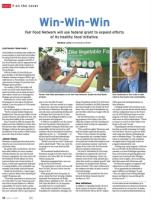
Farmer Vicki Zilke participates in the Fair Food Network's Double-Up Food Bucks
program.
Oran Hesterman of Ann Arbor is dedi-
cated to food justice and sustainability.
nity to move the effort forward:'
Hesterman, who once worked as an organ-
ic farmer, has a doctorate in agronomy from
the University of Minnesota. He taught crop
and soil science and leadership development
at Michigan State University for 10 years,
then went to the Kellogg Foundation to sup-
port innovative food programs.
In 2008, he was tapped to run the nascent
Fair Food Foundation, which planned to
fund nonprofits working for food justice and
sustainability. He had just hired two staff
members when the foundation's benefactors
called him on Dec. 11 — his birthday — to
tell him they'd lost all their philanthropic
funds in Bernie Madoff's Ponzi scheme.
What's in store for me next?"' Hesterman
said he asked himself "This is my work; I'm
not going to let one crook derail my life's
purpose:'
The foundation's landlord believed in
Hesterman enough to let him remain in his
downtown Ann Arbor office for 18 months
without paying rent.
Hesterman reorganized into a new non-
profit, the Fair Food Network
"The opportunity to do the work was still
there," he said, "but now I had to raise the
money to do it:'
While going after those first grants, he
wrote a book, Fair Food: Growing a Healthy,
Sustainable Food System for All (Public
Affairs Books), published in 2011. The New
York Times described it as "an important,
accessible book on a crucial subject:'
Early funders included the Community
Foundation for Southeastern Michigan, the
Kresge Foundation and the New York-based
Woodcock Foundation. By 2009, Hesterman
had raised enough to start Double-Up Food
Bucks. Now, more than 50 foundations sup-
port the effort, which has a budget of $4 mil-
lion this year.
Fair Food Network has or is develop-
ing programs in New Mexico, New York,
Oklahoma, Oregon and Utah. Including two
employees hired recently, the organization
has a staff of 15.
"We're small but mighty:' Hesterman said.
Staff and funders appreciate his passion.
"Oran is truly a visionary, but perhaps
more importantly, he's a strategic thinker
who can implement his ideas into pilots,
move pilots into models and transform mod-
els into mainstream systems," said Carole
Caplan of Ann Arbor, Fair Food Network's
director of program enhancement.
The Fred A. and Barbara M. Erb Family
Foundation has supported the Fair Food
Network since its beginning. "Oran's com-
mitment comes from a deep, spiritual place
rather than merely an academic pursuit:' said
foundation vice president Jodee Fishman
Raines of Detroit "His work is influenced by
the traditions and ethics of justice rooted in
his Jewish heritage:'
The Jewish Fund awarded the Fair Food
Network the Robert Sosnick Award of
Excellence in 2013.
USDA grant and matching donations on
three initiatives:
• Bringing Double-Up Food Bucks to gro-
cery stores, a process that has already started
with four independent stores in the Detroit
area. By 2018, Hesterman hopes to see the
program in 50 stores. He plans to involve
chain stores as well as independents. "There's
no reason we can't be in every Meijer, every
Kroger in the state' he said.
• Expanding the network of farmers' mar-
kets that use mobile technology for Double-
Up Food Bucks. Farmers can process SNAP
cards using smart phones, eliminating the
need to distribute tokens. "I'm calling it 'from
tokens to technology,"' he said, noting that
the digital advance will greatly reduce the
program's administrative costs.
• Piloting year-round programs. Until now,
the use of Double-Up Food Bucks has been
seasonal, as is most of Michigan agriculture.
Now, some farmers are growing greens and
potatoes year-round and other Michigan
produce, such as apples, can be stored long
after their season ends, Hesterman said.
He thinks his program can appeal to indi-
vidual donors as well as foundations.
"It's an opportunity for individuals to
make a difference in Michigan:' he said.
"They can support hard-working Michigan
farmers and help low-income kids get the
food they need:'
New Initiatives
For more about the Fair Food Network, go to
-
In addition to expanding Double-Up Food
Bucks' presence at farmers' markets, the
Fair Food Network will use the $5.1 million
❑
www.fairfoodnetwork.org. Hesterman included his
personal email so he can hear from JN readers.
Reach him at ohesterman@fairfoodnetwork.org .