
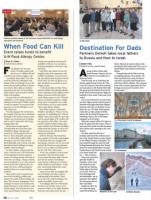

Several hundred people at the luncheon raised $160,000 for food allergy
education and research.
At the Kotel
When Food Can Kill
Destination For Dads
Event raises funds to benefit
U-M Food Allergy Center.
Shari S. Cohen
Contributing Writer
F
ood allergies have become a
major U.S. health problem with
one of every 13 children affected
as families and schools struggle to cope.
According to James Baker, M.D., direc-
tor of the University of Michigan Food
Allergy Center, food allergies are now the
most common health problem in elemen-
tary schools. Baker spoke at a fundrais-
ing luncheon for the U-M Food Allergy
Center held on April 30 at the Townsend
Hotel in Birmingham.
Last year, there were 400 episodes of
anaphylaxis, a severe allergic reaction to a
substance in food, and 50 children died as
a result, he reported. The reasons for this
increase in severe food allergies are not
fully understood.
"Food has changed. The environment
has changed. There has been a fundamen-
tal change in the human immune system.
Children are not growing out of allergies,
and we need to understand why it's hap-
pening:' Baker said.
The luncheon brought together
250 individuals who raised more than
$160,000 for allergy education and
research at U-M through the efforts of
three co-chairs along with many spon-
sors. Co-chairs Hilary Golden, Marla
Karimipour and Stacy Klein, all from
Bloomfield Hills, came to know each other
through the shared challenge of raising
children with food allergies.
For their children, eating outside the
home is risky because of the uncertainty
of food ingredients and the potential
contact of cooking utensils with foods to
which they are allergic. Allergic children
react immediately to even a tiny amount
of such foods with symptoms that can
range from hives, swelling and gastro-
intestinal distress to severe breathing
problems.
These mothers want to expand aware-
ness of the food allergy problem and
improve the quality of life for allergic chil-
dren. That can mean undergoing a "food
challenge" to measure and build up some
limited tolerance to certain foods in a safe
clinical setting. They advocate more edu-
cation and training for restaurant workers
36
May 21 • 2015
JN
Partners Detroit takes local fathers
to Russia and then to Israel.
through state regulation and increased
availability of the Auv-O, a mechanism
for giving epinephrine with step-by-step
directions.
Carly Klein, Stacy Klein's 16-year-old
daughter, spoke of her experiences with
multiple food allergies. "It can be terrify-
ing, especially because the Epi pen doesn't
always work:' she said. The Epi pen con-
tains epinephrine to counteract a severe
allergic reaction.
A video about Mary and Marc Weiser
and their children's food allergies illustrat-
ed the continuing need for vigilance about
allergic substances and the fear when a
severe allergic response occurs. While the
Epi pen can alleviate symptoms, a fright-
ening rush to a hospital ER was a reality
for the Weisers, as it is for many families
with severely allergic children.
Marc Weiser's parents, Ambassador
Ronald N. and Eileen L. Weiser, were key
supporters for establishing the U-M Food
Allergy Center, which began five years ago
with an annual budget of $2.5 million and
has expanded to $42 million. The center
provides outpatient allergy testing, diag-
nosis, treatment and education for allergic
children and their families, as well as edu-
cational resources for schools and other
community institutions.
Katherine Rosman, the featured lun-
cheon speaker, is the mother and daughter
of individuals who have struggled with
food allergies. Rosman, who was born and
raised in the Detroit area and graduated
from U-M, is an editor and columnist for
the New York Times style section.
"Food is the centerpiece of most social
transactions. The bond of the family
occurs around the dinner table:' Rosman
said. Her late mother's food allergies
meant that she couldn't go out to dinner,
which resulted in social isolation. At that
time, some people attributed her condi-
tion to a mental disorder.
Today, 30 years later, her daughter Ella
has food allergies, but there is greater
understanding of the problem. There
are no nuts at her school and gluten-free
snacks are available, Rosman said.
"Food allergies affect the whole family.
We have to eat, but they teach us to be
conscious of what we eat, which should be
fresh, pure and unprocessed," she said.
❑
Chaim Fink
Special to the Jewish News
A
Silence Museum (a museum about under-
standing the deaf) and toured ESova, one of
Israel's largest soup kitchens and homeless
shelters.
Visiting Russia and the Holy Land was
an inspiring experience for everyone. The
entire trip lasted only a week, but the les-
sons these community dads brought back
with them will last a lifetime. They returned
home with a renewed appreciation for their
heritage and as prouder members of the
Jewish people.
group of Metro Detroit dads
joined Partners Detroit at the end
of April for an incredible trip to
Russia and Israel.
Their first stop was St. Petersburg, the
Russian capital during Czarist rule. Then,
it was off to Moscow, where they received a
personal audience with Russia's chief rabbi.
The group learned firsthand about the dif-
ficulty Jews had practicing their religion for
hundreds of years under Czarist and Soviet
control.
Jews in the United States are able to prac-
tice their religion openly, and this group of
Detroiters truly appreciated their religious
freedoms when they saw that this was not
always the case. The dads visited popular
tourist sites as well as points of Jewish
interest, like the Choral Synagogue in St.
Petersburg, which is the second largest
synagogue in all of Europe.
St. Petersburg Choral Synagogue
When they stepped off the El Al plane in
Israel, the group truly felt at home. There is
some part of the Jewish soul that has always
felt an affinity and a yearning for the Land
of Israel.
The dads visited the Old City of
Jerusalem and toured the southern excava-
tion of the Temple Mount, a project funded
by the William Davidson Foundation. The
guys trekked through the waterway built
by King Hezekiah during the First Temple
period. On Israeli Independence Day, they
traveled down to the Dead Sea and celebrat-
St. Petersburg
ed in dassic Israeli fash-
ion — with a barbecue.
There is no experience
quite like Shabbat in
Jerusalem, where a holy
and mystical aura per-
meates the air. Dancing
Friday night at the Kotel,
arm-in-arm with Jews
from all backgrounds
and nationalities, was an
experience that uplifted
the entire group and set
their souls ablaze.
Sunday was off to Tel
Aviv where the group
4
visited the Invitation for Moments at the wall
Climbing Masada
❑