

metro
Links To The Past from page 30
In addition, she provided contact informa-
tion for archives in Slovakia as potential
resources for the family. "She is a gem in
the community," Adler said.
Eric Kappaz recently visited the HMC
Library Archive seeking sources for
his master's project in
secondary education
social studies at Wayne
State University While
he has no family connec-
tion with the Holocaust,
his master's project is an
annotated bibliography
Erik Kappaz
about rescuers of Jewish
people during World
War II. His goal is to
provide stories that teachers could use in
the classroom.
"I thought it would be uplifting and
make the study of the Holocaust more
interesting for students," Kappaz said.
"Mrs. Weiss was wonderful. She pointed
out books and articles — more than I
could ever go through and use?'
Prior to his visit to the Holocaust
Memorial Center, Kappaz had identified
approximately five Jewish rescuer stories
for his project but that number increased
to 16 after his visit to the HMC library. He
spent three days compiling information.
Weiss helped Bruce Henderson, an
author working on a book about the
Ritchie Boys, to find useful photos at the
Library. (The Ritchie boys, most of whom
were Jewish, were Austrian and German
immigrants to the U.S. who served in a
special military intelligence unit during
World War II.) In addition, she con-
nected him with Guy Stern, one of the
Ritchie Boys who now serves as direc-
tor of the Harry and Wanda Zekelman
International Institute of the Righteous at
the HMC.
In addition to multimedia reference
materials, the library also provides a place
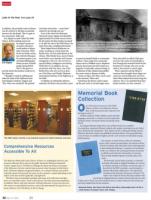
A 1930s photo of the Stoler family farm in Bereznitz shows first cousins of William
Stoler, Richard Stoler's late father. Some of the cousins and their family members
emigrated to Palestine during the 1930s and others died in a mass murder of Jews
that took place in Sarny, 8 miles from Bereznitz in August 1942.
to preserve donated family or community
artifacts. These range from ceremonial
objects such as Kiddush cups to displaced
person's documents and anti-Semitic pro-
paganda. Occasionally, someone brings in
a collection of Nazi-related memorability
the owner wants to dispose of safely.
"Some are fakes, but others can be used
in the museum," Weiss said.
Sometimes the library archive opens
up the past, both in sad and happy ways.
Weiss described an elderly Holocaust
survivor who comes in periodically to
look through the memorial book for her
hometown in Europe. She cries as she
reads it, but returns to read it again.
Weiss' expertise and the library's
resources have brought about happy out-
comes for several Holocaust survivors,
when Weiss helped them locate long-lost
relatives. She is very gratified that these
family members are now reunited.
❑
Memorial Book
Collection
0
The HMC Library Archive is an essential resource for family histories and more.
Comprehensive Resources
Accessible To All
The Holocaust Memorial Center Library Archive is a multilingual reference and
research collection that is open to the public during the Holocaust Memorial
Center's regular hours. The library's holdings document the history and impact
of the Holocaust, but also contain deep resources about European Jewish history,
Judeo-Christian relations and general Judaica. As a reference library and archive,
materials cannot be borrowed, but some can be scanned or copied depending on the
nature of the item and the applicable copyright laws.
The library has an automated catalogue and many of its collections and data-
bases are searchable online. Detail is provided at www.holocaustcenter.org/library .
In addition, library staff and volunteers will help Holocaust victims and survivors
who want to use specialized resources, such as the International Tracing Service, to
locate relatives. Use of the library is free of charge.
32
May 21 • 2015
JN
ne of the special resources of the HMC
Library Archive is its collection of more
than 1,500 memorial books, believed to be
the largest in the U.S.
Written in Hebrew, Polish, Yiddish, Dutch and other
languages, each book is a written record of a particular
European Jewish community before and during World
War II.
According to librarian Feiga Weiss, most of these books were compiled
by committees comprised of former residents who wanted a permanent record of their
once-vibrant Jewish communities. They shared research, writing and editing responsi-
bilities for the books, which were published in limited editions. The memorial books,
some of which are available in English, provide a rich resource for individuals tracing
family histories.
The memory or yizkor books, as they are sometimes
known, often contain personal photos, documents and lists
of former residents with information about what happened
to them during the Holocaust. A separate set of memorial
books was created by the German government to provide
an official record of Jewish communities in Germany.
These include detailed registries of people, places and
events.
The Bereznitz Society hopes to produce a memorial
book that will include an English translation of a special
set of letters donated to the library several years ago. As
described in the HMC newsletter, a man brought in a
shoebox full of letters addressed to "Mr. Harry Katz,
President of the Bereznitz Aid Society of Detroit:' The
letters were written by former Bereznitz residents who
were living in Displaced Persons camps in Europe after the war, and
in later years in Israel. Each one asked Katz how to contact relatives in the Detroit area
and many thanked him for his assistance.
Memorial books, like these from Rovno and Sarny, help people learn of life in
small Eastern European towns and villages.