

metro
Under The Radar
Local author sheds light on women with Asperger's.
William Clay
Ford Jr.
Steven
Spielberg
Shoah Foundation To Honor
Ford At Annual Gala
Steven Spielberg, founder of USC Shoah
Foundation-The Institute for Visual
History and Education, will present
William Clay Ford Jr., executive chair-
man of Ford Motor Company, with the
Institute's Ambassador for Humanity
Award at the organization's annual gala
Sept. 10 in Detroit.
Ford will be recognized for his lead-
ership and corporate citizenry around
education and community. Mickey
Shapiro, real estate developer and
longstanding member of the Institute's
board of councilors, is the event's co-
chairman. The gala vice chairs and
benefit committee will comprise leaders
from the local community and from
around the nation.
The September gala will provide the
opportunity to highlight the Institute's
global work in making the 53,000
audio-visual interviews with survivors
and witnesses of the Holocaust and
other genocides in its Visual History
Archive a compelling voice for educa-
tion and action.
USC Shoah Foundation has a long
history in Michigan and with Ford
Motor Company, which was the sole
sponsor of the 1997 NBC broadcast of
the Academy Award-winning Schindler's
List, the film that inspired the establish-
ment of the Institute. The Institute col-
lected 335 testimonies with Holocaust
survivors and witnesses in the Detroit
area, with local videographers and inter-
viewers specially trained for the job.
The Visual History Archive is avail-
able at University of Michigan campuses
in Ann Arbor and Flint.
The event will also shine a light on
the emerging partnership between USC
Shoah Foundation and Ford Motor
Company to expand the Institute's
IWitness educational platform in the
Detroit area. IWitness brings the first-
person stories of survivors and wit-
nesses of genocide from the Institute's
Visual History Archive to students via
multimedia-learning activities acces-
sible via Macs, PCs, iPads and tablet
devices connected to the Internet.
A significant portion of the proceeds
raised at the gala will remain in the
region, where the funds will be used
for educational programs in secondary
schools.
For more information about the gala,
call the Event Office at (248) 593-9743,
the USC Shoah Foundation Benefit at
(818) 777-7876 or email
ambassadorsgala2015@usc.edu.
Donations are tax deductible to the full
extent permitted by law.
Stacy Gittleman
I Contributing Writer
sk a "neurotypical" person if
they would rather socialize at a
party or run for 12 miles, most
would choose the for-
mer. To Tracey Cohen,
44, of Farmington
Hills, trying to follow
the back and forth of
a conversation at a
loud party is far more
excruciating than lac-
ing up and hitting the
trail for a run.
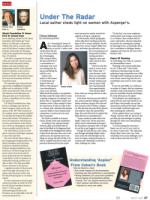
Cohen is the
author of 100 Lessons
A
to Understand and
Support Girls and
Women with Asperger's Tracey Cohen
(www.6wordlessons.
com), a new self-pub-
lished book that speaks to a population
that flies under the radar when it comes
to getting a diagnosis of Asperger's syn-
drome (AS). A competitive runner and
freelance writer, Cohen wanted to share
her experiences of what it is like to live
as a woman with a disorder that impairs
a person's ability to have interpersonal
connections or read social cues most
take for granted.
Her book is available at Amazon,
iTunes, Kindle, Nook and Smashtunes.
According to the Asperger/Autism
Network, girls and women with AS
may be less likely to be diagnosed and
more likely to be misdiagnosed. Indeed,
Cohen's book discusses how even in her
earliest years, her parents knew some-
thing was wrong. She did not like to be
held or cuddled and did not smile. Her
preschool dismissed her from enroll-
ment because her teacher noticed her
anguish at being in a playgroup.
In 100 honestly written paragraphs,
Cohen tells about watching out for the
signs of AS in women and girls. She dis-
cusses how women "Aspies" differ from
men, and shares tips and advice from
her own experiences of
living with AS before,
during and after a
diagnosis more typi-
cally noticed in boys
and men.
"I did not write this
book as a story of my
life Cohen said. "I
wrote because I wish
there was something
like this in the pedia-
trician's waiting room
that my mom could
have read during all
those appointments
when she just didn't
know what was wrong with me or what
to do for me:'
In the book, she discusses the difficul-
ties, stresses and hurt feelings caused to
family members trying to live with and
love someone with AS before a diagno-
sis. She describes the pain felt by parents
and relatives when she rejected their
hugs. She wrote this book to explain that
those like her are misunderstood.
"I never wanted to make others feel
badly" Cohen said. At the same time,
others need to understand and respect
the boundaries of people with AS if they
do not like to get hugged or touched:'
Though she said she has come a long
way through attending helpful confer-
ences and work with therapists as far
away as Oregon, making personal con-
nections and cultivating a social life is
still a challenge for Cohen.
"To this day, I see newer employees
making faster and stronger connections
to co-workers I have worked with for
years" said Cohen, who has channeled
her passion for running into working
for Running Fit Inc. in Northville. She is
also a contributor to Michigan Runner
magazine and writes for the Ann Arbor
Runner's club.
Peace Of Running
To work things out, Cohen is a passion-
ate ultramarathon runner.
"Running is the most peaceful place
for me Cohen said. "I have better
endurance at having a long run than
enduring a long conversation over coffee.
Through careful watching and trial and
error, I have come a long way. But it is
something I must work on every single
day"
It was not until 2000, at a conference
on autism in Oregon, that her symptoms
started to make sense based on a lecture
given by Australian clinical psychologist
Dr. Tony Attwood, an AS expert.
"Everything he was explaining reso-
nated with me, and I just started to cry"
said Cohen, who proudly can say that
Attwood has endorsed her book. Cohen's
AS was finally confirmed eight years
after attending the conference.
Cohen explains there is no curing or
"fixing" someone with AS. However, she
provides tips and strategies for getting
through life, which start with getting a
firm diagnosis.
"I am not looking for someone to
blame, nor do I use AS as a crutch or
an excuse Cohen said. "The important
thing is that I know who I am; I take
ownership of my social challenges; and I
work on them each and every day" ❑
Understanding 'Aspies"
From Cohen's Book
100 Lessons
to
Understand ana ppoIt
with
Girls anaW omen
Aspere,er's
Tracey Cohen
s
• We are literal to a fault.
• Even small changes can be devastating.
• Anything less than perfection is unacceptable.
• Wrong treatment can cause more problems.
• We are logical not purposefully defiant.
• Having "fun" can require maximum effort.
• Don't assume: Ask before you touch.
• Normal is a word, not reality.
❑
May 21 • 2015
27