

metro
Bringing The Past To Life
Jewish Historical Society of Michigan celebrates
56 years, capped by a banner year in 2014.
I
Barbara Lewis
Contributing Writer
I is been a banner year for the Jewish
Historical Society of Michigan (JHSM).
The organization reached a milestone
in December 2014 when membership
reached 1,000. JHSM also published three
books, coordinated 12 bus tours and one
bike tour, and expanded its educational
programs.
On May 28, it will hold its 56th annual
meeting, at Detroit's historic Gem Theatre.
JHSM's Leonard N. Simons History Award
will be presented to former U.S. Sen. Carl
Levin, who will be joined by his brother,
U.S. Rep. Sander Levin, Sen. Levin's daugh-
ter Kate Levin Markel and Rep. Levin's son
Andy Levin for a conversation about family,
Detroit and history.
The 2015 Volunteers of the Year award
will be presented to Elizabeth and Leslie
Kannon and their daughter, Andrea
Kannon, of Ferndale, who have been instru-
mental to the success of the annual J-Cycle
bike tours and numerous other JHSM pro-
grams.
The Jewish Historical Society of Michigan
got its start in 1959. Allen Warsen, direc-
tor of Adas Shalom's religious school,
was the first president, and the founding
members included Rabbi Morris Adler of
Congregation Shaarey Zedek; Emanuel
Applebaum of United Hebrew Schools;
Rabbis Leon Fram and M. Robert Syme
of Temple Israel; Irving I. Katz, executive
director of Temple Beth El; and Philip
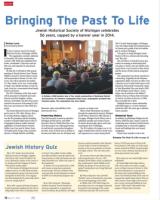
In October, JHSM hosted a tour of the Jewish communities of Southwest Detroit
and Downriver. At Trenton's Congregation Beth Isaac, congregation president Ray
Clements spoke. The congregation has since folded.
Slomovitz, editor and publisher of the
Detroit Jewish News.
Preserving History
They had one goal: to preserve and share
Michigan's Jewish history, said JHSM
Executive Director Wendy Rose Bice. One
of its first projects was collecting histories
of small Jewish communities throughout
the state, some of which were in decline at
the time and which now, for all intents and
purposes, no longer exist.
Much of that information was shared
through the organization's journal, Michigan
Jewish History. Started in 1960 with just a
few pages, Michigan Jewish History now is
published annually and contains dozens
of articles about people, places and events
involving the Jews of Michigan.
The 2014 edition, the largest ever at 144
pages, included pieces about a Jewish wom-
an's experiences as a nurse during World
War II, Jewish federal judges in Michigan,
Jews who helped build the bowling business
in Detroit and a profile of the first radiolo-
gist in northern Michigan.
"Our goal is to bring Michigan Jewish
history to life in a relevant and interesting
way," Bice said.
She and others in the baby boomer gen-
eration are starting to think about their
own place in history, she said. JHSM wants
to give them a way to preserve their stories
and the stories of their parents and grand-
parents.
The organization has always operated on
a shoestring. Originally, the all-volunteer
organization didn't even have an office. Now
it operates out of a small rented space in the
basement of the Jewish Community Center
in West Bloomfield. Bice was hired in 2003
to edit Michigan Jewish History. Aimee
Ergas, now an archivist at the Walter P.
Reuther Library at Wayne State University
in Detroit, was hired as director in 2008;
Bice succeeded her in 2012.
Elizabeth Kannon, whose relationship
with JHSM began as a J-Cycle volunteer,
joined the staff a few years ago as adminis-
trative assistant.
Historical Tours
In addition to publishing Michigan Jewish
History, JHSM has also created a niche for
conducting tours of historic Jewish Detroit,
including visits to old Jewish neighbor-
hoods and buildings that once housed
synagogues.
Recent tours included a visit to the
Bringing The Past To Life on page 14
Jewish History Quiz
Q: In 1977, leaders from the Jewish
Historical Society of Michigan, together
with Detroit City Council President Carl
Levin, dedicated a marker on the corner of
St. Antoine and East Congress in Detroit.
What did the marker depict?
A: The location of Michigan's first Jewish
religious services. In 1850, Sarah and Isaac
Cozens gathered a group of German-Jewish
immigrants in their home. The congrega-
tion they founded, Bet El, exists today and is
known as Temple Beth El.
Q: In 1895, a group of Eastern European
Jewish businessmen gathered in the back of
Selig Koploy's shoe store on Hastings Street
12
May 21 • 2015
in Detroit. They pulled out their wallets
and collected funds to provide relief for dis-
tressed persons to help with burial costs and
other benevolent acts. What is the name of
this institution?
A: Hebrew Free Loan dates back to 1895
and remains an important community
resource today. The story of Hebrew Free
Loan and other Jewish institutions is shared
by JHSM in its educational programs and
tours.
Q: In 1964, during the "Mississippi
Freedom Summer," several Detroit-area
attorneys responded to an appeal from
Ernest Goodman, the prominent civil rights
attorney and then-president of the National
Lawyers Guild, to travel to Mississippi to
provide on-the-scene assistance to arrested
civil rights workers. Who were these attor-
neys?
A: Lawrence Warren and Allen Zemmol,
both young attorneys, who, in a 1994
Michigan Jewish History article, recalled how
they would need to "speak Yiddish on the
Holiday Inn phones in case the lines were
tapped': Joining them were Irving Tukel and
Ronald Karp.
Q: Whose distinctive voice provided
"showbiz" news for Detroiters for more than
four decades beginning in the 1950s?
A: Shirley Eder (1919-2005) began her
journalism career as a newspaper columnist,
but quickly took advantage of the media
of television and radio. She read war bul-
letins in WWII and came to Detroit with
her husband in 1956. Eder, one of the many
women archived in JHSM's women's project,
was very much a feminist and advocate for
advancing women's career paths.
Q: In what year was Central High School
established?
A: Central High School dates back to
1858, when classes were held in a single
room on Miami Avenue in Detroit. In 1863,
the school relocated to a vacant space in
the former State Capitol Building on the
corner of Griswold and State streets and was
renamed the Capital Union School. Then, in
1896, Detroit's Central High School moved
into a newly constructed building on Cass
Avenue. "Old Central" still stands on the
campus of Wayne State University.