

arts & life
How a nice Jewish
girl discovered her
family secret.
Naomi Pfefferman
Jewish Journal
of Greater L.A.
W
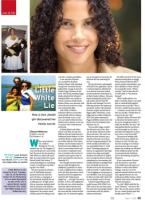
TOP RIGHT: Lacey Schwartz
TOP LEFT: Schwartz at her
bat mitzvah ABOVE LEFT: The
once-happy family on vacation
Little White Lie will
screen at 2 p.m. Tuesday,
May 12, at the Berman
Center for the Performing
Arts in West Bloomfield
as part of the JCC's
Lenore Marwil Jewish
Film Festival. $12. (248)
661-1900; jccdet.org or
theberman.org .
hen Lacey Schwartz
was a child in
Woodstock, N.Y., she
assumed she was "the daughter of
a nice Jewish girl and a nice Jewish
boy," she says in her documentary,
Little White Lie, which will screen
May 12 as part of the JCC's Lenore
Marwil Jewish Film Festival. "I
wasrit pretending to be something
I wasn't. I actually grew up think-
ing that I was white:'
But since preschool, Schwartz,
now 38, had fielded awkward
questions about her dark skin
and curly hair; a congregant at
her bat mitzvah assumed she was
an Ethiopian Jew. In high school,
African-American students stared
hard at Schwartz in the hallways
and confronted her about her racial
background. Her parents waved
off these queries by telling her she
took after a Sicilian grandfather.
It was only after Schwartz
was recruited by the Black
Student Alliance while attending
Georgetown University that she
gathered the courage to press her
mother, Peggy Schwartz, for the
truth. After much prodding, Peggy
finally admitted that Schwartz's
biological father was actually an
African-American family friend,
Rodney Parker, now deceased, with
whom she had carried on a long-
time extramarital affair.
Little White Lie follows
Schwartz's efforts to unravel the
truth and talk with her relatives
about the family secret, as well
as to cast aside her false previous
identity and to embrace a new one
as a person who is both biracial
and Jewish.
In family photos and videos
shown in the film, it's clear how
different Schwartz looks from her
Ashkenazi Jewish relatives. So how
could her family so easily perpetu-
ate its little white lie? One reason,
perhaps, was the insular nature of
Schwartz's Jewish childhood: "So
often in communities there's such
an incentive to emphasize tradi-
tion, to prioritize what we have in
common and to ignore what we
don't; says Schwartz, who lives in
Montclair, N.J.
Even though Schwartz believed
she was white throughout her
childhood, it pained her at times
to look so different from students
at her all-white elementary school.
Questions about her appearance
made her feel "embarrassed,
singled out ... and ugly:' she says in
the film. To fit in, she straightened
her hair and, on a school question-
naire that asked what she most
wanted to change about herself,
she wrote that she wished she had
lighter skin. On Schwartz's applica-
tion to Georgetown University, she
left blank the box indicating her
race.
But she did attach a photograph
of herself to her application, and as
a result Georgetown admitted her
as an African-American student
and forwarded her information to
its Black Student Alliance. Schwartz
began attending the group's meet-
ings and for the first time felt
that she truly belonged. Over the
following summer, she began pep-
pering her mother with questions
about her origins and learned of
Peggy's affair with Parker, a man
Peggy had met while working for
New York's parks department.
Peggy's infidelity, in part, led to her
divorce from her husband when
Schwartz was 16.
Yet even after Peggy revealed
that Schwartz was, in fact, bira-
cial, the family refused to further
discuss the issue. The result was
that by the time Schwartz was a
student at Harvard Law School,
she had "compartmentalized" her
Jewish and black identities and
was essentially living in a "racial
closet:' Attending programs at
Reboot, an organization that helps
modern Jews forge meaningful
identities, led Schwartz to explore
how to merge her diverse selves by
embarking on a documentary she
initially intended to spotlight black
Jews. Eventually, however, she
decided to focus the documentary
solely on herself. "I realized that as
I was struggling to incorporate my
own identities, I was never going to
be able to do that until I dealt with
my own family's secret:' she says.
Schwartz began filming what
would become Little White Lie in
2006, and for the next three years
she eased into increasingly pointed
conversations with her parents,
relatives and friends.
Her father proved to be the most
reluctant among them to engage:
When Schwartz tells him that "I
need to openly acknowledge to you
that I identify as a black woman:'
he sarcastically retorts, "What a
surprise:' Later, he describes his
ex-wife's affair as "the ultimate
betrayal:'
"After I finally talked to my
father, I had this utopia in my mind
that we would all heal together,"
Schwartz says in the film. "But in
the end, I couldn't heal my parents.
... I needed to accept them for who
they are, just like I wanted them to
accept me for who I am:'
Schwartz's father still doesn't like
to talk about the family secret or
the movie, though her mother "is
really into the film," she says. "She
feels grateful that the movie's pro-
cess has brought us a lot closer ...
and that it has helped her to learn
how to live a more honest life:'
The process of making Little
White Lie has been cathartic for
Schwartz as well. The film cap-
tures her marriage to an African-
American man who was raised
Baptist; the wedding was officiated
by his childhood pastor but also
incorporated Jewish traditions,
such as the breaking of a glass by
the groom.
In our conversation, Schwartz
said she intends to raise their
twin toddler boys with aspects of
Judaism as well as their father's
heritage. And she is now the
national outreach director and New
York regional director of a non-
profit group, Be'chol Lashon, which
explores racial, ethnic and cultural
diversity among Jews.
As a kid I didn't really like the
name 'Schwartz: " she says in the
film. "But now the name is perfect
for me: a clearly Jewish name that
literally means 'black"'
❑
May 7 • 2015
39