

oints of view
>> Send letters to: letters@thejewishnews.com
Essay
Very Strategic
Vantage Point
It's essential that Israel maintains
a secure grip on the Golan.
Golan Heights, Israel
A
mountain view from the Golan
Heights, peering into the Jordan
River Valley near Metullah in
the Upper Galilee, provides insight into
just how militarily strategic this land-
scape — so rich in historic, natural and
archaeological vistas — is to Israel.
A major deterrent to Iranian-backed
Syrian terrorists, the Golan must never be
relinquished.
Southern Syria and the
Syrian capital can be seen
from the Golan, allowing
Israel to monitor Syrian move-
ments, especially collaborative
efforts with Lebanon-based
Hezbollah, an ally of Syria and
Iran in threatening the Jewish
state.
Rocky and rugged. featur-
ing Tabor Mountain oaks,
the highlands stretch from
Lebanon eastward to Syria
and Jordan, all Arab nations.
The first two are sworn enemies of Israel;
the third has a peace treaty that's only as
good as the stability of the reign of King
Abdullah II.
More than 20,000 Israeli Jews live in
the Golan. It's home as well to 20,000
Israeli Druze, most loyal to Syria.
Rainwater from the Golan feeds into
the Jordan River, helping replenish
Israel's freshwater. The fertile land boasts
vineyards, orchards and cattle. Black
basalt is a reminder of the region's volca-
nic past.
It was here, in the Golan, that Jewish
historian Josephus Flavius, then a gen-
eral, helped Jewish rebels initially repel
Roman soldiers during the Great Revolt
of 66-70 C.E.; he defected to the Roman
side when his forces fell. The modern-day
Golani Brigade has been central in all
of Israel's wars following an auspicious
start in the Golan during the War for
Independence.
Israel captured the Golan from Syria in
the 1967 Six-Day War, initiated to fight
an impending Arab attack. An armistice
line came in 1974 and the Israel Defense
Forces (IDF) Northern Command stayed.
As Israel began to settle the Golan, it was
forced to staunch Syria's attempt to regain
30
May 7 • 2015
control in the 1973 Yom Kippur War.
Israel unilaterally annexed the region in
1981 to bolster its northern defense.
The U.N. Disengagement Observer
Force has operated in the region since
1974.
Shell Shock
The day after a Temple Israel of West
Bloomfield synagogue mission to Israel
toured the Golan by jeep near the village
of Darbashia on April 27, at
least two mortar shells fired
from Syria exploded harm-
lessly near Central Golan's
Kibbutz EM Zivan.
The explosions activated
Israel's Code Red rocket alerts,
including at Kfar Blum. The
120-member Temple Israel
delegation had left the kib-
butz the morning before for
Tiberias, 45 minutes north of
Kfar Blum and across Lake
Kinneret from the Golan.
The shelling came three
days after the Arab world blamed Israel
for the bombing of a convoy of long-
range, Iranian-Syrian missiles intended
for Hezbollah. Two days before the
shelling, an Israeli airstrike killed four
Syrian terrorists planting a bomb along
the Golan border against IDF forces.
The attackers never breached the border
fence.
The IDF believes the shells were stray
fire from the raging four-year-old civil
war between Syrian President Bashar
Assad's Alawite-minority army and Sunni
rebels. Errant shelling is an unfortunate
byproduct of Syrian fighting.
In March, an Israeli army officer was
wounded by gunfire from the Golan's
Syrian side in what was thought to have
been a deliberate attack. Last June, a
cross-border attack in the Golan killed
a 15-year-old boy and hurt three others
after their vehicle exploded en route to
delivering water to workers along the
border fence.
Volatile Moments
Hezbollah and Syria would love to keep
the Golan border in flux while not coax-
ing Israel into a northern-front war.
For Israel to give back the Golan would
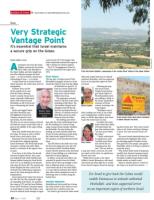
From the Golan Heights, a panorama of the Jordan River Valley in the Upper Galilee
effectively enable Damascus to unleash
unlimited Hezbollah- and Iran-supported
terror on an important region of north-
ern Israel.
Following the jeep
ride up the Golan,
Temple Israel mission-
goer Stuart Sakwa of
West Bloomfield said it
was chilling to think of
the Syrian-dug bunkers,
remnants of Syrian
control, reverting to the
Stuart Sakwa
Assad regime.
"Standing in one of
them, looking over Israel, it was a little
scary realizing there could be Syrians
there, or ISIS for that matter, were Israel
to give the Golan back;' he said.
For fellow first-time
Israel visitor Rose Sallen
of Orchard Lake, the
jeep ride reinforced why
we must never forfeit
the Golan:'
"I didn't understand
its significance until
I actually stood there
Rose Sallen
and viewed the sur-
rounding area," she
said. "You can look at
a map and watch a newscast, but until
you stand on the Golan, its significance
doesn't seem real."
Unlike Druze Arabs in the Upper
Galilee's Carmel Mountains, who stand
with Israel and often fight for it, Golani
Druze haven't forgiven Israel for disrupt-
"
lit v..,
7114
"
;C.
*. t,
4,
141_
1:1 1 110113
!Inn"
... _ _
tri*:-LIAtNGER
--- -A-- '
4r ,
.
omINE s 1 r (... Li'- 1 I I i
,
„ .„.....
.iotz.
k
dia
.....
—
Iiier v• , . _ ..„itsi
. .4i.' j.litiOreli7S
,4,.., ;
Israel marks Golan land mines, intended
to deter attacks via Syria.
ing their Syrian ties. They reject Israel's
claim to the Golan, insisting it belongs
to Syria. Few have become Israeli citi-
zens.
Successive Israeli administrations have
understood the highlands offer strate-
gic advantage against President Assad,
who gassed his own people, and against
Hezbollah, which is striving to expand its
projectile quarry.
Who doesn't think Assad, if desperate,
wouldn't aim chemical weapons toward
the Golan in a last hurrah or Hezbollah,
if pushed, wouldn't launch Hamas-style
missile attacks on Israel's north.
Make no mistake about it: Control of
the Golan is in Israel's best interest.
For Israel to give back the Golan would
enable Damascus to unleash unlimited
Hezbollah- and Iran-supported terror
on an important region of northern Israel.
❑