

arts & life
Nancy Spielberg
tells the story of
American pilots
who fought for
Israel in 1948.
Producer Nancy Spielberg will
speak following the film.
Above and Beyond will
screen at 5 p.m. Monday,
May 11, as part of the
JCC's Lenore Marwil
Jewish Film Festival. $12.
Producer Nancy Spielberg
will speak following
the film.
Above
AndBeyond
Michael Fox
Special to the Jewish News
A
lot of documentary
makers get their ideas
from the front page.
Nancy Spielberg discovered the
forgotten late-1940s saga that
gives wings to Above and Beyond
on the obituary page.
"I found out about Al
Schwimmer, and that this guy,
an American, was considered the
godfather of the Israeli Air Force
Spielberg recalls. "It talked about
smuggling planes and
being indicted [and later
pardoned by Bill Clinton]
and I was like, 'Whoa:"
In 1948, just three
years after the liberation
of Nazi death camps, a
group of American Jewish
pilots answered a call
for help. In secret and
at great personal risk,
they smuggled planes
out of the U.S., trained
behind the Iron Curtain
in Czechoslovakia and
flew for Israel in its War
of Independence. At the
forefront of these pilots
was Schwimmer.
Schwimmer was alive,
and it turned out so
were several other World
War II veterans who risked their
American citizenship and their
lives to leap into the fray when
the State of Israel was created.
They were men of exceptional
character — with a few adrena-
line junkies — rather than ardent
Zionists, but their experience and
skill proved essential when Israel's
Arab neighbors attacked.
Above and Beyond, screen-
ing May 11 followed by a talk
by Spielberg as part of the JCC's
Lenore Marwil Jewish Film
Festival (see "Something For
Everyone" on page 66), soars on
the colorful and occasionally rib-
ald exploits of the still-vital pilots.
"You realize if you want to
talk to anyone, they're in their
90s, and you don't have time"
Spielberg says. "So you really have
to [put the] pedal to the metal.
We didn't have a script. I got a
few bucks, and as soon as I got
enough to get a director on board
and grab a cameraman and go,
we went:'
A businesswoman, fundraiser
and philanthropist (and sister
of Steven), Nancy Spielberg
has in recent years turned her
energy and talents to producing
documentary films, including
the Oscar-winning documentary
Chernobyl Heart.
For Above and Beyond, she
turned to seasoned director
Roberta Grossman, the savvy and
talented director of the riveting
World War II portrait, Blessed Is
the Match: The Life and Death of
Hannah Senesh, and the crowd-
pleasing Hava Nagila: The Movie.
"I was worried when we
started out that the subtitle of the
film was going to be 'Old Guys
Talking,,' Grossman says. "And
that wouldn't be hugely compel-
ling. We'd end up with a film that
would only appeal to those who
were specifically interested in this
story. What makes the film rise
above that, I hope, is that the guys
are really wonderful characters.
As it should be in a film, the his-
tory's in the background and the
individuals are in the foreground.
And they were worthy individuals
to put in the foreground"
Spielberg had the same con-
cern, and she chose Grossman
in part because the director
had employed re-enactments in
Blessed Is the Match with excep-
tional skill and effectiveness.
"I knew that if I wanted to
attract people to the film, I need-
ed to have more than 90-year-old
talking heads" Spielberg says.
"I needed to do these kinds of
[re-enacted] flying sequences.
We researched archival footage
and we got some great stuff, but
there's not a lot out there. That
combination, I thought, may be
able to attract a younger audience,
which to me is very important"
In addition to Schwimmer,
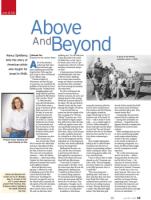
A group of the Machal
(volunteer pilots) in 1948.
among the American pilots fea-
tured in Above and Beyond are
Stan Andrews and Bob Vickman
(who together created the
Angel of Death logo for the 101
Squadron unit of the Israeli Air
Force — still on Israeli F-16 jets
today — on a cocktail napkin in
Tel Aviv), Milton Rubenfeld, a
former stunt pilot (and the father
of actor Paul "Pee-wee Herman"
Reubens) who flew for the British
Royal Air Force and the U.S. Air
Force before volunteering in
Israel.
These straight-talking pilots
belong to the so-called Greatest
Generation, but they have no
interest in perpetuating sanitized
myths or posing for statues. They
revel in long-ago love affairs and
every rule they broke.
"I have to tell you that we really
cleaned up a lot" Grossman says
with a smile. "Not just language,
but stories. Believe me, compared
to the [full] interviews, this is a
G-rated film:'
"They were young men"
Spielberg adds, "and many of
them said when they came back
from World War II they were
celebrated heroes and all of a sud-
den they were selling insurance
or shoes. That just doesn't hold
a candle. They liked their flight
jackets. They liked their girls.
JN
Several of them needed that thrill;
they wanted a band of brothers;
they wanted the glory days. They
wanted another shot"
Consequently, they procured,
repaired and flew airplanes that
— among other invaluable con-
tributions — helped thwart the
Egyptian blockade of supplies that
threatened the newborn state's
existence.
While unambiguously pro-Isra-
el, Above and Beyond gracefully
avoids simple-minded politics.
It sticks to the facts, wrapped
in the colorful recollections of
its endearing protagonists. As a
bonus, the film provides insight
into the contemporary Jewish
experience.
"It's a really interesting snap-
shot for me of how — before,
during and after the Holocaust
and the birth of Israel — the
trajectory of American Jewish
identity became so connected to
Israel and to Zionism," Grossman
says. "It really was a very, very
quick ramp-up. There was a very
small Zionist community in the
United States before the war,
and then we became all about
supporting Israel. These guys'
lives follow that trajectory, and
it's interesting to learn about
American Jewish history through
the lives of individuals:'
❑
April 30 • 2015
65