

jews in the digital age
10 Rants
About
Technology
R
ecently, I was asked how technol-
ogy has improved our lives and
made us more productive and
efficient. I gave my typical response to
such a question: The Internet has vastly
made our lives better and provided us with
a wealth of information at our fingertips
that previous generations could not have
imagined. I talked about the communica-
tion revolution and some of the technol-
ogy innovations that I cannot believe we
ever lived without like GPS, text messaging
and Google Search, not to mention the
ability to pause live television.
But in addition to raves, it's only fair to
rattle off a few rants about technology as
well. Here are my top 10 rants about tech-
nology Do you agree with these and what
would you add to the list?
Sense of Immediacy
The speed of the Internet has led the
youngest generation to expect that every-
thing is immediate. Those of us who
came of age before the Internet gained
wide acceptance remember having to sit
patiently as our 14.4kbps dial-up modems
spent an hour loading a web page (and
that annoying noise!). Now, we order a
pair of pants on Amazon and expect the
drone to drop it off on our porch within an
hour or two.
The 2.0 Factor/Next Big Thing
Just as we get used to our new cellphone,
we're being told that it's time to upgrade to
the newer model, which is bigger, faster,
has more memory and does more tricks. If
we're not updating our operating system,
we're at the store shopping for the latest,
greatest gadget that really isn't much dif-
ferent than what we already have. Teens
today are the 2.0 generation because they
have come to expect everything to have a
short shelf life before it is labeled obsolete
and requires an upgrade. This can make
it difficult to keep up with the growth of
technology.
Quest for Answers
There was a time when you didn't know
something and it took more than a few
minutes to locate the answer. There was
something to be said about the journey
to the public library to search by hand
76 April 2 • 2015
through an actual book iormisommr
that had to be located on
an actual shelf. Today,
as soon as curiosity sets
in, we're searching on
Google or asking our
trusted friend Siri for the answer. In the
21st century, it isn't about how much
knowledge you have, but whether you
know how to search quickly for the accu-
rate information.
Lack of Human
Interaction
It goes without saying that this
is one of the biggest drawbacks
to the Digital Age. Being able to
Skype with cousins in Australia
is truly a modern wonder, but
watching as our children sit in
the back of the minivan texting
each other is just sad. We need
to press the "reset" button. I'm
grateful for our modern com-
munications capabilities, but
we cannot allow it to replace
the power of real life human
engagement.
Voicemail and Batteries
There are certain technologies that have
run their course. When enough of society
adapts to a better technology, we have to
retire the antiquated one. This means a
universal understanding that fax machines
and voicemail are from a bygone era. I
have a vein in my forehead that manifests
itself every time someone asks for my fax
number so they can send me a document
or leaves a lengthy voicemail message that
could have been a one-sentence text mes-
sage. My loudest technology rant comes
when I have to change those double-A bat-
teries in a remote control. My kids' Xbox
has the most intricate, impressive graphics
imaginable, and yet Microsoft can't seem
to find a way to power the remote controls
beyond the same two batteries we were
using in the 1950s.
Evil Usage
I've always loved Google's mantra: "Don't
be evil:' but it's too bad the rest of the
world doesn't practice it. Certain aspects of
modern technology lend itself to scam art-
ists. Our technology experience would be
so much better if we didn't need Snopes.
com to invalidate hoaxes, anti-virus soft-
ware and secure certificates to protect us
from scammers and spammers, software
to keep our kids from seeing
things they shouldn't, filters to
keep us from clicking through
annoying click bait links and
campaigns to educate us about
the malevolence of cyber bul-
lying. In this same category, I
would add the immorality that
exists in the comments sections
of websites, social networks,
blogs and online videos. If
you're interested in learning
about racial epithets, anti-
Semitism, homophobia and
the most convoluted, paranoid
conspiracy theories, then look
no further than the anonymous comments
on the Web.
Bad GUI
You might not be familiar with the term
GUI, but you'd know it when you see it. It
stands for Graphical User Interface, and it's
the way we interact with computers. Some
GUIs have improved well over time like
the simplicity of the interface in our car's
dashboard or your smartphone's operat-
ing system. My rant is with technology
like our cable TV interface, which is slow,
annoyingly simplistic and not intuitive.
We've all come to appreciate having 1,000
cable channels, video on demand and a
DVR to record our shows. Is it too much
to ask to be able to control this mechanism
with ease and efficiency?
Misinformation
There is so much misinformation on
the Web that it's sometimes easier to not
even try to sift through the bad to find
the good. Wikipedia can be a wonderful
resource, but there is also a lot of unreli-
able and inaccurate information on the
Web that gets replicated. News sources can
be found online to back up any ridiculous
argument or to refute a fact someone else
makes.
The Internet's Too Big
Search engines like Google have actually
done a great job of indexing the Web and
making it much easier to find the right
sources quickly. However, the indexed
Web contains over 4.58 billion pages and
that makes it very difficult to monitor
or control. Anything and everything can
be found online. That is both good and
bad. Net neutrality laws are already chal-
lenging us to think about how to govern
Internet traffic and other issues like
graphic content censorship, trademark
protection, identity theft and illegal com-
merce will also have to be addressed in
coming years.
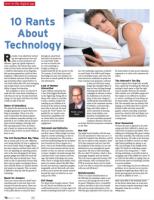
Over Connected
-
We have all come to depend on our tech-
nology and find it difficult to detach our-
selves from our phones and tablets. We're
adding new technology, like smart watches
and other wearables, that will keep us teth-
ered at all times. We wake in the morning
and check our FitBit to see how we slept
right before grabbing our phone to see
who sent messages in the middle of the
night. We check our technology numer-
ous times at the wrong times — while
driving and dining, at our kid's recital, in
synagogue and in the middle of a movie. If
we truly lack the ability to unplug, then we
have become slaves to technology and that
is a severe problem.
I love technology, but it's not without its
problems. As we proceed on our journey
through the Digital Age there will be set-
backs, growing pains and times that call
for rants in addition to raves.
❑
Rabbi Jason Miller is the technology expert
for the Detroit Jewish News. He is also presi-
dent of Access Computer Technology in West
Bloomfield. Follow him on Twitter at
@RabbiJason.