

arts & Life
• •
Activist, author, film producer; broadcaster - but forerimst,
'Daniel -I-lope—
_
Bringing Hope
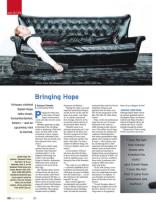
Virtuoso violinist
Daniel Hope
talks music,
humanitarianism,
history — and an
upcoming visit
to Detroit.
Daniel Hope will
perform "Romantic Piano
Quartets" at 8 p.m.
Saturday, April 11, at the
Seligman Performing Arts
Center, Beverly Hills. $10-
$60. (248) 855-6070;
chambermusicdetroit.org .
A pre-concert recital by
pianists Yuki and Tomoko
Mack, free to ticket
holders, will be performed
from 6:45-7:30 p.m.
62
April 2 • 2015
I
Suzanne Chessler
Contributing Writer
p
laying the violin stays
at the center of Daniel
Hope's varied musical
career and enters into his social
activism.
Whether appearing on stage,
performing in the recording
studio or producing a film about
music, he often relies on the
instrument to honor compos-
ers directly confronted by the
Holocaust. His own Jewish roots
have impacted some career
choices.
This season, Hope's range
reaches from the concert
"Romantic Piano Quartets:'
scheduled April 11 at the
Seligman Performing Arts
Center, to the recording
Escape to Paradise, showcasing
Hollywood movie sounds by
composers who survived the
Nazi reign.
The Chamber Music Society
of Detroit hosts the local con-
cert that includes cellist David
Finckel and pianist Wu Han, co-
artistic directors of the Chamber
Music Society of Lincoln Center,
along with violist Paul Neubauer,
a soloist with some 100 orches-
tras worldwide. The program
includes music by Mahler,
Schumann and Brahms.
"Playing the violin is the most
important professional thing in
my life, but it's not the only ele-
ment of my music:' says Hope,
41, in a phone conversation
from Georgia, where he serves
as associate artistic director of
the Savannah Music Festival.
"Chamber music is an
extremely important part. I was
the violinist in the Beaux Arts
Trio [the youngest for its final
six seasons] for seven years
when I dedicated myself to the
music. Since then, I've done a
number of different things, but
I return to chamber music every
season:'
A local audience will hear
selections described by Hope
as three of the most wonderful
works in chamber music, com-
bining the best of the Romantic
era.
"The works are very different
— extremely established pieces
by Brahms and Schumann and
a little gem of a piece by Mahler
from his student days ... not all
that well-known but absolutely
beautiful;' he says.
Hope, who has appeared
internationally and recorded
some 25 albums, holds special
recollections about Michigan
visits. He made his American
orchestral debut with the Detroit
Symphony Orchestra and
appeared with the Beaux Arts
Trio for the inauguration of The
Max (The Max M. Fisher Music
Center).
Hope, on the solo professional
stage since he was 15, became
immersed in the violin as a
child, learning to play when he
was 4. His mother was the long-
time secretary for violinist and
conductor Yehudi Menuhin —
with whose grandchildren Hope
played when visiting his mother
at work — who became a men-
tor, introducing him to other
important instrumentalists and
teachers. Born in South Africa
and raised and educated in
England, Hope earned degrees at
the Royal Academy of Music. He
went on to work as a conductor-
from-violin (a performer who
conducts while at his instru-
ment) and writer.
"In the 19th century, it was
a common practice for violin-
ists to be conducting from their
instruments:' he explains. "It
was absolutely normal before
there was the idea of solo con-
ductors.
"It went through a phase of
being not so popular, but in the
last 30 or 40 years, we've seen
a big return to its popularity.
Many of my colleagues do this:'
JEWISH HERITAGE
Although Hope's father (novel-
ist and anti-apartheid activist
Christopher Hope) was Roman
Catholic and Hope attended a
Church of England school, the
violinist also traces a Jewish
heritage through his mother.
"I always knew I had a strong
Jewish connection, but it was
"l love the fact
that nobody
knows who
invented the
violin,"
says Daniel Hope.
"l love the fact
that it came from
somewhere and
nowhere."