

health & wellness
End-Of-Life Care
Annual Caring Coalition event draws record crowd to learn from speakers.
Barbara Lewis
Contributing
Writer
I
E
xciting changes are on the
healthcare horizon, and Dr. Sofia
Merjaver is helping to make them
happen.
Merjaver (rhymes with "the driver"), a
medical doctor with a doctorate in physics,
is director of the Breast and Ovarian Cancer
Risk Evaluation Program at the University of
Michigan, a program she founded in 1995.
She was a featured speaker at the March
18 Shenkman-Weisberg Caring Coalition
Conference at Congregation Shaarey Zedek
in Southfield, an annual event coordinated
by the Jewish Hospice and Chaplaincy
Network and the Hospice of Michigan
Institute. The conference, "Caring for the
Whole Person:' attracted nearly 950 physi-
cians, nurses, social workers, nursing home
administrators, clergy and others involved in
end-of-life care.
Merjaver's lab is studying "precise medi-
cine," looking at cancer at the cellular level
and investigating why some cancer cells
metastasize and some don't. The researchers
are hoping to improve outcomes by learning
how to modify the behavior of cancer cells.
She talked about the promise of nano-
technology using tiny molecules one one-
thousandth the thickness of a human hair to
deliver tumor-killing drugs directly to cancer
cells while sparing nearby healthy cells.
"I'm trying to move the needle, not incre-
mentally but to make a leap forward," she
said.
Merjaver is also working to ameliorate
inequity in healthcare, which she defines
as "no early detection of potentially curable
diseases" and little or no palliative care in
developing countries. This inequity leads to
low survival rates and poor quality of life,
particularly at the end of life.
She recalled seeing a man in Ecuador, in
the end stages of cancer, carried out into
\
I 111k.'l
/WWII '111fuii ■
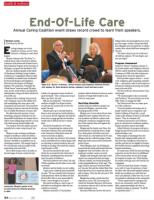
Immaculee Ilibagiza speaks of her
survival during the Rwanda genocide
in 1994.
54
Dallas told her she had taught her how to let
go of her anger. Another woman described
how Ilibagiza's story prompted her to call her
mother, from whom she'd been estranged for
20 years.
"No matter what you do, do it with love,"
she told her audience. "If I can forgive, any-
one can forgive7
March 26 • 2015
Program Announced
Rabbi E.B. "Bunny" Freedman, Jewish Hospice and Chaplaincy Network director,
with speaker Dr. Sofia Merjaver during a speakers' lunch-and-learn event
a field so his agonized screams would not
upset his family. "This is what passes for pal-
liative care there she said.
Still, she was optimistic. "The future of
medicine is bright if we all get involved,
we advocate for research and we strive for
equity ' she said.
Merjaver grew up in a Jewish family in
Buenos Aires and says her Jewish identity is
a core reason she left Argentina. She said she
knew from a young age that anti-Semitism
would make it difficult for her to remain
there.
She left her homeland in 1972 when
she was 19, abandoning her studies at the
University of Buenos Aires and enrolling
at the University of Maryland, where she
earned a doctorate in physics.
Ten years later, she entered U-M's medical
school, and followed her medical degree with
an internship in internal medicine and a fel-
lowship in oncology. She joined the medical
school faculty in 1994.
She said was shocked by the racial
divide she encountered at the University of
Maryland, something that has driven her
quest for equity in healthcare.
"All of the professors were white," she said.
All the custodians and the other service staff
were black7
Merjaver said her family was not wealthy.
"I grew up in a relatively poor household,"
she said. "We were a family of five living in a
small apartment, where my father also had
his law office. But we were surrounded by
books. I never thought of us as poor7
She started working as a tutor at age 13
and held two teaching jobs while she was
enrolled at university.
Merjaver, married to U-M psychiatry
;
professor Melvin McInnis, has been an active
member of Temple Beth Emeth in Ann
Arbor for many years.
Surviving Genocide
Another featured conference speaker was
Immaculee Ilibagiza, a survivor of the
Rwanda genocide of 1994.
Ilibagiza was 19 years old and home from
college for Easter vacation when the coun-
try's president was killed in a plane crash,
setting off a murderous rampage by mem-
bers of the majority Hutu tribe against the
Tutsi minority.
Ilibagiza and her family were Tutsis. Her
parents told her to seek help from a neigh-
bor, a Hutu pastor. He hid her and seven
other women in a tiny bathroom for 91 days.
Ilibagiza said she could hear gangs of Hutu
thugs only inches away as they searched the
pastor's house.
When Ilibagiza came out of hiding she
learned that her family and friends had been
slaughtered. Only one brother, who was
studying in another country, survived.
Ilibagiza said during her early days in hid-
ing she was consumed by hate and anger.
A Roman Catholic, she started praying fer-
vently and gradually let go of her rage. "The
anger I held in my heart could have killed
me," she said. She said she realized that if she
truly believed in God, it meant she had to be
able to forgive. When she did, she said, it "felt
like freedom7
Ilibagiza has written a book about her
experiences, Left to Tell: Discovering God
Amidst the Rwandan Holocaust. She became
an American citizen in 2013, and now travels
widely, sharing her story.
She said a Holocaust survivor she met in
Rabbi E.B. "Bunny" Freedman, director of
the Jewish Hospice and Chaplaincy Network
(JHCN), said he started the Caring Coalition
Conference in 2008 to let other hospice pro-
fessionals know about the organization.
JHCN provides support services — social
work, chaplaincy, grief counseling, volunteer
help — and partners with 20 area hospices to
provide the medical and nursing care people
need at the end of life.
The first conference attracted about a hun-
dred people.
"We wanted people to take us serious'
said Freedman. "We just wanted a seat at the
table. Today we manage the table7
The Detroit Jewish News is a major spon-
sor of the conference.
"I love the speakers and seeing a lot of
people I haven't seen in a long time," said
Sandra Goldberg of Royal Oak, a social
worker at the Hospices of Henry Ford Health
System. "They do a fantastic job7
Freedman announced a new JCHN pro-
gram at a luncheon for conference speakers,
hospice executives, donors and rabbis.
Called LifeLinks, the program will aim to
bridge the gap between acute care in the hos-
pital and hospice care.
Often people are discharged from the
hospital with ongoing health needs, but
they don't have a prognosis of less than six
months, and thus are not eligible for hospice.
New health insurance regulations discourage
hospital readmission.
For many years, JCHN has been providing
supportive services for those too debilitated
to live at home alone, but not sick enough
for hospital or hospice care. What's lacking
for people in this gap area is the clinical care
component.
JCHN has hired Rose Fenster, a hospice
nurse with 15 years of experience, to head
the effort. She will monitor patients' physical
health and coordinate care with their pri-
mary care physician, if they have one, or con-
nect patients to physicians in the community.
"There's a great need for a program like
this in our community" said Dr. Manuel
Sklar, a gastroenterologist who lives in
Franklin and plans to volunteer. "It will fill
an important niche7
❑