

>> Torah portion
The
First
Priest
It's not manna from heaven,
but this Passover, provide
something just as crucial to the
survival of the Israeli people.
Parshat Tzav,
Shabbat HaGadol:
Leviticus 6:1-8:36;
Malachi 3:4-3:24.
MOM
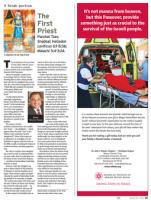
A depiction of the High Priest
T
he second part of our portion
Aaron as the Levite, not as the kohen;
of Tzav deals with the seven-
but when Moses keeps refusing to be
day induction ceremony
the emissary, God removes the dynastic
of Aaron and his sons as the kohanim
priesthood from Moses and bestows it
(priests) of the Sanctuary.
upon Aaron.
Moses, the prophet, conducts the
I believe that this switch in role was
proceedings: First he "invests" them,
much more than a result of God's anger;
dressing them in their unique priestly
it had to do with the different functions
garb; and then he slaughters the second
of priest and prophet and the different
ram, the consecration-inauguration ram, personalities of Aaron and Moses.
"which fills and completes the function
Moses describes himself as "heavy of
of the priests [father and
speech"; he had little patience
for small talk, for human fel-
sons] within their priest-
lowship or even for family
hood:'
I would submit that the
relationships or obligations.
seemingly insignificant
He seeks only Divine fel-
phrase "and [Moses] slaugh-
lowship and Divine Torah
tered it" in the introductory
talk, and such endowments of
text to our commentary is
intellect and spirit cannot be
one of the most poignant
passed down as an inheritance
and moving phrases of the
to the next generation; they
entire Bible, which also
are limited to rare, charis-
illuminates the purpose of
matic
individuals blessed with
Rab bi
the priest in contrast to the
unique
abilities.
Shlomo Riskin
prophet.
Aaron, on the other hand,
The nuances of inter-
was a man of the people, who
pretation emanate from a rare cantina-
loved making peace between individuals.
don "trope" — the shalshelet — which
He loved all of humanity and through
appears above the letter "chet" in the
loving acts and words, brought everyone
Hebrew word vayishchat ("and he
close to Torah. Moses acquired the Torah
slaughtered"). None of the tropes are
intellectually, but Aaron taught it to the
as distinctive, or as lengthy, as is the
masses with love. Acts of lovingkind-
shalshelet; it appears only four times in
ness can be passed down from parent
the Bible, usually connoting the drama of to child, from generation to generation;
confused hesitancy and deep apprehen-
to speak loving words and to do loving
sion.
deeds can be learned and bequeathed.
But what is complex about slaughter-
Nevertheless, Moses the human being
ing a ram? In order to understand this,
would have loved to see his sons assume
we must realize that the initial plan was
religious leadership positions in Israel;
for Moses to have received the Kehuna
but they do not. Moses cannot help but
— priesthood, the hereditary leadership
hesitate to give vent to feelings of loss,
function in Israel.
frustration and even a little jealousy, as
However, when the Almighty sug-
well as apprehension as to his own conti-
nuity within his own family line.
gests to Moses that he be His emissary
to Pharaoh to lead the Israelites out of
Moses, who gave himself over com-
Egypt, Moses demurs, again and again
pletely to God and nation, understands
refusing the mantle of leadership, declar- at this pivotal moment the personal
ing himself to be unworthy. At length,
sacrifice it had cost, the loss of family
"the Lord became angry with Moses, and closeness and continuity it had engen-
He said, 'Is there not Aaron your brother, dered. This I believe is the message of
the Levite? He will surely speak ... he
the shalshelet.
will be your mouthpiece, and you will
Shlomo Riskin is chancellor of Ohr Torah
provide for him [the words] of God:"
Stone and chief rabbi in Efrat, Israel.
In this context, God initially refers to
4 1616-
-
k
In a country where terrorism and sporadic rocket barrages are an
all-too-frequent occurrence, your gift to Magen David Adorn ensures
Israel's national paramedic organization has the medical supplies
it needs to save lives. So this year, while you recount the story of
the Jews' redemption from slavery, your gift will help modern-day
Israelis survive the threats they face today.
Thank you for making a gift today. And we wish you and
your family a Pesach kasher v'sameach.
Dr. John J. Mames Chapter — Michigan Region
Manny Charach, Chair
Cari Margulis Immerman, Director
23215 Commerce Park Road, Suite 306
Beachwood, OH 44122
Toll Free 877.405.3913 • central@afmda.org
www.afmda.org
-
AMERICAN FRIENDS OF
MAGEN DAVID ADOM
SAVING LIVES IN ISRAEL
❑
March 26 • 2015
41