

>> ... Next Generation ...
Change Agent
Eric Adelman is moving Kadima forward.
VIVIAN HENOCH I SPECIAL TO THE JEWISH NEWS
T
hose with a Jewish soul and a smattering
of Hebrew might recognize the word
kadima, meaning forward. And forward
is the word that resonates most often in
conversation with Eric Adelman, speaking on behalf
of the clients of the Jewish mental health agency,
Kadima.
Moving forward into his second year as executive
director of Kadima, Adelman already has navigated
some of the challenges in the changing landscape
of health care today. "It's been a wonderful time of
transition," he says.
Adelman stepped into the role of longtime director
Janette Shallal, who had built Kadima from one
home about to lose its license to what it is today,
serving more than 200 individuals and their families,
based in 25 residential settings throughout Oakland
County, as well as in therapy and group activities at
the Zussman Activity Center in Southfield.
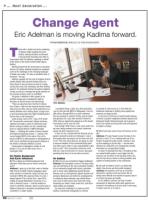
The guitar in Adelman's office speaks to his
youthful energy and a management style he
describes as heimish (warm and welcoming).
"There are days here that I feel like I'm Norm
from Cheers. I walk into the Zussman Activity Center,
steps from my office, and our clients welcome me so
warmly. Whether we're talking about a tough issue
or just shmoozing about last night's football game, I
feel we have a real connection."
Listed among Crain's 2014 "Class of 40 Under
40" honoring the community's highest achievers,
Adelman has made a career of community work.
Before coming to Kadima, he led a membership
boom as regional director of BBYO Michigan
Region — doubling the number of teens involved
and tripling fundraising revenue — making it the
second-largest BBYO in the nation. Prior to his
tenure at BBYO, he held positions in development at
JARC and in interfaith and government relations at
the Jewish Community Relations Council.
Proud parents of daughters, Jocelyn, 8, and
Natalie, 3, Eric and his wife, Karen, live in
Farmington Hills.
40
Eric Adelman
I considered being a rabbi. But, after graduation,
I got my first job with BBYO in Milwaukee. I met my
wife, Karen, through BBYO at a staff conference.
She was working in southern Florida, and we dated
long distance for a year, then moved to Detroit in
2002 when an opportunity opened up at the Jewish
Community Council, now the JCRC.
Even though I didn't have a clear career path from
the start, being involved in the Jewish community
always has been important to me.
In fact, for me, it started with the financial aid my
parents received to send me to Tamarack. I was in
third grade when my parents sat me down and said
to me, "The only reason that you are going to camp
is because members of this community have given.
And when you're older, it's your responsibility to give
back as well." That conversation clearly has stuck
with me. I was 8 at the time. So I'd say it was good
parenting that had a lot to do with my choices.
On Family Background
And Early Influences
On Kadima
Q: Tell us about your family background and
education. What drew you to Jewish communal
work?
Adelman: I grew up in Oak Park, went to Berkley
High School and Beth Shalom Synagogue, spent
seven summers at Tamarack Camps and was very
involved in BBYO. (No surprises there.) As a kid, I
always figured I'd be a doctor. But, I went off to
college at George Washington University in D.C.,
took a chemistry course — and that ended my
career in medicine! Instead, I spent my junior year at
Hebrew University in Jerusalem and graduated with
a bachelor's in Judaic studies.
Q: What do you see as Kadima's biggest challenge?
Adelman: Our immediate concern is the day-to-day
care and well-being of the most vulnerable members
of our community, people with chronic, persistent
and, in some cases, debilitating mental illnesses.
Illnesses such as schizophrenia, bipolar disorder and
pervasive depression can further be complicated by
co-substance abuse disorders, age-related illness
and a host of other factors that come with living.
Answering our clients' needs comes first, and those
needs always are changing.
Our long-term challenge is to make sure that
Kadima is positioned strategically to continue
March 19 • 2015
to provide its vital services in a time when the
healthcare landscape is shifting more rapidly than
everyone can keep up with.
As we look to the future of mental health delivery,
I envision a greater integration between physical and
behavioral health. Moving forward, we're going to
have to be nimble and resourceful and well prepared
to adapt to change.
Q: What have been some of your first lessons on the
job?
Adelman: I'll never forget my very first day on the
job here. I had a 10 a.m. meeting with one of our
funders through the public system. Literally, it was
my first meeting on my first day — and we were
informed of a $36,000 cut in funding that virtually
eliminated our transportation budget.
So what I've learned from Day 1 at Kadima is that
our mental health system is very fragile, that the
resources are not there in the way they need to be,
that we must be pro-active in solving problems and
vigilant in finding partners in the community.
Q: The bulk of Kadima's work is currently with
adults. How do you see that model changing?
Adelman: No question, we'll see an increased
demand for capacity in the near future. We are
seeing more referrals now and the occupancy rate in
our homes has gone up steadily.
As for children's services, we need a further
assessment to determine what other agencies are
involved in the delivery of services and in what ways
it makes sense for us to step in.