

is This
n
„ D
metro
Full STEAM Ahead
Hillel Day School adds arts back into its STEM curriculum.
I don't know what's happening to
my son. He's not the boy he used
to be. He used to spend every
spare minute with his friends; now
he doesn't want to go anywhere
after school or on weekends.
When he's home, he stays in his
room, doing homework or playing
video games. When I asked why
I haven't seen his friends around,
he just said they've been busy.
Lately I hear him walking around
the house in the middle of the
night when he should be sleeping.
And his appetite - he used to
eat nonstop; now he's hardly
interested in food. Yesterday I
baked his favorite carrot cake, and
he just picked at his slice. I asked
him what was wrong, and he said
he ate a big lunch, but I didn't
believe him. He used to devour
two or three pieces right away; he
could hardly wait for me to finish
frosting it. Report cards come out
next week, and he told me not to
be surprised if his grades aren't as
good as last semester.
I don't know what to do. My
husband tells me I worry too
much. He says teenagers are
moody, they go through phases.
Maybe I am overreacting. He
still goes to school and soccer
practice every day. But this seems
like more than a phase. When I
ask him if something is bothering
him, he says everything is fine.
But I can see it's not.
I've been thinking about getting
him some help, but I don't know
where to turn. Should I talk to
someone at his school? I don't
care about his grades; I just want
my son back.
I
Stacy Gittleman
Contributing Writer
T
inkering in Judaism goes all the
way back to Mount Sinai. After
all, Sinai was the place where
the children of Israel declared they would
learn about the Ten Commandments
through doing.
Growing out of this tradition, Hillel
Day School's new Innovation Hub
and Makerspace, part of the Audrey
and William Farber Family IDEA
Collaborative, provides a resource where
students apply the tried-and-true methods
of trial and error to deepen their under-
standing of everything from kinesthetic
energy to kashrut.
Tinkering is trendy throughout
Michigan. As the state once again re-
energizes its can-do spirit of innovation,
makerspaces are popping up in Detroit,
Ann Arbor and Northville. Think of them
as a spot where enterprising inventors can
come together to collaborate and share
overhead costs of rent, tools and materials.
Just in its first few months of operation,
the Hillel makerspace has inspired several
projects and events. They include a school-
wide Makerspace Faire and a Shark Tank-
style entrepreneurial competition, where
local businesspeople and innovators sat on
a judge's panel while students pitched their
product ideas and marketing plans. Some
product ideas included a multicolored
crayon and a smart-chip golf club.
One judge was local entrepreneur Arik
Klar, owner of Toyology, who also spent
several months working with fifth-graders
in creating a school store where kids of
all grades can sell their creations. As they
learned what it takes to run a small busi-
ness, the fifth-graders applied their math
skills and learned basic economic concepts
such as supply and demand. They will
The
only
bad CCU//,
is the one you
don') make.
An initiative of the Schulman Fund
0.4 L B SOBEL
HOUSE
Trevett Allen, director of innovation,
SUPPORT &
FRIENDSHIP
FOR ALL
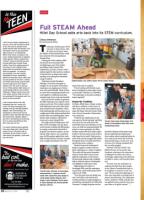
demonstrates a "squishy circuit"
made with conductive play dough to
sixth-grader Rachel Siporin, first-
grader Louis Kowalsky, fourth-grad-
er Ryan Sparago and second-grader
Spencer Cherrin.
248-788-8888
rabbiyarden@friendshipcircle.org
thefnendshiphouse org
1,912,0
26
March 19 • 2015
17,
Eighth-grader Lily Collins shows off her guitar design.
donate their sales to tzedakah.
"I loved working with the kids to give
them my feedback on what makes a prod-
uct successful; said Klar, 25, of Berkeley.
"The makerspace is the perfect setting to
inspire ingenuity:'
Hands On Tradition
-
Sol Rube, Hillel's dean of Judaic studies,
said that in addition to their hours of
daily Torah study, all of Judaism's great
sages did things with their hands. Rashi
was a French winemaker. Maimonides
was a physician.
"Creativity and collaboration are all
core aspects of Jewish learning:' said Rube
as he sat in the new sunlit area of the
school that houses the makerspace. In the
room, one child was programming the 3D
printer to create a geometric toy. Other
students worked with their Judaic studies
teacher in front of a green screen to film a
video based on the week's Torah portion.
Some of the school's youngest kids looked
through the bins of recycled materials to
upcycle them into a sculpture.
Teachers harness the makerspace's
hands-on appeal to enhance their stu-
dents' exploration on a variety of subjects.
They work with the space's innovation
director, Trevett Allen, as how to best
apply the makerspace to their lessons.
Seventh-grade students built a shakable
table to study the impact of earthquakes
on buildings for earth science class.
Eighth-grader Lily Collin, 14,
Farmington Hills, used the makerspace
as part of her social studies project about
culture in the 1960s.
"I love the music from the British inva-
sion; said Collin as she showed off a
wooden prototype of a guitar designed to
resemble the one played by the Who's Pete
Townsend. To design the guitar, she first
Trevett Allen helps third-grader Eric
Diskin of Farmington Hills with some
woodworking tools.
penciled a blueprint of the guitar using
precise mathematical measurements,
drew another colored rendering before she
set to work on the wood. She carved the
shape herself using a circular saw. And,
of course, her training mandated that
she use safety goggles.
"STEAM is the new STEW said
Hillel's Director of Curriculum Joan
Freedman, referring to the importance
of adding the arts back into science,
technology, engineering and mathemati-
cal skills to create a well-rounded educa-
tion.
"In some ways, the makerspace is
undoing what kids have been taught
in the culture of standardized tests: to
be compliant, to learn for a test:' she
said. "We are seeing the beginning of a
time when education is turning back to
project-based learning. The makerspace
teaches students to think critically and
use applied sciences and the arts to pre-
pare them to be global citizens:'
❑