

world
Decision 2015
Here are Israelis' choices as they head to the polls.
Alina Dain Sharon
JNS.org
T
he leaders of eight of the 11
political parties running in the
March 17 Israeli Knesset election
participated in their first televised debate
on Feb. 26, moderated by anchor Yonit
Levi of Israel's Channel 2 network.
Absent from the discussion, however,
were current Prime Minister Benjamin
Netanyahu and his most formidable chal-
lenger, Zionist Union alliance chairman
Isaac Herzog.
If Zionist Union wins the most seats
in the Knesset (Israel's legislature) and is
able to form a governing coalition, Herzog
— whose Labor party merged with Tzipi
Livni's Hatnuah party for the election —
would rotate the role of prime minister
with Livni.
When Israelis enter the kalfi (Hebrew
for ballot box) next week, they will cast
votes for entire parties — not for specific
candidates. Each party, which presents a
list of candidates for membership in the
Knesset, must win at least 3.25 percent of
the total vote to get the minimum repre-
sentation of about four seats.
The new Israeli government will be
---,,.
established based on how many seats
each party wins; and the president will
appoint the prime minister, who is usually
the leader of the party that won the most
Knesset seats. That party leader must then
form a governing coalition with other par-
ties, and the parties that are not included
in the coalition become the "opposition"
As such, even after the votes are tallied
on Israel's election day, it is never imme-
diately clear which parties will form the
governing coalition.
The following is a list of parties — some
old, some new and some that have merged
— vying for seats in the 20th Knesset.
Likud (Union)
Israel's current ruling
party, the right-leaning
Likud seeks a free-mar-
ket economy, supports
some Israeli construction
in Judea and Samaria,
and affirms Jerusalem as
Benjamin
Israel's
undivided capital.
Netanyahu
Netanyahu and his party
oppose total Israeli with-
drawal from Judea and Samaria due to the
security challenges that move would pose
for the Jewish state.
Zionist Union
An alliance between
left-leaning parties,
the Herzog-led Avoda
(Labor) and the Livni-
led Hatnuah (the
Movement), Zionist
Union seeks a more
Isaac Herzog
proactive Israeli govern-
ment effort to reach a
peace agreement with
the Palestinians, but
with some conditions.
The party also promotes
more government con-
trol of the economy.
Professor Yossi Yonah,
a candidate on Zionist
Tzipi Livni
Union's Knesset list,
recently said the party
would be willing to discuss the division of
Jerusalem.
"Jerusalem is in practice a divided city:'
Yonah said. "We have to discuss the pos-
sibility of having the Arab neighborhoods
be on the Palestinian side in a permanent
arrangement:'
Erel Margalit, a Knesset member
for the Labor party, told JNS.org at the
American Israel Public Affairs Committee
Conference that the Israeli-Palestinian
11-" ■ ..—
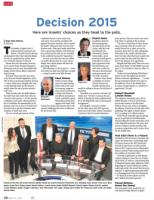
Posing at the Feb. 26 Israeli election debate hosted by Israel's Channel 2 television are, standing: news anchor Yonit Levi, Shas
leader Aryeh Deri, Kulanu leader Moshe Kahlon, Jewish Home leader Naftali Bennett, Meretz leader Zehava Gal-On; seated:
Yisrael Beiteinu leader Avigdor Liberman, Yesh Atid leader Yair Lapid, Yachad party leader Eli Yishai and Joint Arab List leader
Ayman Odeh.
20
March 12 • 2015
JN
peace process "deserves much more atten-
tion" than it is getting at the moment.
"The time to lead some of these discus-
sions is perhaps when the world is not
totally focused on it, when you can be
proactive about this:' he said, adding that
both sides in the conflict should under-
stand not only what they have to gain from
a peace deal, but also what they have to
lose in the absence of an agreement.
Margalit said that Israel "does not neces-
sarily stand alone" in the Middle East and
that it is "crucial that we find our allies" in
the region.
"Jordan has been fighting ISIS [Islamic
State]; we saw that Egypt just declared
Hamas a terrorist organization. ... I would
like an Israeli government to be open to
the different voices in the Middle East
as a place of opportunity or a window of
opportunity:' he said.
Habayit Hayehudi
(Jewish Home)
This religious-nationalist party, led by
Naftali Bennett, a 40-year-old software
tycoon and veteran of an elite Israel
Defense Forces unit, seeks to strengthen
the identity of Israel as a Jewish state while
upholding "the rights of Israel's minori-
ties:' according to its official website.
Jewish Home staunchly opposes giving
up any Israeli land to the Palestinians,
instead calling for Israel's annexation of all
of the disputed territories. The party also
strives to improve Israeli education and
economic competition and to reduce taxes
for the middle class.
Yesh Atid (There Is a Future)
Founded in 2012 by former journalist Yair
Lapid, this party won a surprisingly high
19 Knesset seats in the 2013 Israeli elec-
tion but is expected to see that number
drop in 2015. Lapid served as Netanyahu's
finance minister before being ousted from
the coalition in December 2014.
Currently, Lapid's party is still champi-
oning a strategy to lower the cost of hous-
ing in Israel, as well as a controversial plan
to eliminate Israel's value-added tax (VAT).
Regarding the Israeli-Palestinian conflict,
Lapid said earlier this month that his party
supports "a regional agreement that leads
to a disengagement from the Palestinians
— let them do as they please on their
side Yedioth Ahronoth reported.
Yisrael Beiteinu
(Israel Our Home)
This nationalist party, headed by cur-
rent Israeli Foreign Minister Avigdor