

arts & life
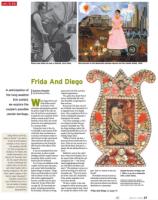
Rivera and Kahlo at work in Detroit, circa 1933
In anticipation of
the long-awaited
DIA exhibit,
we explore the
couple's possible
Jewish heritage.
"Diego Rivera and Frida
Kahlo in Detroit" runs March
15-July 12 at the Detroit
Institute of Arts. Free for
DIA members; $8-$19
for others regardless of
residence. For tickets and
exhibit information, visit
dia.org . On Thursday, April
30, the Jewish Historical
Society of Michigan will
explore labor art and the
early labor leaders with a
touring symposium, "Art and
Early Jewish Leaders of the
Detroit Labor Movement,"
including a docent-led
tour of Rivera Court. For a
list and details of related
programs, visit ixiti.com/
diegoandfrida.
I
Suzanne Chessler
Contributing Writer
W
hen Diego Rivera and
Frida Kahlo arrived
in Detroit in 1932,
newspaper photographers greeted
the power couple at the train sta-
tion. He had been commissioned
to paint the now-acclaimed Detroit
Industry murals at the Detroit
Institute of Arts (DIA); she would
pursue her own painting projects
in a museum studio.
During their year in the city,
occasionally as party guests of the
social elite, they encountered an
economic environment similar to
what Detroit recently experienced.
There had been talk about sell-
ing masterpieces and closing the
DIA because of the effects of the
Depression.
It was not anticipated that some
80 years later, in places outside
Michigan and the couple's Mexican
homeland, Kahlo would be more
famous than her husband.
For 10 years, an exhibition of the
couple's work has been discussed,
and curator Mark Rosenthal has
helped bring it to fruition. "Diego
Rivera and Frida Kahlo in Detroit"
will run March 15-July 12 at the
DIA and be supplemented by
lectures, activities and the opera
Frida (See "In Step With Frida"
on page 38). The associated pro-
grams, including presentations
by Rosenthal, variously are being
Self-Portrait on the Borderline between Mexico and the United States, 1932
sponsored by the DIA and other
cultural organizations.
"It's a great story about Detroit
and an unbelievable full circle"
says Rosenthal, comparing times
then and now
Because the DIA does not hold
any of Kahlo's work, Rosenthal had
to negotiate loans of 26 display
items. They complement 38 Rivera
works, including his preparatory
drawings for the murals.
"One of her paintings is of the
two of them just after they got
married" Rosenthal says. "She
has Diego holding a palette [the
traditional identification of an old
master]. She has painted herself
holding Diego's hand.
"While in Detroit, she does a
print and shows herself with three
arms. There are two normal arms,
and with the third, she's grown a
palette. She has declared herself an
artist:'
Kahlo's key work in the exhibi-
tion is Henry Ford Hospital, where
she stayed while suffering through
a pregnancy loss — one among
many hospitalizations through-
out a life filled with illness and
injury. "The painting is a gruesome
scene of her lying in an iron bed"
Rosenthal says. "This is the lynch-
pin of her career. It's a declaration
of her artistic inspiration to do
work about herself.
"It's also a marker in the sand
compared to all the previous paint-
ings of women lying in beds, which
are usually the subjects of the male
gaze. This is a woman as she sees
herself'
Rosenthal's research turned up
information about Jewish heritage
associated with each artist even as
they practiced atheism and defined
themselves as communists.
Double-Portrait of Diego and
1,1944, is an oil on Masonite
with a shell frame.
COURTESY OF GALERIA ARVIL, MEXICO 0
2014 BANCO DE MEXICO DIEGO RIVERA FRIDA
KAHLO MUSEUMS TRUST, MEXICO, D.F. /
ARTISTS RIGHTS SOCIETY (ARS), NEW YORK
Frida And Diego on page 41
IN
March 5 • 2015
37