

>> ... Next Generation ...
Zomplex Relationships
U-M grad studies chimps in Uganda and
does tikkun olam work in village school.
NATHAN CHESTERMAN
n my first day in Uganda, I
nearly killed a baboon.
To be fair, it wasn't me
but the car I was in, which
was hurtling down a dirt road through
Kibale National Park, a rainforest in
western Uganda. We rounded a corner to
see an ambling troop of baboons, and the
driver slammed on the brakes just in time
for a young monkey to narrowly escape
death.
This was my first glimpse of the complex
relationship between people, wildlife and
development in rural Uganda.
Baboons are attracted by the sound
of car engines because taxi drivers feed
them. Plans are under way to pave the
road, a lifeline for the rural villages on the
other side of the forest. But the improved
road will allow cars to drive faster, and
future monkeys may not be as lucky as the
one we encountered.
Since that day in August, I have been
living in the center of Kibale National
Park, studying the Ngogo community
of wild chimpanzees. I graduated from
the University of Michigan in May 2014
and was not drawn to the prospect of
spending 40 hours a week in a cubicle.
Instead, I opted for a life in the jungle.
The Ngogo Research Camp, my home
for the year, is rustic. The cabin porch
overlooks the rainforest canopy from a
hilltop, and the nearest sign of civilization
is barely visible 10 miles away. The din
of the primates, birds and insects never
fades, but it's a quiet life nonetheless. Just
a handful of others are here with me —
two researchers from the U.S., one from
the U.K. and the Ugandan camp manager.
The forest can get lonely with so few
people, and it is not always easy being far
from home. Certain comforts — reliable
electricity, a hot shower, cheese — have
become things to savor when available.
The other American researchers are
also Jews, and we've managed to put a
Jewish spin on our jungle home. We ate
potato kugel for Rosh Hashanah (though
it wasn't as good as Bubbie's), and spent
Yom Kippur in self-reflection next to a
babbling stream. In keeping with Jewish
tradition, we made mu shu pancakes and
watched a movie on Christmas, and we
celebrated Chanukah with latkes and
34
March 5 • 2015
I
SPECIAL TO THE JEWISH NEWS
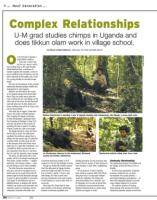
Nathan Chesterman is spending a year in Uganda studying wild chimpanzees, like Django, a young adult male.
As Chesterman observes in the background, Richmond
Chesterman collects chimp urine from a leaf.
grooms his brother, Hutcherson.
a menorah that Aaron Sandel, a Ph.D.
student at U-M, had the foresight to bring.
Though my Jewish life revolves around
food, the daily grind at Ngogo involves
more than kugel and latkes. Far from a
9-to-5 routine, I spend 11 hours a day
with chimps. As I hike to work each
morning, listening for hoots and screams
in semi-darkness, I have no idea what I'll
encounter.
Most days, the chimps feed in trees
and socialize on the ground, alternating
between momentary squabbles and
friendly grooming. On rare occasions, they
travel to the far reaches of their territory to
hunt monkeys or clash with a neighboring
group.
For my research, I need to identify
every chimp at a glance. With 200 chimps
living here, this is no easy task. Named
mostly for celebrities, the chimps and
their personalities form a dramatic cast
of characters. As I've come to know them
as individuals, my preconceived barrier
between humanity and our closest living
relatives has begun to erode.
Unsteady Relationship
The relationship between the wildlife and
the villages around the forest is not as
friendly.
As the human population of Uganda
increases, rainforests are cut down
for farmland. This causes animals —
particularly elephants and baboons — to
leave their degraded habitats to eat the
crops villagers depend on to survive.
The common practice of hunting
forest animals only worsens the hostile
relationship between people and animals.