

oints of view
>> Send letters to: Ietters@thejewishnews.com
Editorial
Guest Column
African American Confab
Praises Jews And Israel
kt Charles Wright Museum
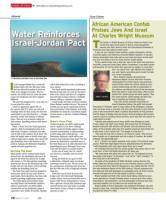
A stunning shoreline view of the Dead Sea
I
n the besieged Middle East, Israel and
Jordan boast a 20-year-old peace treaty
that has allowed Jerusalem to focus on
other, more dangerous borders. The two
nations, one Jewish and one Arab, also have
a pact over freshwater, the desert region's
lifeblood.
The pact was imagined over a year ago, but
is now poised for action.
Under an agreement signed Feb. 26,
the nations, both U.S. allies, not only will
exchange water for their needs, but also will
work jointly to save the Dead Sea — a fragile,
saltwater wonder that harkens to biblical
times. That sea is an economic engine for
both nations, benefiting industry and attract-
ing tourists.
Phase 1 of the Two Seas Canal agreement
calls for a Red Sea desalination plant to be
built north of Aqaba, a Jordanian city adja-
cent to Eilat at the southern tip of Israel. The
plant will supply water to Israel's Arava agri-
cultural region and to Aqaba. Also, Israel will
pipe freshwater from Lake Kinneret in the
north to Amman, the Hashemite Kingdom's
capital and most-populous city.
Reviving The Dead
Plans further call for residual saline brines
derived from the desalination process to be
piped to the Dead Sea, famous for its high
salt content. A 125-mile pipeline emanating
from the Red Sea on the Jordanian side of the
border will carry the brines, which will help
stabilize the dwindling Dead Sea.
The Dead Sea's water level has dropped in
recent years partly because water from its
main feeder, the Jordan River, has been redi-
rected to growing neighboring countries.
The World Bank and European Union
may help finance the freshwater initiative,
which is projected to cost $250 million.
Construction on the desalination plant is
expected to start within 18 months. Pipeline
28
March 5 • 2015
will be laid within three years, according to
news reports.
The Israel-Jordan agreement underscores
that the Jewish state can work for the better-
ment of its citizens and those of a neighbor-
ing Arab land as long as there's a certifiable
partner willing to cooperate regionally.
Israeli energy and water resources minister
Silvan Shalom considers the pact "the peak of
fruitful and very good cooperation between
Israel and Jordan!' If the initiative truly helps
rehabilitate the Dead Sea and address region-
al water issues, it will have validated Shalom's
enthusiasm.
Water's Force Field
Underscoring the wet stuff's political pull,
and its capacity to rise above clashing
cultures, Israel and Jordan signed a water-
oriented memorandum of understanding
in 2013 along with a third partner — the
Palestinian Authority, which will be posi-
tioned to buy freshwater from Israel. The P.A.
governs the Palestinian-controlled areas of
the West Bank and is at odds with Israel over
negotiating for peace although it does coop-
erate with Jerusalem on security matters.
In the case of water, the P.A. clearly
sees Israel as a valuable, and necessary,
resource.
Saving the Dead Sea is a goal of what
is effectively a trilateral water accord, but
achieving it won't be easy: The jury is out on
the consequences of mixing water from the
Red Sea with that of the ecologically sensitive
Dead Sea.
While the accord struck by Israel and
Jordan won't solve the Israeli-Palestinian
conflict, whose roots are inextricably tied to
Israel's 1948 War for Independence, it does
offer a glimmer of hope that sustained coop-
eration between Jews and Arabs is possible
when there's at least a thread of common
interests at stake.
❑
he Charles H. Wright Museum of African American History may
not be first place you'd expect to find an Israel educational
seminar, but that's exactly where the International Fellowship of
Christians and Jews held its recent event.
It was not your standard Israel seminar. Largely attended by African
American pastors and featuring renowned Baptist speakers, it was part
history lecture/part holy-roller-get-on-your-feet-and-shout revival meet-
ing, all in the name of love for Israel and the Jewish people.
To this Jewish writer, one of only two Jews at the event and represent-
ing AIPAC (American Israel Public Affairs Committee), it was both surreal
and beautiful. It's not too often that Jews are the subject of a love-fest,
but I can report that I was indeed in the middle of
one, and I had to sometimes pinch myself to make
sure I wasn't dreaming.
Revs. Deedee Coleman (Russell Street
Missionary Baptist Church) and Glenn Plummer
(Ambassadors for Christ Church), two prominent
Israel activists within the African American com-
munity, kicked things off with an examination of
the religious and historical roots of the two groups.
Both have been to Israel many times, often accom-
panied with Jewish groups and other pastors. They
love Israel and the Jewish people, and their pas-
sion is heartfelt and instantly infectious.
They told of their personal involvement in
Israel's Operation Moses, the airlift that brought
thousands of Ethiopian Jews to Israel. Many of the Ethiopians, Coleman
said, had been living so remotely that they were shocked to learn that all
Jews in the world weren't black. As direct descendants of King Solomon
and the Queen of Sheba, they had lived in strict accordance with ancient
Jewish customs, including animal sacrifice, and it was their life mission to
make aliyah to Israel.
Coleman was onboard one of those airlifts from Ethiopia to Israel.
It was a plane ride she'll never forget. She shared how the Ethiopians
became overcome with emotion and literally cried and danced on the
plane. At the moment when they first spotted Israeli soil, they broke into
a wild chant of Am Yisrael Chai ("The people of Israel live!")!
"This was the first time in history," Dr. Plummer noted, "that African
were brought out of oppression and into a place of freedom. We should
embrace and appreciate that."
Dr. E. L. Branch, the highly regarded senior pastor of the Detroit mega-
church, Third New Hope Baptist Church, demanded that the attendees
"build friendships with Jews, learn about them, go to Israel."
He reminded everyone that the Jewish people "had always been on the
front lines" of the Civil Rights Movement 50 years ago.
"We must stand with those who stood with us!" he implored and told
the pastors that blacks "of all people" must not be "silent onlookers" to
the rising tide of anti-Semitism.
He spoke of the greatness of Rabbi Abraham Joshua Heschel, the
famed rabbi who literally stood arm-in-arm with Rev. Martin Luther King
Jr. and marched from Selma to Montgomery, Ala. Calling Heschel "one of
the most influential figures of the 20th century," Branch explained how
the rabbi and King had developed an unshakable bond. At King's funeral,
Heschel had been one of the few people to deliver a eulogy.
Branch pointed out that in the recent movie Selma, Heschel is incor-
rectly depicted as a Greek Orthodox priest. It was an error that clearly
irked Branch, who presented a correct photograph of Heschel and King
marching together, just to make sure the record was clear.
Branch spoke of Henry Moskowitz, the prominent Romanian Jew who
moved to New York, committed himself to Civil Rights and ultimately co-
founded the NAACP in 1909.