

tOOM Hospice
Shattering The Myths
los' •
N i
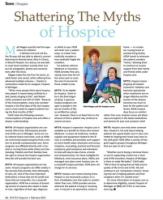
att Magee recently had the expe-
rience of a lifetime.
A diehard rock-and-roll fan,
the 56-year-old was able to attend a concert
featuring his favorite band, Alice in Chains,
in Mount Pleasant. As a bonus, he was able
to meet band members outside their tour
bus for autographs, photos and conversa-
tions after the show.
Magee made the trip from his home, an
adult foster care center, while suffering from
advanced multiple sclerosis — thanks to
connections made by his caregiver, Hospice
of Michigan.
"When most people think about hospice,
they expect it means being confined to a
bed, barely clinging to life," said Robert
Cahill, president and CEO of HOM. "Because
of this misconception, many only consider
hospice in the final days of life, but hospice
care is most suited to support patients dur-
ing the final months of life."
Cahill notes the following common
misconceptions of hospice care and offers a
deeper understanding:
MYTH: All hospice organizations are con-
nected. More than 100 hospices provide
end-of-life care in Michigan. Some are run
by national chains and some, such as HOM,
are community-based and grow from a mis-
sion to provide compassionate care. Some
programs are affiliated directly with a hos-
pital or nursing home while others are free-
standing. Patients and their families have
the right to choose the hospice organization
they feel will provide the best care.
MYTH: All hospice organizations are the
same. Hospice programs can differ widely in
the services they provide, their philosophy
of care, etc. One of the most important
distinctions is those that are for-profit and
those that are nonprofits. As a nonprofit
organization, HOM has a mission of provid-
ing service to anyone who needs or seeks
its care, regardless of their age, diagnosis
14
BOOM Magazine • February 2015
or ability to pay. HOM
will never turn a patient
away, no matter how
medically complex or
how medically fragile the
condition.
For patients without
Medicare or insurance,
HOM provides free care,
raising more than $4 mil-
lion every year to cover
the cost of services for
those unable to pay.
home — or a hospi-
tal, nursing home or
assisted living facility.
HOM travels to wherever
the patient considers
"home," allowing them
to continue to receive
support from their family
and friends while under
hospice care.
MYTH: Hospice means
forgoing all medical
treatment. Palliative care
MYTH: To be eligible
becomes appropriate
for hospice, I have to
when treatments are no
be in the final stages
longer effective and the
of dying. In general,
burden of the disease
hospice programs are
becomes too much to
open to people in the
bear for the patient and
Matt Magee and his hospice nurse
last six months of life,
family. While hospice
as certified by a physi-
does focus on comfort
cian. However, there is no fixed limit on the
rather than cure, hospice nurses and physi-
amount of time a patient may continue to
cians are experts in the latest medications
receive services.
and devices for pain and symptom relief.
MYTH: Hospice is expensive. Hospice care is
available as a benefit for those who receive
Medicare. It covers all medicines, medical
supplies and equipment related to the ill-
ness or condition and provides such support
as home health aides, physicians and nurses,
chaplains, counseling, practical and financial
assistance, grief assistance and volunteers
to help with day-to-day chores, errands
and companionship. For those ineligible for
Medicare, most insurance plans, HMOs and
managed care plans cover hospice care. As
a nonprofit hospice provider, HOM does not
charge for its services.
MYTH: Hospice care means leaving home.
Hospice is not necessarily a place; it's a
form of palliative care that seeks to comfort
rather than cure. HOM provides services
wherever the patient is living or receiving
care. It may be in an apartment, condo or
MYTH: Hospice care ends when someone
dies. Hospice is not only about helping
patients die a good death, but it's also com-
mitted to helping their loved ones learn to
live with grief. HOM offers a variety of free
grief support groups throughout Michigan
that are open to all in need.
"Whether you're facing a terminal illness
or you're supporting a loved one in their
end-of-life transition, Hospice of Michigan
is there to make life better," Cahill adds.
"We're fond of saying that we help ensure
quality of life at the end of life. We will
continue in our 'compassion mission,' know-
ing that we're helping patients and their
caregivers when it's needed most."
For more information on hospice care or
to determine eligibility, contact Hospice of
Michigan at (888) 247-5701 or visit www.
hom.org .
■