
Diane tevy-Wubinatein Advertisement
Therapist Helps People To
Empower Themselves
sychotherapist Diane Levy-Rubinstein
is a baby boomer, and she understands
what her generation is facing.
"We're also the Sandwich Generation, with
our own kids and older family members who
need us," she says. "Baby boomers also have
their own issues about aging that are very
different from our parents. Today, people are
more health-conscious and exercise. But you
just don't know — we live in a stressful world
with so much responsibility.
"Baby boomers want to help their children
and be there for their parents, but they are
stuck in the middle. I provide a lot of resources
through therapy to help them move through
the process. There's a lot of juggling and
people get stuck. Baby steps are how we move
through the process."
Levy-Rubinstein has plenty of experience
working with individuals, couples and groups
in her 38 years as a psychotherapist with her
L.M.S.W. For 30 years, she was an outpatient
psychotherapist in Macomb County. When
she retired in 2013, she opened a private
counseling practice called Innovative Thinking
in Farmington Hills.
She specializes in geriatric issues, bereave-
ment, women's issues, couples therapy, and
anxiety and depression. She believes in the
therapy process and knows she can help
people make positive changes that will last.
"Most people would not hesitate to contact
a lawyer or an accountant when they have
legal or financial difficulties," she says. "Why
delay improving critical areas of your personal
life?"
Levy-Rubinstein does a little bit of every-
thing in her practice, she says.
"I work with couples to help them learn
how to communicate in healthy relation-
ships and, if they are uncoupling, I help them
promote a healthy separation. I also work with
women's groups and divorce groups as well as
adolescents, adults and families. I help them
find their own path to move forward."
Although she employs many therapeutic
techniques, Levy-Rubinstein places the em-
phasis on validating and accepting uncomfort-
able feelings and thoughts rather than denying
them.
p
24
BOOM Magazine • February 2015
Diane Levy - Rubinstein
All forms of psychotherapy are helpful in
counseling those who are grieving, which has
become a passion for Levy-Rubinstein.
From 7-8:30 p.m. every other Thursday, she
volunteers by leading a drop-in bereavement
group that meets at Temple Israel, where she
is a member. The group is open, non-denom-
inational and free; it often ranges from 12-15
people of varying ages and stages of grief.
Levy-Rubinstein knows about grief from
personal experience. She lost her father when
she was a 19-year-old college student.
"I didn't know anything about grief," she
says. "I saw a college counselor who asked
me if I was angry at my father. I said I was not
angry at him, but at the cancer that took him.
The counselor was astounded. She'd never
heard that. I teach people to separate the
illness from person and to separate the guilt,
too. That really changed me."
At the bereavement group, she uses many
methods to help people truly grieve and reach
a "new normal."
"Many who experience loss try to keep as
busy as possible," Levy-Rubinstein says. "But
when you grieve, it is important to face the
sadness, and even anger, and not block it out."
She says she also shares tears — and joy —
with the group.
"When someone has a child that dies, it
affects all of us," she says. "I'm only human.
In order to understand emotions, you have
to understand what's going on — and loss is
very sad. Some group members are so raw
and wounded; you can feel the empathy in
the group. I share my stories from life to help
them process."
She recognizes that a person is progress-
ing through grief's stages when they can live
with the memories of their loved one yet not
experience sadness on a daily basis.
Another of her specialties that relates to
baby boomers is her focus on geriatric issues.
Levy-Rubinstein uses reminiscence therapy
to help people with Alzheimer's, dementia
and Parkinson's find meaning in life and work
through their anxiety about their disease.
"I grew up with an extended family at our
house so I know about working with older
people — I love them," she says. "I see older
people in their homes in Oakland, Macomb
and parts of Wayne counties. I do a lot of work
with families who don't know about the aging
process. They get angry at the person. I know
what that's like — you want that person to be
the person they once were.
"So I do a lot of educating about the aging
process. I also help coordinate services either
to keep a person at home or at a facility, such
as an assisted living facility with a special
Alzheimer's unit. I also work with the family so
they can understand their place in the process.
Sometimes they think they might get it, too,
and get angry or frightened.
"I tend to be very active with my patients;
I get involved," she says. "I also do some life
coaching, and people know they can call me at
different hours on my cell. I use a lot of posi-
tive reinforcement and validation."
Levy-Rubinstein says she gets much gratifi-
cation from watching people grow emotionally
and empower themselves.
"It fascinates me the way people cope," she
says. "I bring a lot of enthusiasm, humor and
passion to my work. It is my pleasure to work
with people and help them have meaningful
lives worth living."
■
Innovative Thinking
Diane Levy-Rubinstein, L.M.S.W.
31275 Northwestern Hwy. Suite 120
Farmington Hills, MI. 48334
(248) 932-7799 / (248) 285-1479 (cell)
Innovativethinkingl@comcast.net
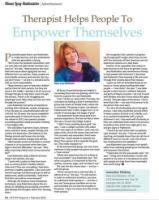
Scanned image of the page. Keyboard directions: use + to zoom in, - to zoom out, arrow keys to pan inside the viewer.
February 26, 2015 - Image 104
- Resource type:
- Text
- Publication:
- The Detroit Jewish News, 2015-02-26
Disclaimer: Computer generated plain text may have errors. Read more about this.