
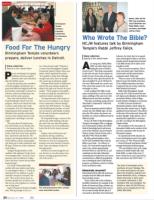

Sandy Lada, NCJW-
GDS vice president,
Joyce Sherman and
Birmingham
Temple
members
assemble
sandwiches
for Detroiters
in need.
Food For The Hungry
Birmingham Temple volunteers
prepare, deliver lunches in Detroit.
Diana Lieberman
Special to the Jewish News
p
overty and hunger are ongoing
problems. However, people's
attention often turns elsewhere
after the holiday season.
Yet for the past four years, members
of the Birmingham Temple have pre-
pared and delivered bagged lunches for
the homeless and hungry in January or
February, when the temperatures are
lowest and the need is greatest.
They work with Detroit's Central
United Methodist Church N.O.A.H.
program, which serves lunch four days
a week to some of the city's needi-
est residents. N.O.A.H. (Networking,
Organizing and Advocating for the
Homeless) also provides community
services, from medical advocacy and
employment counseling to arts and
crafts.
This year, about 50 temple mem-
bers and friends met on Sunday, Feb.
1, the snowiest day of the year. They
assembled 618 lunches, including sand-
wiches, fresh fruit, juice boxes, granola
bars, snack items and desserts. The
project is an intergenerational one, with
small children, parents and grandpar-
ents lining up to make sandwiches and
fill bags. At least two of the volunteers
used walkers.
"Imagine being homeless in this
weather," said volunteer Carolyn Lowe
of Farmington Hills. "I'm lucky I have
insurance and can afford my walker.
This is the least I can do for my fellow
human beings:'
Liza Wade of Bloomfield Hills
worked with sons Andrew and Sasha,
10, and daughter Chloe, 4. "I think it's
important for our children to under-
stand the concept of a mitzvah," she
said. "They need to know there are
homeless people here in Detroit, and
that we can come together as a commu-
nity to help them:'
Audrey Pleasant of Dearborn Heights
said, "Having enough to eat is, to
20
February 12 • 2015
JN
me, a basic human right:' Pleasant is
co-chair of the Birmingham Temple's
Community Impact/Tikkun Olam com-
mittee, which organized the project.
"It is painful to realize that, although
enough food exists, there are people
who cannot get an adequate supply."
Volunteer Mark Persitz of South Lyon
directed the proceedings, despite the
sling on his right arm courtesy of recent
surgery. "These people are incredible,"
he said, surveying the assembly line of
sandwich-makers and packers.
An important part of this project is
that we are not isolated; we are all part
of one community of human beings,"
said his wife, Beth Notarius. "So, along
with distributing the lunches, we hand
out our desserts, individually, on plates.
We all want to be loved, accepted and
seen as individuals:'
She frequently brings a camera to the
church and, while speaking with peo-
ple, asks if she may take their photos.
These portraits are not for publication,
but for the N.O.A.H. clients' personal
use.
Despite a foot of fresh snow and
treacherous driving conditions,
Notarius and Les Biederman of Oak
Park drove to N.O.A.H. headquarters,
located across from Detroit's Comerica
Park. There were plenty of takers for
the bag lunches.
And there was food enough for not
one, but two or even three days of sus-
tenance, lovingly prepared for those
who truly need it. ❑
The intergenerational effort yielded
more than 600 lunches.
Paula Wolfe, event
co-chairs, and Rabbi
Jeffrey Falick
Who Wrote The Bible?
NCJW features talk by Birmingham
Temple's Rabbi Jeffrey Falick.
Diana Lieberman
Special to the Jewish News
A
s a young man, Rabbi Jeffrey
Falick was taken aback upon
reading the story of Noah in
Genesis 6 and 7. Was Noah commanded
to take only one pair of each creature on
Earth? Or was it seven pairs of clean ani-
mals? Was the water upon the land for 40
days and nights? Or was it 150 days? In
one verse, Noah sends out a raven to see
if the waters had ceased; in the next, the
messenger is a dove.
A close reading of the Bible reveals
many contradictions as well as anachro-
nisms, retellings of the same story with
different heroes and other anomalies.
"Was there something wrong with me?
What didn't I understand?" Falick had
asked himself
These are questions asked by biblical
scholars since the Middle Ages. At least
since the 19th century, the answer was
the Bible was written at different times by
different people.
On Jan. 28, Falick of the Birmingham
Temple in Farmington Hills, a congrega-
tion of Humanistic Judaism, led off the
Nosh & Knowledge lunch-and-lecture
series of the National Council of Jewish
Women-Greater Detroit Section with a
talk titled "Who Wrote the Bible:'
He told a packed audience at the
NCJW-GDS Southfield offices that the
Bible is not a book— it's a library of
books. The Torah itself comprises four
major texts, written approximately
between 950 B.C.E. and 450 B.C.E. and
combined at a later date. Exhaustive
scholarship has revealed that each source
emanated from a different geographical
area or ideological school, with specific
purposes, vocabularies, rules for worship,
heroes and literary styles.
Historically Accurate?
Falick illustrated his talk with numerous
examples from the Bible and citations
from scholarly sources.
"None of them tell us that nothing in
the Bible is historical. For example, in the
Books of Samuel and Kings, scholars can
find archeological evidence that some of
the accounts actually did take place, if
not exactly as described. Even David and
Solomon, for whom there is no agreed-
upon archeological evidence, may have
actually existed, though their portrayals
in the Bible should not be taken as his-
torically accurate.
"This is not just my opinion. This is
what universities teach, what Reform,
Conservative and Reconstructionist
seminaries teach," Falick said.
"When it comes to this information,
believers leave their beliefs at the door.
To be credible researchers, they have
to approach this text as they would any
other historical document:'
Rabbi of the Birmingham Temple
since July 2013, Falick received his mas-
ter's degree and ordination at the Reform
movement's Hebrew Union College-
Jewish Institute of Religion in Cincinnati.
In 2009, he became involved in
Humanistic Judaism, which values the
Torah and other ancient texts as "highly
significant human literature" that reflects
on the time of its writers and, along with
modern thought, "helps fashion a set of
rational ethics applicable to contempo-
rary life," according to the Birmingham
Temple website.
He is president of the Association of
Humanistic Rabbis and a member of the
executive committee of the Society for
Humanistic Judaism.
An experienced Jewish educator, he
is now teaching the second of two eight-
part courses on "Who Wrote the Bible
— Sacred Chronicle and Historic Reality"
through Federation's FedEd program.
"We were thrilled to have such a large
audience for Rabbi Falick's talk," said
Paula Wolfe, co-chair of the event. "I
know I learned a lot, and I hope he'll be
able come back to the NCJW often:' ❑
The Nosh & Knowledge series
continues at noon Tuesday, Feb.
24, when participants will learn
about the Academy Awards from
Karen McDevitte, Ph.D., of Wayne
State University. A dairy lunch
is included. Admission is $10,
members; $15, non-members. For
details on other NCJW-GDS pro-
grams, go to ncjwgds.org or call
(248) 355-3300.