

arts & life
The Art Of Werner Pfeiffer
Daily life in
Nazi Germany
influences the
artist's work, shown
in a new exhibit.
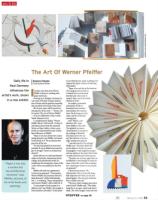
"Paper is not only
a surface but
has architectural
structure," says
Pfeiffer, pictured, of
his artist books and
paintings.
I
Suzanne Chessler
Contributing Writer
I
t makes sense that artist Werner
Pfeiffer is drawn to working with
paper and books.
Growing up in Stuttgart, Germany, he
was aware of the lack of paper, destruc-
tion of books and the general censorship
that prevailed at the hands of the Nazis.
His 50-year career will be traced in a
retrospective of his work — "Drawn, Cut
& Layered: The Art of Werner Pfeiffer"
— to be on exhibit Feb. 6-May 3 at the
Toledo Museum of Art.
A complementary display, "Werner
Pfeiffer Selects:' will run Feb. 13-May 10
and feature pieces from the museum's
Works on Paper Gallery. Artists, some
Jewish, are represented because of their
later influences on Pfeiffer.
"Paper, to me, has always been a fasci-
nating element," says Pfeiffer, now based
in Red Hook, N.Y. "It's an element that
goes into all the arts.
"I'm also fascinated by its structural
potential. It can be folded and creased to
give it strength. There's an architectural
element:'
Nearly 200 one-of-a-kind and limited-
edition artist books, dimensional prints,
collages and experimental works are
included in the retrospective. Some of the
works will be seen publicly for the first
time.
Pfeiffer will make two appearances
to discuss his approach. "Conversation:
Werner Pfeiffer and [museum-director]
Brian Kennedy" will be held Saturday,
Feb. 7. A workshop, "Paper Manipulation
with Werner Pfeiffer; will be held Feb. 8.
"I want people to look at paper in a
different way:' says Pfeiffer, who taught at
Pratt Institute in Brooklyn. At this point
in our development, paper is getting to be
replaced by digital versions of collecting
information.
"Paper is less and less at the forefront
of a young person's activity so
I wanted to put out the point
that there are other ways of
using it. Paper can be an artistic
element in itself'
As sculptor, printmaker
and painter, Pfeiffer is
fascinated with machines
and machine-like construc-
tions. His drawings are sche-
matic, and his books have
moving parts.
Liber Mobile, com-
pleted in 1967, repre-
sents Pfeiffer's early work.
The alphabet becomes a
visual element in reaction to
the writings of Marshall
McLuhan, known for say-
ing "the medium is the mes-
sage among other phrases.
"I was fascinated by his writings:'
Pfeiffer says. "McLuhan didn't fore-
see the Internet, but he was aware
that gadgetry would supplement paper
and our reading to the point where what
we look at becomes part of the process.
"The piece has six loose pages that can
be followed or interchanged to make pic-
tures. A lot of the works I do are interac-
tive. I encourage viewers to use a hands-
on approach:'
A more recent project, The
Ghostwriter's Hat, is a hat with many
little chips that have been cut out and
glued together. The only part of the hat
that is visible is the rim.
"The top is what I imagine goes into a
writer's head:' Pfeiffer says. "The whole
thing fits on an open, white book that is
blank. The word 'images' comes out over
PFEIFFER
on page 55
JN
February 5 • 2015
53