

business & professional
Fresh. Pure. Delicious.
A better peanut butter — and it's made in Detroit.
ler
.‘"
*t
Paul Zuckerman shaking hands with
Vice President Lyndon B. Johnson in
Stockholm, Sweden, September 1963
MEL
PERMIT
NMI
BUTTER
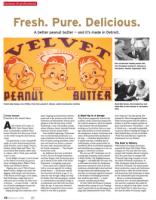
Velvet label design, circa 1940s, from the Leonard N. Simons Jewish Community Archives
David Ben-Gurion, Paul Zuckerman and
Golda Meir at the Knesset in Jerusalem,
1973.
Vivian Henoch
Special to the Jewish News
A
fter a hiatus of 25 years, in
2009, Velvet Peanut Butter
made a remarkable comeback when
former Detroiter Eric Bruce put it back
on the market using the same famous
recipe.
For generations, it was a household
staple, an iconic brand among Detroit-
made favorites, such as Faygo, Vernors,
Sanders, Better Made and Vlasic. The
story behind that familiar yellow label
is a classic, still as "fresh, pure and deli-
cious" as ever.
To the delight of many, it can be found
on the shelves of several area grocery
stores including Meijer, Hiller's, Plum
Market and Westborn Market.
Digging into a jar of Velvet Peanut
Butter can be a delight unto itself. But
digging a little deeper into the history
of the brand and the legacy of its maker,
Paul Zuckerman, might lead you to
reflection and to wonder. By what turns
of fortune — or leaps of faith — did the
son of Jewish immigrants become the
peanut butter king of Detroit?
Paging through old scrapbooks, news-
42
February 5 • 2015
paper clippings and hundreds of photos
preserved in the archives at the Jewish
Federation of Metropolitan Detroit gives
glimpses of the life and times of Paul
Zuckerman, a man of boundless energy
whose influence clearly extended beyond
America's taste for peanut butter.
From humble beginnings, Zuckerman
rose to international prominence as a
major fundraiser for Detroit and Israel, a
man of stature among presidents, states-
men and Israeli war heroes, a pioneer
for peace and a passionate advocate
for Jewish community — "One People"
around the world.
An Ashkenazi Jew born in Istanbul
in 1912, the son of Joseph Zuckerman
and Rose Popper, Paul Zuckerman grew
up in Detroit in the midst of the Great
Depression. A strapping young man
— street-smart and a capable student
with a voracious appetite for reading
Jewish history — Zuckerman entered
the University of Detroit at age 15. To
make his way through college and help
his family, Paul sold newspapers, worked
in a haberdashery and played bridge in
a professional card club with men three
times his age. At one point, financial
difficulties caused him to leave school
before he was able to graduate.
A Start-Up In A Garage
With all doors temporarily closed to the
academic world, Zuckerman jumped into
the world of commerce, where he claimed
to have learned "the real humanities:'
working as a truck driver, then as a man-
ager and purchaser in a food warehouse.
An entrepreneur at heart, Zuckerman took
notice of the peanut butter purchased at
the time — a brand he deemed inferior
in quality and taste. Confident that he
could produce a better peanut butter, he
invested $1,700 in second-hand equipment
and started his own company in a two-car
garage on 12th Street in Detroit.
The year was 1937. Zuckerman was 25,
a young man of promise, newly married
to Helen Fleisher. The fledgling business
struggled — and failed after two years. But,
as self-made men always do, Zuckerman
persevered, returned to work at the food
warehouse, attended night school and stud-
ied agriculture and manufacturing. One
year later, on borrowed capital, he returned
to the business of developing the brand
that would become Velvet — a richer,
creamier, smoother peanut butter.
In 1944, Velvet Nut Products Company
introduced the concept of a new "homoge-
nized" peanut butter in an advertising cam-
paign that trademarked the words "Fresh.
Pure. Delicious:' The idea spread. The
demand for Velvet Homogenized Peanut
Butter became greater than the ability to
produce it, and the company quickly out-
grew several factories. The product — now
a Detroit icon — was easily recognizable
on grocery shelves, boasting the images of
three freckled-faces of a boy on the label,
"Fresh Pure and Delicious:' inspired by
Zuckerman's own son, Norbert.
The Rest Is History
With business booming, Zuckerman
acquired the Krun-Chee Potato Chips
Company in 1952 and, after five years,
merged with Sunshine Biscuit Company.
Just a few years later, he merged with
O'Donnell Importing Company to form
the Velvet-O'Donnell Corporation. In
1984, Zuckerman made the decision to
sell Velvet-O'Donnell. The famed peanut
butter production ceased, and Zuckerman
passed away in 1986. But Jewish Detroit
will always have Paul Zuckerman to thank
for his indomitable spirit and generosity.
Always a creative businessman,
Zuckerman was a devoted philanthropist
who used the companies that made his
fortune as vehicles to help others. At the
end of World War II, when there was a
fear that the defeat of Germany might