

health & wellness
Artificial Vision
meeting in Detroit brings experts together to share.
International
I
Ruthan
Brodsky
Xjllent
Writer
Contributing
patients, which includes surgically implant
ing the chip onto the retina:' Zacks said.
GluSense
than 30 experts on artificial
gathered in Detroit last
More
best
vision
taining
Eye and the
Chip:'
They were there to report to their peers
I.nnl'
from many eye conditions, diseases and
According to the National Federation
of the Blind, 50,000 people in the United
States go blind annually.
"This is thefirst generation of the device,
which is constantly being tweaked by
by the Detroit Institute
researchers:' Zacks said.
of Ophthalmology,
Nano Retina's
implant is powered by
day congress focused on identifying the
progress made that will ultimately enable
devices
to
be
Raanan Gefen,
"This semi-annual
retina
patients will benefit from
.
prosthetic
devices
Dr. David
neuro-
Goldman
and where the interface
will be best
targeted
for
different patients, the eye or the brain:'
says Dr. David J. Goldman, DIO associate
medical director. "The
discussions also
presentations
and
explored the complexities
of implanting these devices while also gen
erating an appreciation for the Food and
Drug Association's (FDA)
role in requiring
safe and effective medical devices:'
The event included
presentations
fol
managing
commonly identi
fied
as the bionic eye.
"In the past, there
was no treatment for
amalgama
tion of global ideas and
thought processes geared
toward identifying which
eye-safe
progress the company is
making on the artificial
blind.
was an
an
director, described the
placed in the eye or the brain
of those who are severely
event
Ra'anan Gefen
those blinded
by retinal
degeneration diseases
using seeing eye dogs and white
canes:' Gefen said. "Today, the first artifi
cial retina prosthesis, Argus II, is available
other than
in the U.S. and
retinitis
Europe for
treatment
of
pigmentosa patients.
the Bio- Retina,
"Our retina
prosthesis,
designed to transform sight restora
tion for the blind. It can be implanted in 30
minutes in a minimally invasive procedure
similar to cataract treatment, as opposed to
the four-hour general surgery requiring full
is also
anesthesia for the
Argus
II. Moreover, the
lowed by discussion, debate and rebuttal.
"Presenters were aware they couldn't
Nano Retina bionic eye delivers 576 pixels,
10 times more than the Argus II, which
attend this event with weak concept proof:'
Goldman says. "This resulted in an atmo
restores vision to the functional level for
sphere
of collegiality that fostered collabo
the
based
process of turning the concept of artificial
vision Into reality. Many presenters, for
invented
example,
already partnered
with other
presenters for further research and busi
ness opportunities from this event:'
Israeli Bionic Eye
Creating an artificial retina prosthesis is
goal of Nano Retina Inc., an Israeli
company located in Herzliya Pituach.
the
74 January
29
•
2015
neur,
Aviv
on
is the
premier meeting in the world for
this small niche in oph
thalmology:' says Dr.
Michael Ober,
on
at Beaumont and
staff
Henry
Ford Health systems.
"It brings together
experts using different
techniques from all over
Dr. Michael
the world into
ball movement.
Ober
dedicated to
Argus II
Also attending the conference was Dr.
Robert Greenberg, CEO and president of
Second Sight Corporation in California,
the company that designed and developed
the Argus II Retinal Prosthesis System.
The Argus II enables some patients, blind
on the
eye focused on
the cornea, and the results were contact
lenses and corneal transplants. Research on
one room
tackling a
problem:'
from diseases such
as
retinitis
pigmentosa,
visual tasks such
as
perform
identifying
sidewalks.
and
following
doorways
"The Kellogg Eye Center, University of
Michigan, Ann Arbor,
to
was aware
on
of the research
Argus II
and
stayed in
touch with the company
for over more than 15
established in 2009,
several of the medical devices
by Israeli Yossi Gross, entrepre
inventor and engineer. Today, Tel
University,
"The
"The current generation, which has already
begun production, is planned for human
clinical trials in two years and hopeful FDA
approval:'
With Bio-Retina, a rechargeable, battery
powered mini laser, situated on a pair of
eyeglasses, efficiently powers the implant
wirelessly. Bio- Retina is designed to work
harmoniously with the natural functions of
the eye, including pupil dilation and eye
was
Massachusetts General
Hospital in Boston and Mount Sinai
Hospital in New York, together with indus
trial corporations, are working with Nano
Retina to help fabricate the product.
"The first generation of our implant,
designed to verify the concept, was suc
cessfully tested on animals:' Gefen said.
Experts Collaborate
Eye and the Chip world congress
laser in the glasses.
patient:'
Nano Retina
ration and tended to accelerate the whole
have
small computer worn
glasses that transmits the signals wire
lessly to the implant. The implant sends
electrical impulses to the brain, causing
the patient to perceive patterns of light.
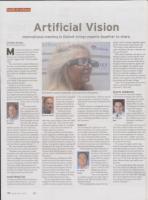
The device looks like sunglasses with a
wire at the side. Once the device is in place,
patients can't recognize a face, but they can
see contrast and the edge of shape.
injuries.
Department of
(DIO),
Henry Ford Health
Ophthalmology
Pointe
in
Grosse
Park, the three
System
camera, a
the
artificial vision
Hosted
Argus II, patients wear glasses con
a
on a
the most recent advances in nanoelectron
neurobiology relative to providing
to people who are blind
the device:'
belt that processes the signals from
the camera and an antenna on the side of
research congress titled "The
ics and
use
With
fall from the United States,
Asia, Australia and Israel for a
Europe,
"The surgery is then followed by much
rehab and physical therapy so patients can
complicated because the
retina is more complicated. For instance,
the retina is
there
are
more
morethan 1 million
axons
that
lead from the eye to the brain that need to
be connected for vision.
The retina is the
light -sensitive layer
of tissue at the back of the inner eye that
works like the film in a camera. Images
come
through the eyes lens and focus on
the retina, which converts these images
to electric signals and sends them via the
optic nerve
to the brain. The retina also has
many different
layers, each with its own
years until the device
received FDA approval:'
functions.
said Dr. David N. Zacks,
else in the world and, although it doesn't
receive a lot of press, it is a big deal in the
Kellogg associate pro
fessor, ophthalmology.
Zacks
"Once it was approved,
we rushed to acquire one of the Argus II
devices to use with our severely vision
impaired patients.
"We've implanted the Argus II in four
Dr. David
Previous research
"No
meeting like this is held anywhere
ophthalmic world and for people who have
profound vision loss:' Ober said. "Although
they can't be helped at this time, there
is much hope that some vision will be
restored eventually:' D
.