

metro >> on the cover
Inclusive Community
Bet Chaverim in Canton marks 20 years as a committed Jewish outpost.
Stacy Gittleman I Contributing Writer
CONTINUED FROM PAGE 1
being outwardly Jewish can be seen as a tes-
tament to the dedication of the clergy, educa-
tors and families of Reform Congregation
Bet Chaverim, who believe there is a space
for Jewish life in every corner of Michigan.
These skaters were raised in a Jewish
setting that practices "trickle-up" Jewish
education from the child to the parent, from
the classroom back to the home. It encour-
ages members to be involved in their child's
Jewish education through hands-on projects
and experiences, said its longtime leader
Rabbi Peter Gluck. It continues to be a sup-
portive atmosphere of communal Passover
seders, Chanukah parties and warm, inclu-
sive Shabbat services.
"For the average American Jew, it is a big
act of courage to stand up and say or do
something Jewish:' Gluck said. "What those
skaters did on the ice is the product of expe-
riential Judaism and, in my mind, the best
way to assure Jewish continuity:'
Gluck said that for Jewish continuity to
be successful, Jewish educators must bring
learning out of the textbooks and focus on
creating community between family, com-
munity and peers.
"There is no standardized Jewish achieve-
ment test," he said. "Judaism is all about
coming together as a community:' After all,
he added, the original model of a synagogue
was to be one of a belt midrash, a place of
gathering.
For 20 years, the temple has been Canton's
center for Jewish life and outreach. Since
1995, it has shared the building of the Cherry
Hill United Methodist Church in Canton,
where it holds its monthly Shabbat services
and weekly religious school as well as other
programs. The relationship is highly respect-
ful, Gluck said.
Now, the small congregation of about 40
families seeks to grow its congregation to
reach out to those in newer neighborhoods
who seek connections to Judaism even if
they have been disenchanted with larger
synagogues or have let their religious affilia-
tions lapse for many years.
The key to its growth, say temple clergy
and educators, is a welcoming attitude that
meets Jews — and their interfaith partners
— wherever they might be on their Jewish
journey.
Compared to the Jewish neighborhoods
in West Bloomfield, Farmington Hills and
Oak Park, Canton may not be thought of
as a Jewish population center in Southeast
Michigan. And there are no statistics that
8 January 22 • 2015
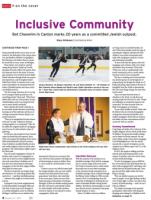
Sarah Liberatore, 13, Reagan Liberatore, 16, and Tamar Nemeth, 17, — all members of
Bet Chaverim where Reagan and Sarah's mom, Robin Liberatore, serves as the can-
tor — show their Jewish pride by performing to Chanukah music at Canton's famed
Arctic Edge arena.
Rabbi Peter Gluck congratulates Zack Honiss on his Torah reading at his bar mitz-
vah last year.
demonstrate that Jews are moving to this
area. However, Gluck points to the high rate
of intermarriage as reason to believe there
is a new model of a Jewish family to reach
out to.
"Canton is not so very off the beaten path
for younger families, who are more mobile,
transient and intermarried then in past
generations:' said Gluck, who noted that
in the recent past, Canton was one of the
fastest-growing communities in Southeast
Michigan. If there are families seeking Jewish
life, they will want it conveniently located.
So, when families with Jewish members
moved to Canton, it was natural to create a
congregation, Gluck said.
Interfaith Outreach
With the majority of its members in an
interfaith marriage, Gluck said his congrega-
tion is a mirror image of the most recent
Pew Study of American Jewry, which stated
that nearly one in every three marriages
in the American Jewish community is an
interfaith marriage. Gluck, ordained through
the Hebrew Union College in 1982, recently
earned a Ph.D. in anthropology from the
University of Michigan by studying the nar-
rative of interfaith families rearing Jewish
children. He believes intermarriage is a social
issue that the Jewish community must grasp
instead of ignore or reject.
About 1.5 million American children
are being raised in interfaith families, he
said. When these families reach the stage of
searching for religious education for their
children, every point of association they
make with synagogues needs be as warm
and welcoming as possible.
"It starts from that first phone call to the
synagogue and continues with every clergy
and teacher they encounter; Gluck said.
"When you work as a professional in the
Jewish community, you're a social worker.
You have to know your community:'
The key to reaching out to Jews and their
non-Jewish spouses is not through lots of
programming, but though the simple act of
being welcoming. Gluck points to lessons of
hospitality from the Torah to demonstrate
that "the more things change, the more they
say the same'
"Just as we learn from the story of
Abraham in the Torah, it is all about wel-
coming people into the tent:' he said. "People
are looking for an emotional response and
connection. We miss the point when we
think of synagogues as a business.
"In my mind, smaller is better; Gluck said.
He believes this new Jewish demographic
coming from intermarried families need
smaller synagogues where kids can interact
and adults can have conversations and feel
connected with one another.
Growing Commitment
Craig Organ of Garden City is director of the
temple's religious school, which enrolls about
30 children. He agrees that smaller settings
can be better for Jewish outreach. He was
raised within a large Conservative synagogue
in the Philadelphia area. Now he and his
second wife, a convert to Judaism, are edu-
cating his two children, ages 9 and 12, in the
religious school.
In 2015, the temple is adding post-b'nai
mitzvah and adult learning classes at the
request of members who now wish to deep-
en their Jewish knowledge.
At a lot of synagogues, once a child hits
bar or bat mitzvah, that child thinks they are
done [with synagogue life]," said Organ, who
admits that was his path decades ago. Time
goes by and they might realize that some-
thing is missing.
"Now our family increases our involve-
ment at temple. As we light Shabbat candles
every Friday night, I realize I am still on that
journey of Jewish learning — and I am on it
with my children:'
The temple encourages active parental
participation, which starts with doing the
shopping and cooking for a Shabbat or holi-
Inclusive on page 10