

world
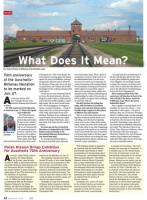
The main entrance to Birkenau extermination camp
70th anniversary
of the Auschwitz-
Birkenau liberation
to be marked on
Jan. 27.
A
n interview with Dr. Piotr
M.A. Cywinski, director of the
Auschwitz-Birkenau State Museum
in Poland.
The 70th anniversary of the liberation
of Auschwitz is Jan. 27. What is the signifi-
cance of this day?
The 70th anniversary
will not be the same as
previous big anniversaries.
We have to say it clearly: It
is the last big anniversary
that we can commemorate
with numerous groups of
survivors. Until now, it has
Dr. Piotr M.A.
been
them who taught us
Cywinski
how to look at the tragedy
of the victims of the Third
Reich and the total destruction of the world
of European Jews. Their voices became the
most important warning against the human
capacity for extreme humiliation, contempt
and genocide. However, soon it will not be
the witnesses of those years, but us, the post-
war generations, who will pass this horrible
knowledge and the crushing conclusions that
result from it.
On this day, we must understand that the
survivors, the former prisoners, did every-
thing they could to make us realize that the
road to the most terrible tragedies is surpris-
ingly simple. All you need is social frustra-
tion, a bit of demagoguery, an imaginary
enemy, a moment of madness ... It may be
clearly observed in at least several regions
of the world, which makes it even more
alarming. The future of our civilization is in
our own hands, and we must take respon-
sibility for the shape of that future. And a
wise vision of the future must be rooted in
memory.
Ten years ago, the day of Auschwitz
liberation was designated by the United
Nations General Assembly as the
International Holocaust Remembrance
Day. Doesn't that help?
It is an important political signal, as
the General Assembly unites representa-
Polish Mission Brings Exhibition
For Auschwitz 70th Anniversary
A
merica's oldest Polish cultural
mission, the Polish Mission
of the Orchard Lake Schools
founded in 1885, is partnering with the
Auschwitz-Birkenau State Museum and
the Permanent Mission of Poland to
the United Nations to begin nationwide
observance of the 70th anniversary of
the liberation of Auschwitz.
To commemorate the anniversary
(Jan. 27,1945), the Polish Mission,
in cooperation with the Permanent
Mission of Poland to the United
Nations, will take the Forbidden Art
exhibition to the United Nations in New
York to commence worldwide commem-
22
January 22 • 2015
orations of the liberation on Jan. 21.
The exhibition presents the story
behind 20 works of arts made illegally
and at great risk by prisoners of the
German Nazi concentration camp.
Each of the photographs is accom-
panied by historical commentary and
excerpts from archival accounts. The
artwork shows the reality of life in the
camp and types of artistic escape cre-
ated by the camp prisoners.
Forbidden Art was first presented
at Wayne State University in Detroit,
with help from the Holocaust Memorial
Center Zekelman Family Campus in
Farmington Hills.
tives of all member states. When I speak of
remembrance, however, what I mean is not
its institutionalized form. It is also neces-
sary, but not as much as it is important, for
a sense of awareness of the meaning behind
the extermination of European Jews and the
whole tragedy of concentration camps to
take root in our whole culture, politics and
education system. Without internalizing and
understanding the reality of this atrocity, we
will be unable to recognize today's challenges
for what they really are.
But don't you have the feeling that
today, while the history of Auschwitz
becomes more and more distant, similar
horrible images reappear in other places,
in different ways and contexts?
They do. And it clearly shows that teach-
ing about Auschwitz and the Shoah is not
just telling a story that had its beginning
and its end. It is also a lesson about human
nature, society, the power of the media, poli-
tics. If today, when we see what is happening
in some parts of the world, we are reminded
of the Second World War, even of Auschwitz,
it is because deep inside we feel that, regard-
less of various factors, we are facing the same
pathological passions: hatred, contempt, anti-
Semitism, racism, nationalism ...
"The Holocaust center is pleased to
be a partner with the Polish Mission
and Orchard Lake Schools in foster-
ing awareness of and education about
the Holocaust," said Stephen Goldman,
HMC executive director. "The Polish
Mission's director, Marcin Chumeicki,
has a unique relationship with not
only the Polish government, but also
the Holocaust memorials throughout
Poland, which places us in an excel-
lent position to build cooperative pro-
gramming with these places that are
so important to the success of
the our museum.
"Forbidden Art, which will open
at the United Nations and continue
touring around the nation, is an
example of what can be accom-
plished with such a partnership."
I sincerely hope that commemoration of
this day will take place all over the world,
in every place inhabited by people aware
of our obligation. We encourage everyone
to express this memory everywhere in the
world. I have to admit that what alarms me
most is the still-present overwhelming pas-
sivity in the face of organized evil.
Main commemoration of the 70th
anniversary will take place in front of the
Gate of Death of the former Auschwitz
II-Birkenau camp. What is the reason
behind this choice?
Man is capable of crossing almost every
boundary. For those who crossed — most
frequently in cattle wagons — the gate of
Birkenau, there was no way back. Nowadays,
almost 1.5 million people cross the same gate
every year in an attempt to face the meaning
of Auschwitz. The visit starts in the former
Auschwitz I Stammlager camp, where all
the educational and exhibition-related aids
are located. They introduce visitors to the
history Then, visitors go to Birkenau, where
the immensity of the post-camp space,
kilometers of barbed wire, rows of barracks,
remains of gas chambers and crematoria
make them fully realize the size of that trag-
edy and its undeniable realness.
According to Chumiecki, "We have
brought the message of Auschwitz, in
a tangible way, to the United States.
We invite all Americans to join the
international community as we remem-
ber the Holocaust in January – and
always. Silence can be violent, and we
must be united in protecting the future."
Auschwitz-Birkenau State Museum
Director Dr. Piotr Cywinski said, "It
is urgently critical that we preserve
Auschwitz, the most authentic sym-
bol of the Holocaust. The United
Nations will be a most meaningful
venue for Forbidden Art in the United
States, but it will be most especially
important to the global community
of survivors, many of whom will par-
ticipate personally in this remarkable
anniversary."
❑