
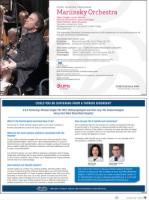

FORD HONORS PROGRAM
Mariinsky Orchestra
Valery Gergiev, music director
Behzod Abduraimov, piano (Saturday)
Danis Matsuev, piano (Sunday)
Saturday, January 24, 8 pm
Sunday January 25, 3 pm [NOTE START TIME]
Hill Auditorium
The legendary Mariinsky Orchestra returns to Hill Auditorium for two performances of
Russian orchestral masterpieces.
PROGRAM (SATURDAY 1/24)
Prokofiev
Piano Concerto No. 3 in C Major, Op. 26
Shostakovich Symphony No. 4 in c minor, Op. 43
PROGRAM (SUNDAY 1/25 - FORD HONORS PROGRAM CONCERT)
Shchedrin
Tchaikovsky
Mussorgsky
Concerto for Orchestra No. 1
Piano Concerto No. 1 in b-flat minor, Op. 23
Pictures at an Exhibition (arr. Ravel)
The Ford Honors Program recognizes the longtime and generous support of UMS's
Education & Community Engagement program by Ford Motor Company Fund.
41200
SPONSORED BY
Miller, Canfield, Paddock, and Stone, P.L.C.
CONCERTMASTER SPONSORS
Bank of Ann Arbor and University of Michigan Health System
•
ENDOWED SUPPORT FROM THE
William R. Kinney Endowment Fund and the Catherine S. Arcure Endowment Fund
MEDIA PARTNERS
WGTE 91.3 FM and WRC) 90.9 FM
TICKETS ON SALE NOW
734.764.2538 I ums.org
'M UMS
BE PRESENT
1935990
COULD YOU BE SUFFERING FROM A THYROID DISORDER?
Q & A Featuring: Michael Singer MD, FAGS, Otolaryngologist and Shin Levy MD, Endocrinologist,
Henry Ford West Bloomfield Hospital
What is the thyroid gland and what does it do?
How can you tell if nodules are cancerous?
The thyroid is a small, butterfly-shaped organ in your neck. It produces a
hormone (thyroid) that controls the body's overall metabolism.
After a physician discovers the presence of a nodule, an ultrasound will often
be used to study it. If necessary, an ultrasound-guided needle biopsy can be
performed to discover if the nodule is cancerous. In certain situations the biopsy
results are not conclusive. There are now specialized molecular tests that can be
used to confirm the diagnosis of cancer.
What are the most common problems associated with the
thyroid?
Twenty million Americans struggle with some type of thyroid disorder. These
include hyperthyroidism, which occurs when the gland produces an excess of
thyroid hormone, and hypothyroidism, when not enough is produced. Symptoms
such as sudden weight loss, jitteriness, feeling hot, and heart palpitations can all
be signs of hyperthyroidism.
Fortunately, while thyroid cancer is quite common, it is very treatable and in
most patients is completely curable.
Low thyroid hormone can cause different symptoms, including a lack of energy,
weight gain and feeling cold. In some patients, hypothyroidism can be attributed
to more serious conditions. Most of these can be diagnosed and treated medically
with the help of an endocrinologist.
Shiri Levy, MD
Endocrinologist
How common are thyroid nodules?
Thyroid nodules are another very common problem. Thyroid nodules, which
are areas of abnormal growth within the thyroid gland, are often found during
routine tests (ultrasound or CT scan) or during a physical exam. They occur more
frequently in women than men. Up to fifty percent of women may have them.
These nodules often are benign, but in five percent of cases they are cancerous.
If the nodule is large and causing symptoms (such as difficulty swallowing or a
choking sensation) or if it is cancerous, treatment is usually recommended.
Michael Singer, MD, FACS
Otolaryngologist
Join us for a free seminar to discuss treatment options for thyroi
problems on February 18, 2015 at 6:00pm at Henry Ford West Bloomfield
Hospital. To RSVP for this event or to make an appointment, contact us
at 1-800-HenryFord, by email at thyroidsurgery@hfhs.org , or on the web
at www.henryford.com/requestanappointment-thyroidsurgery.
HENRY FORD WEST BLOOMFIELD HOSPITAL
1967200
JN
January 22 • 2015
19