
metro >> Jews in the digital age
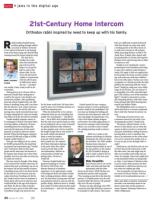
21st-Century Home Intercom
Orthodox rabbi inspired by need to keep up with his family.
R
abbi Jonathan Frankel had no
problem getting through rabbini-
cal school at Yeshiva University
or law school at Harvard. It was keeping
track of his three young sons that had him
running around his house losing his mind.
The tech-savvy
Frankel, 30, would
often find himself yell-
ing at the top of his
lungs to try to get his
kids to come to the
dinner table. On the
way to his job, he'd be
I unable to communicate
with his wife because
Rabbi Jonathan
he didn't know where
Frankel
she was — and there
was usually a baby crying to add to the
commotion.
Having grown up in a house with an
intercom, Frankel had a feeling that it
would be the answer to his family's com-
munication problem. After graduating
from law school, Frankel took a job with
Boston Consulting Group and it was there
that the idea for a 21st-century intercom
first came to him. He and his wife were
moving into a newly renovated home and
he began taking bids for intercom installa-
tion before all of the drywall was installed.
Frankel studied computer science as
an undergrad at Yeshiva University before
receiving rabbinic ordination. He knew
something about the technology that
went into the intercoms, but he wasn't
prepared to install an intercom system
himself. When the bids began coming in
for around $3,500 and as high as $5,000,
Frankel couldn't believe it.
"One guy was willing to do me a favor
for $2,000 and install the old model that
my parents had a generation ago:' Frankel
said. "Contractors told me that many
people ask for intercoms, but because of
the expense they decide not to have them
installed. And once the walls are closed up,
it's really not worth it"
This was crazy, he thought. After doing
a lot of research for wireless intercoms, he
realized that such a technology was not on
the market. He had just started at Boston
Consulting Group, and it was there that he
let the idea for a new intercom unit per-
colate in his head. Traveling a lot for his
job, Frankel used his time on airplanes to
dream about what such an intercom unit
would look like in the age of the Internet
and iPads. He did six weeks of market
research to get a sense of what other types
of problems a high-tech intercom unit
20 January 8 • 2015
JIB
for the home would solve. He knew there
must be some sort of wireless solution at a
much less expensive price.
When he realized that a 21st-century
residential intercom was something that
people were searching for — just like he
was — but it didn't exist, Frankel decided
that the only way to get his hands on what
he was looking for was to create it himself.
He quickly launched a fake website to
see how popular such a device would be.
He bought Google Ads to steer people to
his mock website and allowed
them to order his wireless
intercom (which hadn't even
been created yet). He captured
all of their information right up
to the point when they would
need to provide their credit
card information. Without an
actual product, Frankel was
getting orders. He knew it
would sell.
However, Frankel hadn't pro-
grammed anything in 10 years.
He had no VoIP (Voice over
Internet Protocol) or hardware
experience. So, he approached a couple
of development firms and within months
had a working prototype, albeit a rough
one. He then found a young man who had
just graduated school to come up with the
product design. Before he knew it, Frankel
had created a wireless intercom that would
be revolutionary — and solve the problem
he had.
Frankel named his new company
Nucleus and got to work on getting his
product ready for the marketplace. His
next step was finding the funding and
someone who had experience with soft-
ware and design. He tapped Isaac Levy,
a New York-based software designer
and inventor who holds eight patents, to
become the company's chief technology
officer. Levy was able to have a beauti-
ful, working prototype ready in about a
month.
While Levy works on the
software technology for Nucleus,
Frankel gets the word out about
his invention. The WiFi-enabled
Nucleus home intercom is
already being heralded as one of
the top products on the market
for 2015 (Frankel is hoping it
will be ready to ship by the sec-
ond quarter of the new year).
Wide Versatility
Each Nucleus device can record
video and audio and share the
information with the other
devices in the home. While Nucleus was
intended for parents with young kids
("less running up and down the stairs for
parents:' as Frankel points out), the wall-
mounted tablet-like devices will undoubt-
edly serve all sorts of people.
Nucleus can take advantage of its WiFi
connection and high-definition cameras to
be extended to other homes. That means
kids can collaborate on their homework
with their friends via video chat, while
a working parent at the office checks in
to make sure everyone is safe at home.
While promoting Nucleus on NBC's The
Today Show, Frankel video chatted with
his grandmother in Toronto showing how
Nucleus can be used to keep tabs on elder-
ly relatives as well.
Frankel is now traveling the country
promoting his novel invention and trying
to raise more capital to make Nucleus a
reality. He's eager to find new applications
for his product for home security monitor-
ing, real estate tours and team collabora-
tion in the office place. Nucleus uses voice
recognition so it already provides the ideal
platform for interacting with the "smart
home:' Simply by using your voice within
range of any Nucleus, you can instruct it
to manipulate your other networked gad-
gets ("OK, Nucleus, turn off the basement
lights"). Frankel is interested in eventu-
ally integrating Nucleus with other smart
home products like NEST (learning ther-
mostat) and Belkin's WeMo.
The Philadelphia native is cautious to
add to that there is a security component
that is built into Nucleus for privacy rea-
sons.
"Protecting everyone's privacy was
a foremost concern for me when I was
developing the product:' Frankel said.
"We placed a physical shutter on the
devices so that anyone can see when the
camera is able to record or is turned off.
This gives individuals a feeling of privacy,
knowing that no one is watching. Also
there is an indication on the screen when-
ever you're connected to another unit so
no one can spy on you through video or
audio:'
Furthermore, any Nucleus unit can con-
trol how discreet the interaction is with
the other units. One unit might only be
able to use another unit's audio, but not
video, for example. Some units might have
to ask permission before accessing audio
or video. A nice feature of Nucleus is that
it can be used as baby monitor, but then
transitioned to a full-home intercom sys-
tem when the children get older.
You can preorder as many devices as
you want at $150 per Nucleus. Visit the
website at www.nucleusintercom.com.
❑
Rabbi Jason Miller, an educator, entrepreneur
and writer, is the technology expert for the
Detroit Jewish News and the president of
Access Computer Technology. Follow him on
Twitter: @RabbiJason.
Scanned image of the page. Keyboard directions: use + to zoom in, - to zoom out, arrow keys to pan inside the viewer.
January 08, 2015 - Image 20
- Resource type:
- Text
- Publication:
- The Detroit Jewish News, 2015-01-08
Disclaimer: Computer generated plain text may have errors. Read more about this.