

arts & entertainment
One Man, Two Identities
Film tells the dramatic story of the French
archbishop who became the "Jewish Cardinal."
I
Naomi Pfefferman
Jewish Journal of Greater L.A.
I
n 1981, when Pope John Paul
II named Jean-Marie Lustiger
Archbishop of Paris, Lustiger felt
conflicted, even burdened: "For me, this
nomination was as if, all of a sudden,
the crucifix began to wear a yellow star:'
Lustiger told a reporter at the time.
Ilan Duran Cohen's riveting French-
language film, The Jewish Cardinal,
explores the reasons behind this startling
statement, spotlighting Lustiger's intense
struggle with his complex dual identities
as a Catholic and a Jew. The 2014 drama
is now available on DVD.
The movie tells of how the priest —
born Aaron Lustiger to Polish-Jewish
immigrants in France in 1926 — survives
the Holocaust in hiding with a Christian
woman and fervently converts to
Catholicism at age 14, even as his mother
dies in Auschwitz.
Lustiger's father, who survives the
war, staunchly opposes his son's conver-
sion. Nevertheless, Lustiger goes on to be
ordained a priest in 1954, rising swiftly
through the ranks of the Roman-Catholic
Church, to be named a cardinal in 1983.
He also becomes a close confidante of John
Paul II (who was canonized on April 27).
"You're a shameful Jew," Lustiger's
father tells him in one scene in which the
two men almost come to blows.
Lustiger (played by Laurent Lucas) is
clearly anguished by his father's rejection,
as well as by that of Jewish and Catholic
observers infuriated by his declaration
that he is both Christian and Jewish.
In one scene, several priests accost
Lustiger, shouting, "Don't Jew up the
gospel:' and, "Get your people to accept
responsibility for killing our Lord!'
But the cardinal — nicknamed
"Monsieur Bulldozer" for his stubborn,
sometimes mercurial temperament —
ultimately comes to terms with his dual
identities, in part, by helping to build
bridges between Christians and Jews, by
arranging for Pope John Paul II to visit
Israel and by convincing the pontiff to
remove the Carmelite nuns who had set
up a convent inside Auschwitz in the
1980s.
In 2007, as he is dying of bone and lung
cancer, the cardinal requests that a cousin
recite the Kaddish prayer for him at his
funeral, in front of Notre Dame Cathedral.
The film unabashedly explores all of
Lustiger's contradictions — even though
Duran Cohen said he was initially reluc-
tant when his co-screenwriter, Chantal
Derudder, approached him with the idea
for the biopic five years ago.
"I cannot say that I liked the character
from the start:' the 51-year-old French
Jewish writer-director said in an interview
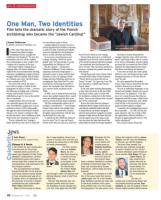
Laurent Lucas in The Jewish Cardinal,
now available:on DVD
from Tel Aviv, where he was visiting.
Duran Cohen grew up in a traditional
Sephardic home in Paris, where members
of his Jewish community felt that Lustiger
"was somebody who had betrayed the
Jews:' he said. "His conversion and that he
became a cardinal was painted somehow
with shame
During those early years, Duran Cohen
encountered his share of anti-Semitism:
"There's still a case about the Jews in
France he said. "As I grew up, I was 'the
Jew: basically; I couldn't hide behind a
French name
It was only while studying filmmaking
at New York University in the late 1980s
that Duran Cohen came to terms with
his Jewishness, noting that in the United
States, "Jews are not outcasts but a normal
part of the community"
And so, the writer-director remained
ambivalent about Lustiger until he discov-
ered that the cardinal's mother had died
at Auschwitz; he was further intrigued
when he learned about Lustiger's successful
attempts to help remove the nuns who had
erected a giant cross at the camp, on the
very site where the Nazis had stored their
lethal Zyklon B poison for the gas chambers.
"And then I became fascinated by
Lustiger's identity crisis, which tore him
apart:' said Duran Cohen, who is a novel-
ist as well as a filmmaker. (Duran Cohen's
previous film Les amants du Flore (2006)
explored the relationship between Jean-
Paul Sartre and Simone de Beauvoir.)
"I was born in Israel, but I don't speak
Hebrew; I am a Jew living in France with
immigrant parents, so I'm also kind of
torn:' he said.
Yet, as he approached the project,
Duran Cohen said, he feared that the film
would be denounced on all sides.
"It's not an authorized biography, so the
Church and Lustiger's family were scared
of the movie he explained. "I was also
very, very scared, because this film was
dangerous and full of traps. I didn't know
anything about Catholicism, and I didn't
want the film to be perceived as propa-
ganda somehow against Lustiger.
"I wanted to be nonjudgmental, and as
fair as possible. ... So I felt a bit like the
main character, who was trying to find
the right balance between identities —
because in approaching the movie, I felt
totally unbalanced."
Thus, Duran Cohen, along with
Jews
I
„Da Nate Bloom
Special to the Jewish News
111. Chinese & A Movie
•
A list of films for your viewing plea-
sure that open on X-mas Day:
Imitation Game covers the tri-
umphs and tragedies of Alan Turing
(Benedict Cumberbatch), a British
mathematical genius who leads a
diverse team that cracked the secret
communication code produced by the
Nazi Engima machine.
This accomplishment probably
brought World War II to an end two
years early, thereby saving millions
of lives, including what was left of
European Jewry. An important real-
life character in the film is English
mathematician and code-breaker
Peter Hilton (1923-2010).
While the film focuses on World
42
December 25 • 2014 PI
War II code-breaking, intercut are
scenes of Turing's early and later life,
including his prosecution in the 1950s
for being a homosexual.
The film's screen-
play is by Graham
Moore, 32, who
describes himself as
a "Jewish kid from
•
•
Chicago." He also
is the author of the
bestselling novel
V.
Moore
The Sherlockian.
His mother, Susan
Steiner Sher, 63,
was Chicago's chief civil attorney and
Michelle Obama's chief-of-staff from
2009-2011.
Director Rob Marshall, who con-
founded pundits when he turned
the Broadway musical Chicago into
a hit film, tries again with the 1987
Broadway hit Into
the Woods. The
movie retains the
original score by
Stephen Sondheim,
84, with a screen-
play by James
Lapine, 65, who also
Lapine
wrote the book for
the original stage
show, a modern retelling of a number
of Brothers Grimm fairy tales. The
large cast includes Meryl Streep,
Emily Blunt, Johnny Depp and Anna
Kendrick.
The Gambler is a remake of a 1974
film of the same name that starred
James Caan, now 74. In the remake,
Mark Wahlberg reprises the Caan role
(a literature professor with a gam-
bling problem who runs into trouble
with gangsters). The plot pretty much
follows the original script by James
Toback, now 69. Caan and Wahlberg,
by the way, are real-life buddies.
The Sony Films comedy The
Interview was originally scheduled
to open in theaters on Dec. 25 but
has been withdrawn under threats of
terror attacks. Seth Rogen, 32, and
James Franco, 36,
play celebrity jour-
nalists who land an
interview with North
Korean leader Kim
Jong-un and then
are instructed by the
CIA to assassinate
him.
Goldberg
The film, co-
written and co-directed by Rogen and
his longtime business partner, Evan
Goldberg, 32, was the subject of North
Korean regime protests (North Korean