

arts & entertainment
The
Makeup
Of A
V
VI •
Helena Rubinstein's eclectic
take on beauty is on view at
New York's Jewish Museum.
/ Artists R ig hts Soc iety (ARS), New York
he new exhibition "Helena
Rubinstein: Beauty is Power" is
about biography and art, telling an
uncommon life story and showcasing the
spectacular art collected over a lifetime and
reassembled at the Jewish Museum in New
York City.
What links the personal history and 200
objects is Rubinstein's own pioneering, eclec-
tic and highly inclusive take on beauty.
Among the family photographs, vintage
advertisements for Helena Rubinstein cos-
metics, portraits by leading artists, works
from her distinctive collection of European
and Latin-American modern art as well
as African and Oceanic folk art, items of
clothing and jewelry, and her collection of
miniature rooms, viewers can almost feel the
presence of Madame, as she was known.
The 4-foot-10-inch icon was a self-made
powerhouse. While she may not have used
the word feminism, she viewed her business
as advancing women's freedom.
She saw makeup as a way for women to
make choices for themselves and assert their
independence. Both wealthy and working
women found her approach and her prod-
ucts appealing.
Helena Rubinstein had a kind of fairy-tale
life, making the trajectory from growing up
in Poland to building a major international
cosmetics empire and transforming the way
women think about beauty.
But as curator Mason Klein points out,
fairy tales can be embellished, and some-
times details like dates are hard to pin down.
As he writes in the handsome book that
accompanies the show, Beauty Is Power
(Yale University Press), she was "famously
unforthcoming with details of her early life:'
Rubinstein was born Chaja Rubinstein in
Krakow, Poland, in 1872, to an Orthodox
family. She was the oldest daughter of eight
sisters (four other siblings died early), and in
a family photo from around 1888, she is at
the center, looking regal and stylish.
Her father arranged for her to marry an
older man that same year. She rejected his
choice and instead left home to live with an
aunt for the next eight years. Some say that
her father pursued the match after learning
of her romance with a non-Jewish medical
student.
Independent in spirit, she made her way
from Krakow to Vienna to live with another
aunt, and then to Melbourne, Australia,
where she had other relatives, bringing along
some of the skin cream her mother used in
Poland.
Barely speaking English, she soon opened
her first beauty salon and established a busi-
ness producing a skin cream called Valaze
— she had success marketing her cream
to Australian women whose pale skin was
affected by the harsh climate.
"Beauty is Power. Dr. Lykuski's Valaze Will
Make You Beautiful" was an early advertising
headline. (Lykuski was a Hungarian chemist
in Krakow who created the cream her moth-
er used in Poland, blending herbs, essence
of almonds and extract from the bark of the
Carpathian fir tree.)
Rubinstein grew the business in Sydney
and Wellington, New Zealand, and then
moved into the European market, opening
salons in London and Paris.
In 1908, she married Edward Titus, a
Polish-born Jewish American journalist she
had met in Australia; he had literary aspira-
tions and creative ideas about copywriting,
advertising and public relations. Their mar-
riage wasn't particularly happy, but they had
two sons, Roy and Horace. (They divorced
in 1937.)
She was determined to launch the busi-
ness in America and opened her first New
York salon in 1915.
When we hear the word salon, we think
of a contemporary hairdresser's shop, but
i!!
.( 7
0 ,40
eo t p tag--
eum of Art, Japan; © 2014 E
Special to the Jewish News
Bradford Robothamn
Sandee Brawarsky
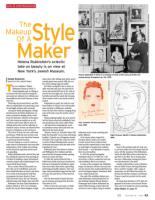
Helena Rubinstein in front of a montage of some of the many portraits she
commissioned throughout her life, 1958
Jo, a RaimAtew
Your Cosmetic Portrait pamphlet
from 1935
Rubinstein had in mind something alto-
gether different.
Pablo Picasso: Sketch of Helena Rubinstein,
At her beauty salons, inspired by
1955.
European literary salons, she wanted
to teach women how to improve their
looks and also wanted them to learn about
gallery).
art and design to broaden their outlooks
Some of the portraits make her look exot-
about beauty — and ultimately to express
ic, and most make her look younger than her
their own personalities.
years, with the exception of the Sutherland,
In 1936, she opened her flagship
which she didn't like at first as she looks her
Manhattan salon at 715 Fifth Ave., with
age (then in her 80s). She is wearing what
seven floors, a library, auditorium and cafe,
was once a Balenciaga evening gown that is
with exhibitions like an art museum.
now shortened into a day dress.
In many of the company's ads, Madame's
Another wall includes a series of sketches
image was featured, with her clear and radi-
done by Pablo Picasso, showing Rubinstein
ant skin and her hair usually pulled back in a from a number of angles, with a range of
severe but elegant chignon. Sometimes she'd
expressions, not all of them becoming. For
wear a white medical coat.
decades she had been trying to commission
One wall of the exhibition features por-
Picasso to paint her portrait, but he would
traits Rubinstein commissioned from art-
decline.
ists including Christian Berard, Roberto
He made these sketches in 1955, after she
Montenegro and Graham Sutherland (an
appeared at his home on the French Riviera
Andy Warhol drawing, created when she
They were to be studies for a future painting,
met him on tour in Japan, hangs in another
Style Maker on page 47
m
December 18 • 2014
43
E