

arts & entertainment >> on the cove
Lifetime miniseries brings
a beloved book to TV.
a
4
Suzanne Chessler I Contributing Writer
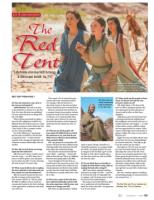
Minnie Driver (Leah), Rebecca
Ferguson (Dinah) and Morena
Baccarin (Rachel) star in the all-new
N
J
Lifetime miniseries The Red Tent.
11
,
RED TENT FROM PAGE 1
JN: Does the miniseries come close to
the way you envisioned it?
Anita Diamant: The book is as close
to the miniseries as Genesis is to The Red
Tent. Ever since the book was published,
I've been criticized about not being faith-
ful to the Bible.
When Lifetime purchased the rights, I
knew the film adaptation would be very
different from the book because in a visual
medium, you have to show rather than tell.
I don't think it's fair to compare written
word to visual storytelling.
For all the differences, I am pleased
that the series is faithful to The Red Tent
in important ways — in that it honors
women's work, courage and ingenuity and
celebrates women's relationships with one
another.
JN: How did you feel about not having
input into the miniseries?
AD: That was by choice. I didn't want to
write the script — nor did I know how. I
knew it would be given a new interpreta-
tion by others, but after 17 years of having
the book in print, I'm used to that.
JN: What research did you do in making
the story authentic to the times and was
that carried over into the miniseries?
AD: My research focused on the every-
day life of women in the ancient Near
East, around 1500 B.C.E. I did not study
the Bible or rabbinic sources much but
concentrated instead on the food, clothing,
social organization, architecture and medi-
cine of the era.
There wasn't a lot of material because
women don't leave monuments behind.
For example, I did not find any evi-
dence that women in that time and place
(ancient Iraq/Israel) used a menstrual tent.
However, menstrual tents and huts are
a common feature in pre-modern cultures
around the world, from Native Americans
to Africans. So it is quite possible there
was such a place. However its color and
the book's description of what happened
inside that tent are entirely my own cre-
ation.
JN: What do you think people will
learn about the biblical times in which
the miniseries is set, and what do you
think viewers will learn about Judaism
from seeing the film?
AD: I am pleased the moviemakers did
not turn The Red Tent into a biblical movie,
which generally turns characters into stiff
icons rather than real human beings.
The characters are human first and fore-
most. I think — and hope — viewers will
relate to them that way. This is very different
from how most people relate to the Bible.
I never thought of The Red Tent as a
Jewish book or the characters as Jews. This
time period is before Sinai, before the Ten
Commandments and the laws that spelled
out the rules that would clearly delineate
the Hebrews as a people rather than a fam-
ily or tribe.
JN: How many copies of the book have
been sold internationally, and how did
the entire experience with the story and
interest in it change your life?
AD: There are approximately 3 million
lain Glen stars as
Jacob, husband to
Leah and Rachel,
in The Red Tent.
copies in print. Having a bestseller is a
Cinderella experience, an unexpected gift,
for which I am deeply grateful. One way
it changed my life was that it gave me the
freedom to write what I wanted, and so
my other four novels are each very differ-
ent from the other.
IN: Do you think there are benefits to
reading the book before seeing a film or
reading the book after seeing it?
AD: I have always regretted reading a
book prior to seeing it on film — especial-
ly if I loved the book. It's impossible not
to compare, and I'm always aware of what
was left out and usually disagree.
But seeing a movie afterward does allow
me to understand why the filmmakers
made the choices they did; I can appreciate
it on its own merits.
JN: What would you like people to know
about The Boston Girl and the time
period in which it is set?
AD: Addie Baum is The Boston Girl,
born in 1900 to immigrant parents who
were unprepared for and suspicious of
America and its effect on their three
daughters.
Addie grows up in the North End, then
a teeming multicultural neighborhood.
Her intelligence and curiosity take her to a
world her parents can't imagine — a world
of short skirts, movies, celebrity culture
and new opportunities for women. Addie
wants to finish high school and dreams of
going to college. She wants a career and to
find true love.
Eighty-five-year-old Addie tells the story
of her life to her 22-year-old granddaugh-
ter, who has asked her, "How did you get
to be the woman you are today?"
She begins in 1915, the year she found
her voice and made friends who would
help shape the course of her life. From
the one-room tenement apartment to the
library group for girls she joins at a neigh-
borhood settlement house, from her first,
disastrous love affair to her work life and
ultimately a happy family, Addie recalls
her adventures with compassion for the
naive girl she was and with a wicked sense
of humor.
Her story continues against a backdrop
of fascinating changes in American history
and women's lives.
❑
The Red Tent airs 9 p.m. Sunday and
Monday, Dec. 7-8, on Lifetime.
December 4 • 2014
53