
Forgotten Story from page 38
now, little was known in Detroit's Jewish communi-
ty about the culture and heritage of these Sephardi/
Mizrachi Jews.
In addition to the idea of sponsoring a com-
memorative ceremony, Keter Torahs committee
generated a long list of programming possibilities
in its lengthy brainstorming sessions. The new law's
directives inspired action.
The committee sent letters to community leaders,
along with copies of the law and background infor-
mation. These letters urged recipients to educate
themselves about the law and to learn the history
behind its enactment. Educators were urged to
develop curricula to teach students how Jews were
forced from ancestral homelands and what their
lives were like before and after.
Changing The Narrative
The non-Jewish world and Ashkenazi Jewish com-
munities had inadvertently contributed to the igno-
rance surrounding these forgotten Jewish refugees
by only focusing on European Jewry's narrative of
the Holocaust. And that narrative has fed the anti-
Israel delegitimizing lie: If only Israel's Jews would
go back to Europe, the indigenous Arabs could have
their (Judenrein) land back.
Countering this lie and preserving the history and
culture of the once-flourishing Middle East, Persian
and North African Jewish communities became the
motivation for new programming, leading Rabbi
Sasson to create the JRefugees1948 website.
The committee appealed to Rabbi Sasson to
expand Keter Torahs annual barbecue on Sept. 7 to
include a Rosh Hashanah seder demonstration and
a screening of the movie The Forgotten Refugees.
Frankly, I had never heard of a seder unrelated to
Pesach and enjoyed the learning experience along
with nearly 90 participants.
On Nov. 2, Keter Torah hosted the launch of a
groundbreaking series titled "Different Cultures,
Different Foods': At the first program, Rimona
Lieberman demonstrated Iraqi cooking. She began
by sharing the heart-wrenching story of her mater-
nal grandmother Margalit Abraham's life as a Jew
in Baghdad and her eventual flight to Israel in 1950.
At age 102, she still resides in Israel surrounded
by three generations of her Iraqi/Israeli family. In
advance, I found my Ashkenazi self in Keter Torahs
kitchen learning how to make kubbah balls. That
afternoon I helped serve the Iraqi meal to 70 curi-
ous community members who attended the pro-
gram.
❑
Barbara Moretsky is president of Oakland County-based
Stand With Us-Michigan.
Keter Torah will host a commemoration of
the plight of Jews from Arab lands and Iran
at 7:45 p.m. on Saturday, Dec.13. The syna-
gogue is at 5480 Orchard Lake Road at
Walnut Lake Road, West Bloomfield.
To learn about the "Different Cultures,
Different Foods" program scheduled for
Jan.11, register your email address at
JRefugees1948@gmail.com . To host a SWU-
M! Jewish Refugees of the Middle East pro-
gram, send an email message to
standwithusmichigan@gmail.com .
Guest Column
Immigration Politics
p
resident Barack Obama on
Nov. 20 announced sweep-
ing immigration initiatives
that would protect about 5 million
undocumented immigrants from
deportation, while also calling for
legislators to create a bill that would
address ongoing tensions at America's
borders.
Under the new terms
of this executive order,
undocumented immi-
grants who have been in
America for at least five
years, or who are par-
ents of children who are
either American citizens
or legal residents, will
not be at risk for depor-
tation and will be able to
apply for temporary citi-
zenship and a Social Security number
after passing a criminal background
check and paying taxes.
Other undocumented immigrants,
however, remain at risk of deporta-
tion, including parents of children
protected under the Deferred Action
for Childhood Arrivals (DACA)
executive order issued by President
Obama in 2012. Nor does the new
executive order protect future undoc-
umented immigrants.
While some protection is granted
to about half of the country's 11 mil-
lion undocumented residents, full
citizenship isn't guaranteed to anyone
affected by the president's order.
"It does not grant citizenship or
the right to stay here permanently, or
offer the same benefits that citizens
receive President Obama said. "Only
Congress can do that. All we're saying
is we're not going to deport you."
For now
There is no doubt that President
Obama's executive order is a land-
mark in our nation's ongoing debate
on immigration. By his action, the
president took a strong stand on what
is a very contentious issue to help
millions of people living in shadows
and in fear of being torn apart from
their loved ones.
There are many very powerful
reasons for immigration reform.
President Obama framed his decision
mostly on moral grounds. He said,
"We are, and always will be, a nation
of immigrants. It's about who we are
as a country. Are we a nation that
accepts the cruelty of ripping children
from their parents' arms?:'
He also argued for reform on
practical grounds ("Tracking down,
rounding up and deporting mil-
lions of people isn't realistic"); on
economic grounds ("Our history and
the facts show that immigrants are a
net plus for our economy and soci-
ety"); and on legal grounds ("actions
I have the legal authority to take as
president").
But the unfortunate reality is that
immigration reform has
become a political game
between Republicans and
Democrats, and the parties'
inability to reach a solution
to determine the fate of 11
million people is unrelated
to the merits of the case.
The president could have
invoked this executive order
at any point in his presiden-
cy but waited and waited
until after the mid-term
elections so as not to hurt the elect-
ability of Democrats. The Republican
House could have passed the immi-
gration bill sent by the Senate in June
2013, but didn't even bring it up for
discussion on the floor, much less to
a vote.
Now, in what Republicans see as
an affront by the administration,
we have the executive order, which
Republicans are already looking to
limit or derail in earnest.
The truly unfortunate aspect of this
is that immigration has now become
an even more difficult and polarized
political issue. A policy that makes
sense economically, socially and mor-
ally, a policy that affects almost 5
percent of the U.S. population directly
— and many times more than that
indirectly — should have become a
matter of real bipartisan lawmaking
and support. And the next two years
will do little to diminish the charged
atmosphere.
I applaud the president's brave deci-
sion, but we all know that executive
orders are not lasting legislation and
do not represent stable, fundamental
change.
For that, the road ahead is clearer
than ever. Starting today, our com-
munities and allies must escalate the
active immigration reform organizing
effort so that the next Congress and
president have a mandate to reform
immigration.
A political fight is won at the voting
booth. And, as President Obama said,
that's where all of us have the chance
to make of our lives what we will. ❑
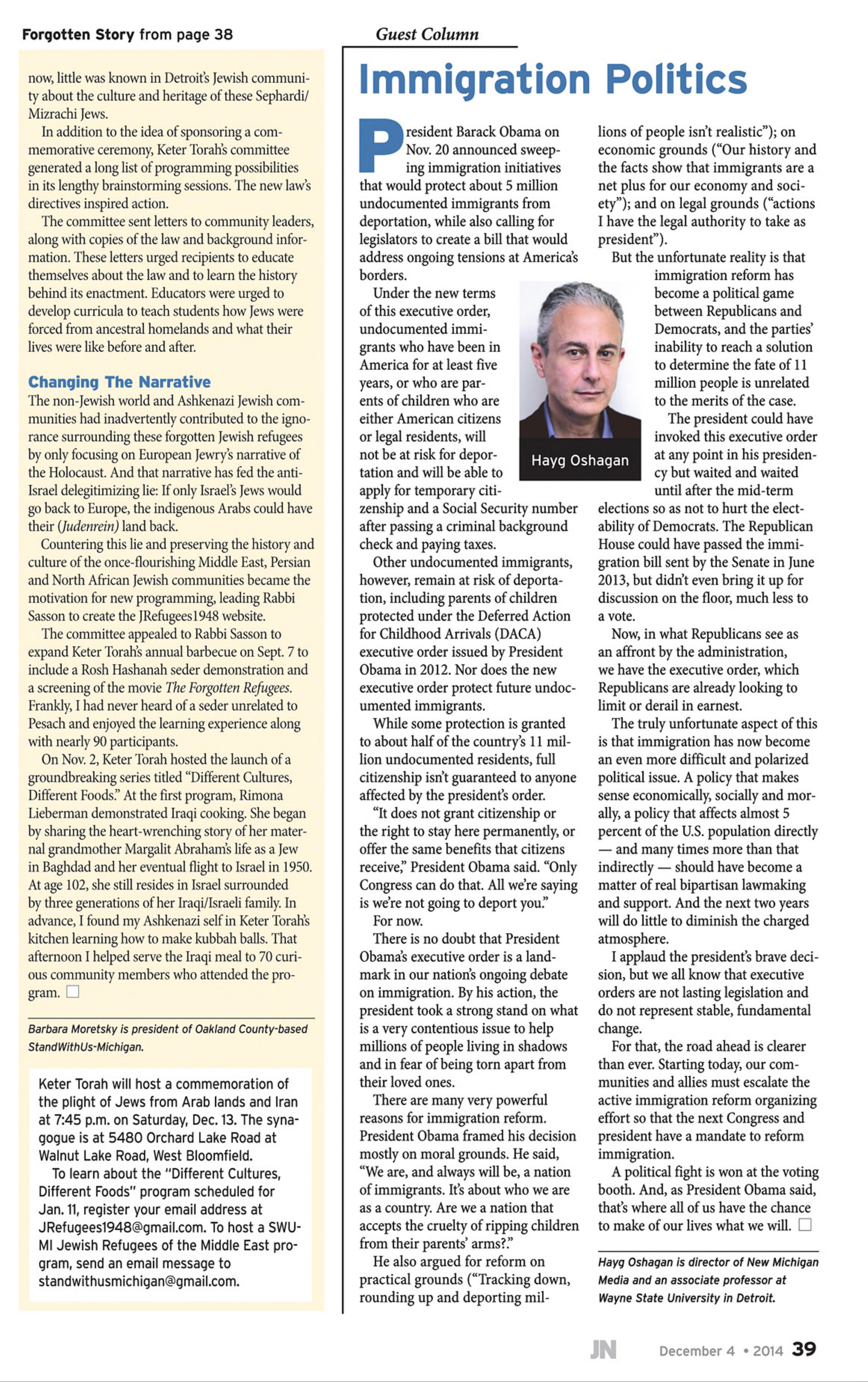
Hayg Oshagan is director of New Michigan
Media and an associate professor at
Wayne State University in Detroit.
JN
December 4 • 2014
39