

For most animals, the Torah describes those
that are permitted as food: mammals that chew
the cud and have cloven hooves, and fish that have
fins and scales. For birds, the Torah lists only those
that are forbidden.
Over the centuries, Jews knew from tradition
which birds were permitted and which were not.
But Jews didn't know about turkey, a New World
creature, until the 16th century. Because turkey
was not part of the tradition when Jewish law was
codified, a minority of Orthodox Jews do not eat
turkey today, even turkey that is certified kosher.
"The rabbi explained enough about the contro-
versy so that we could make decisions on our own,"
Sabes said.
KASHRUT AND BUGS
Many of the students were impressed by the
possible problems with produce and the need to
inspect fruits and vegetables carefully and wash
them thoroughly.
"He told us that in the Torah there are six pro-
hibitions against eating bugs and creepy, crawly
things, compared to only one against eating
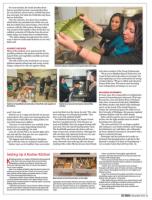
Yael Aviv watches as Rachel Lory inspects lettuce for bugs.
with other members of the Young Professionals.
"We go out to Shabbat dinners all the time, but
I want to host and invite others to my home," she
said, explaining one of her motivations for having
a kosher kitchen. "We go to rabbis' and educators'
houses all the time. We want to start becoming
more independent and doing it on our own."
INFLUENCE ON PARENTS
Yael Aviv of Southfield and Josh Sabes of Oak Park work together in
the kitchen.
pork," Aviv said.
Rachel Lory is a vegan and doesn't eat any ani-
mal products. She wasn't sure learning about the
kashrut laws would affect her eating habits, but
now she's being more vigilant.
"You have to wash lettuce very carefully. Some
berries have so many bugs hiding behind the
seeds, it's just horrifying," she said.
Lory, 33, of Oak Park is an animal rights advo-
cate and said the class gave her new respect for
the laws of kosher slaughter.
The biggest myth about kashrut, Burnham
said, is that the rules are Judaism's health laws.
Kosher meat can be healthier than non-kosher
Rachel Lory removes the bread as Jaimee Wine
watches.
meat, but that's not the intent, he said. "The rules
have nothing to do with physical health. They
have to do with spiritual health."
For Elizabeth Gretzinger, 24, keepin' it kosh
has been a gradual process. First she gave up
pork and shellfish, then she stopped mixing milk
and meat. Next she started buying kosher meat.
The Southfield apartment she shares with two
other women has a kosher kitchen. Although she
still eats dairy and vegetarian foods out, she says
she eventually will be entirely kosher.
Jaimee Wine, 28, of Royal Oak said she became
more observant a few years ago after she started
studying with a rabbi. She has become close friends
Setting Up A Kosher Kitchen
eeping kosher is a matter of following three general
rules: Don't eat any animals that are not kosher;
laughter animals according to Jewish law; and
don't mix milk and meat. But, of course, the reality is
much more complex.
Here is an outline of Rabbi Leiby Burnham's advice for
setting up a kosher kitchen. There's a lot more to each
step, and he will be happy to provide advice. Contact
him at Iburnham@partnersdetroit.org .
•Determine which of your dishes, utensils and pots
can be kashered and which can't. Many things can be
kashered by immersing them in boiling water or pouring
boiling water over them.
•Determine the layout of your kitchen: Where will you
put the meat dishes, utensils and tools, and where will
you put the ones used for dairy. They should be stored
Meat utensils on the left and others on the right
separately. Some kosher kitchens also have utensils and
pots that are parve; these are never used for milk or meat
but only for"neutral"foods such as vegetables and rice.
(If you're a vegetarian and eat no meat you can skip this
step.)
In some cases, the young adults are leading their
parents to becoming more observant. Wine says
her parents, Gary and Robin Wine of Orchard
Lake, have reconnected with their Yiddishkeit.
Her father studies with Rabbi Fully Eisnberger
and is on the board of the Jewish Resource
Center, the outreach program the rabbi runs at
the University of Michigan. Her parents regularly
celebrate Shabbat with the rabbi's family.
Sabes said his parents can see a positive change
in him over the eight months since he started
becoming more observant.
"My mom said that if I'm no longer comfort-
able eating in a non-kosher kitchen, she'll change
her kitchen for me," said Sabes, who will gradu-
ate from Oakland University in December with a
degree in physical therapy.
Gretzinger said her parents don't really un-
derstand what keeping kosher is all about. She
planned to explain it to them at Thanksgiving —
over a kosher turkey that she'll provide. RT
•Clean your kitchen thoroughly, especially the
counters, and then leave them for 24 hours. Kasher the
counters with boiling water.
•Throw away any foods that are not certified kosher
and any leftovers that have been cooked or marinated in
non-kosher pots or dishes.
•Kasher your oven by cleaning it and running it
through a self-clean cycle. If it does not have a self-clean
cycle, clean it thoroughly and heat it to the highest set-
ting for an hour.
•Clean the stovetop thoroughly and kasher it by pour-
ing boiling water over it and turning the burners on as
high as they will go for 10 minutes.
•After kashering your kitchen, buy only products with
reliable kosher certification symbols, and be careful not
to mix meat and milk dishes, pots and utensils.
•Make really good kosher food, then sit back and
enjoy it with friends!
RED TIMID I December 2014 43