

world
Finding
RootF
Detroiter attends 70th anniversary ceremonies
of the liquidation of the Lodz Ghetto.
Dr. Charles Silow
Special to the Jewish News
he 70th anniversary of the liq-
uidation of the Litzmannstadt,
also known as the Lodz Ghetto,
was commemorated Aug. 28-31. I was
in Berlin around that time at the World
Federation of Jewish Child Survivors of
the Holocaust and Descendants confer-
ence, and I felt compelled to go to Lodz to
attend the memorial ceremonies.
Lodz was the city my parents were
from, and the historical home of my great-
grandparents, grandparents, aunts, uncles
and cousins. Lodz was the city where I
probably would have lived had there not
been the Holocaust.
Statistics from the United States
Holocaust Memorial Museum indicate
that before World War II, about 233,000
Jews lived in Lodz, or about one-third of
the city's population, making it the second
largest Jewish community in Europe.
As a point of reference, the Jewish popu-
lation of metropolitan Detroit in 2010 was
estimated to be 66,500.
From 1940 to 1944, the Germans estab-
lished a ghetto in Lodz. Living conditions
were horrendous. Most of the ghetto had
neither running water nor a sewer system.
Hard labor, overcrowding and starvation
were the dominant features of life. The
overwhelming majority of ghetto residents
worked in German factories, receiv-
ing only meager food rations from their
employers. More than 20 percent of the
ghetto's population died from these harsh
living conditions. It is estimated that only
5,000 to 7,000 Jews from the Lodz ghetto
survived the war.
One of the thousands that died of star-
vation in the ghetto was Chil Parzenczeski,
my grandfather.
In 1941 and 1942, almost 40,000 Jews
were deported to the Lodz ghetto. By
September 1942, the Germans deported
more than 70,000 Jews and about 5,000
Roma to the Chelmno killing center.
German personnel shot and killed hun-
dreds of Jews, including children, the
elderly, the frail and the sick, during the
deportation operations.
Between September 1942 and May 1944,
there were no major deportations from
Lodz. The ghetto resembled a forced-labor
camp.
In the spring of 1944, the Nazis started
the destruction of the Lodz ghetto. By
28
November 20 • 2014
m
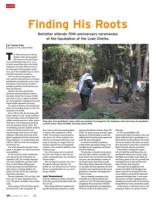
Silow prays at his grandfather's grave, which was unmarked. He arranged for this tombstone, which also honors his grandmoth-
er, Reizel, aunts, Chaya and Malka, and young cousin, Mirka.
then, Lodz was the last remaining ghetto
in Poland, with a population of about
75,000. The Germans resumed deporta-
tions from Lodz. Ghetto residents were
told they were being transferred to work
camps in Germany. In August 1944, the
Germans deported the surviving ghetto
residents to the Auschwitz-Birkenau exter-
mination camp.
Two of the women sent to Auschwitz
from the Lodz Ghetto in 1944 were my
mother and grandmother, Sara and Reizel
Parzenczewska.
After arriving in Auschwitz, they went
through the infamous selection. My
mother, 24, was selected to live as a forced
laborer; my grandmother, 55, was sent to
the gas chamber.
Lodz Remembered
From the conference in Berlin, I traveled to
Lodz with my good friend Mirka Gluck, who
lives in Lodz.
That evening, Mirka, her husband and I
attended the opening ceremonies, a perfor-
mance by the Klezmer orchestra, Brave Old
World. The music was very powerful, captur-
ing the joys of Jewish Poland as well as the
suffering that the Jewish people experienced
in the five years of the ghetto.
In contrast to the Berlin conference,
mostly positive and hopeful, being in Lodz
brought home the magnitude and devasta-
tion of the Holocaust.
The next day, we attended ceremonies in
Survivors' Park, created to remember and
honor all Jews who survived the Lodz Ghetto.
Last year, a tree was planted in memory of
my beloved mother, Sara Parzenczewska
Slow. Mayor Hanna Zdanowska welcomed
us. She spoke about the importance for all to
remember and, in particular, for the second
generation to remember what happened to
the Jews of Lodz.
Later, we attended ceremonies in the
remarkable and oddly beautiful Jewish
cemetery in Lodz. We heard many speeches
of dignitaries from around the world talk-
ing about the importance of remembering
the horrors of the Lodz Ghetto and the
Holocaust.
In 1942, my grandfather, Chil
Parzenczewski, died of starvation in the Lodz
Ghetto. With the help of a genealogist, I was
able to find the location where he was buried
in the Lodz cemetery. Chil, who I am named
after, did not have a matzevah (a monument)
placed on the site where he was buried.
From Detroit, I arranged for a matze-
vah to be built that would honor him, my
grandmother, Reizel, my two aunts, Chaya
and Malka, and my little cousin, Mirka, all
who had no graves. It was very powerful and
meaningful for me to have had this tomb-
stone erected in their memories.
The people who had gathered at the
cemetery all walked to the Radegast train
station, where Jews were deported on box-
cars to Chelmno and Auschwitz. Memorial
ceremonies took place there. A new memo-
rial museum was built at Radegast station,
including a locomotive with two boxcars that
transported Jews to the concentration camps.
At the boxcars, a Holocaust survivor was
speaking in Hebrew to a group of Israeli