

metro
Growing on page 8
What is the most significant
way your organization has
been a catalyst for economic
development in Detroit?
Davidoff: As the largest professional
services firm in Michigan, we're leading
on many fronts. From recruiting talent
from Michigan universities and provid-
ing rewarding career opportunities that
encourage these young professionals to stay
in Michigan, to serving our state's most
important clients, to providing leadership
through corporate citizenship, we are mak-
ing a difference in moving the great state of
Michigan forward.
Provost: We are very aware that as a
community bank we have a mission to
support those communities in which our
employees live and work. For four years
now, we have been a title sponsor of the
Detroit Free Press/Talmer Bank Marathon —
an event that has a tremendous economic
impact on the city.
Recently, Talmer Bank announced its
support of Mayor Duggan's plan to help
revitalize and rebuild Detroit. So we are
excited to have the opportunity to partner
with the city of Detroit and the Detroit Land
Bank Authority to increase homeownership
and vitality in the Marygrove neighbor-
hood.
Talmer Bank has committed $1 million to
this program. Homeowners can receive up
to $25,000 in forgivable grants to help with
renovation costs when they buy homes in
the Marygrove neighborhood. The grants
will be forgiven at the rate of 20 percent per
year that the buyer continues to live in the
home, up to five years.
Aronoff: Through our work with small
business, D:hive Detroit has had more
than 400 small business come through
our "BUILD" training program, which has
grown into a suite of related programs and
will be branching out as its own organiza-
tion ("Build Institute"). The small busi-
nesses we've worked with are growing up
into path-blazers in the city, which is tre-
mendously rewarding.
Staebler: Wayne State University has
a lot of great assets — spending, land,
purchasing power, intellectual property
and research — a quarter billion dollars of
research activity a year. In addition, WSU
has millions of visitors on campus each year
and thousands of professors coming to cam-
pus each week.
Midtown has double the population per
density of the city on average. With Wayne
State University, the Midtown community
becomes much denser. Over 60 new busi-
nesses have opened up in Midtown over the
last few years. Midtown has a much safer
climate today and that provides greater con-
fidence to businesses that open up shop or
are considering expanding.
Over the last five years, Wayne State
University has facilitated a more proac-
tive campus safety plan that has reduced
10 November 20 • 2014
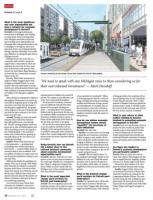
Artist's rendering of the Grand Circus Park station for the M-1 Rail project
"We need to speak with one Michigan voice to those considering us for
their next inbound investment." — Mark Davidoff
criminal activity in Midtown by around 50
percent. The campus is now safer than Ann
Arbor, East Lansing and Birmingham.
We are proud to coordinate, communi-
cate and collaborate with all of the other
players in the economic development
arena — including Henry Ford Hospital,
Bedrock and city government. We also use
our academic ability to promote the Detroit
Orientation Institute and teach courses to
better educate individuals about where the
city has been and where we are going.
We can also be a neutral place because
we are an academic institution and can
challenge, probe and question leaders in
an academic setting and create a forum for
leaders from various backgrounds to discuss
serious issues and answer questions relevant
for residents
Going forward, how can Detroit
tell a better story to the
national business community
about economic development
opportunities here?
Davidoff: Cohesion. That's the one-word
answer to how we best present ourselves to
the world stage. Whether it's a manufacturer
from China or a high-tech company from
Silicon Valley, we need to speak with one
Michigan voice to those considering us for
their next inbound investment.
What is the most important
change you'd envision for
Detroit post-bankruptcy?
Aronoff: The city's regulatory process for
businesses trying to set up shop. In connec-
tion with the city's post-bankruptcy plan,
it has committed to investing $1.5 billion
in retaining programs that do a variety of
things, including attracting and retaining
residents and businesses to foster growth
and redevelopment. I'm hopeful some of
that investment is directed at reforming
and streamlining the permit process and
regulatory systems to make life easier for
entrepreneurs.
How do you believe economic
development leaders should
"quantify" the successes of
their initiatives?
Davidoff: Jobs. Jobs. Jobs.
Staebler: At a macro level, we're looking
at things like new businesses, investment
dollars, occupancy rates, number of new
visitors, media hits and the attention we're
bringing to Midtown. Also important are
the partnerships we're promoting for busi-
nesses to access universities resources and
the federal dollars coming in to the city for
research and grant money.
Aronoff: I like the mayor's metric: "Is
the population increasing?" People are the
lifeblood of a city, and I think that metric
should be used to measure all aspects of
the city's plans: public safety, city systems,
neighborhood services and economic devel-
opment.
What is the greatest change
you'd envision for Detroit post-
bankruptcy?
Staebler: I'm optimistic there will be addi-
tional reasons to invest in Detroit's city
services. Mayor Duggan talks about being
judged on population gain. If the standard
of living gets better, then residents will see
they are getting more services and getting
a better bang for the buck. There is still a
question of whether Detroit can uphold the
promises they've made. It will take another
few years to do the hard work and confront
the very serious concerns of residents.
What is your advice to other
leaders wanting to become
involved in promoting economic
development in Detroit?
Aronoff: Don't ever stop listening. Listen to
people who have worked on projects that
resemble yours or have enjoyed victories
or endured defeats you can learn from.
People underestimate how powerful and
resourceful Detroit's community of existing
grassroots business and community leaders
can be.
Are there any leaders in
Detroit's economic development
you particularly admire?
Provost: There are many who come to
mind. One is Mayor Mike Duggan. His mis-
sion to rebuild Detroit is inspiring. Another
person is U.S. District Judge Gerald Rosen
— he has been and continues to be a key
player in Detroit's financial restructuring.
Staebler: Eugene Driker [who serves
on the Board of Governors at Wayne State
University] would be my nominee for the
Congressional Medal of Honor. The work
he's been doing has been nothing less than
phenomenal. He doesn't get the credit he
deserves for his incredible work. Both of the
Drikers [Elaine and Eugene] are giants in
the city.
❑