

metro
Claims Conference
Forever Families from page 10
3-111))2T111
The Conference on Jewish Material Claims Against Germany
Holocaust-Era Assets in Former East Germany:
Deadline December 31, 2014
The Claims Conference has established a Late Applicants Fund ("LAF") of €50 million in order to accept
applications from certain heirs of a former Jewish owner ("persecutee") of property/assets in the former East
Germany for which the Claims Conference received proceeds as Successor Organization under the German
Property Law of 1990.
The heirs of a persecutee who can make application to the LAF are:
(a) The immediate testamentary heir of the persecutee;
(b) Children, grandchildren, or great grandchildren of the persecutee;
(c) Siblings of the persecutee;
(d) Children of siblings listed under (c);
(e) Spouses of persons listed under (b), (c) and (d).
The Claims Conference has published on its website, www.claimscon.org , a list of the properties/assets
received by the Claims Conference as of the date of publication, and such assets for which claims by the Claims
Conference are still pending under the German Property Restitution Law, including the name of the former owners
and/or businesses, as well as the addresses of the properties/assets.
Applications can be filed directly with the Claims Conference for no fee. There is no need for applicants to pay a fee
to any party. The LAF will accept applications through December 31, 2014.
The detailed rules of the LAF, applications, and other information are also on the Claims Conference website,
www.claimscon.org .
All applications and communications regarding the Late Applicants Fund must be submitted to:
Claims Conference Successor Organization, Sophienstrasse 26, 0-60487 Frankfurt am Main, Germany.
Fax: 011-49-69-97-07-08-11. Email: claims-conference-laf@daimscon.org
After the application deadline, the Claims Conference shall determine the payment that each eligible heir will receive. This
determination will be based on a number of factors detailed on the Claims Conference website.
To aid applicants who do not have complete information, the Claims Conference has a Department for Property
Identification. If you believe that you or your relatives may have owned Jewish property in the former East
Germany, please include as much information as possible in your application and the Department will endeavor to
identify such property. Please write to the above address. There is no charge for this service as well.
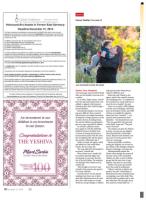
Lynn and Charlie Aronoff, 20 months
The Claims Conference has an Ombudsman. To contact the Office of the Ombudsman, please email
Ombudsman@claimscon.org or write to The Ombudsman, PO Box 585, Old Chelsea Station, New York, NY 10113. 1956070
ek
•6
Or
An investment in our
children is an investment
in our future.
•
6
Ilk
THE YESHIVA
YESHIVA
PiaieZaph-it
of Lelli's Inn on the Green
ec•
r
12
YESHIVA BET Jer.‘
YEHUDAH ,
November 13 • 2014
Verna clexceler.-elit eciaeczt
•
•
Foster Care Adoption
A few years ago, Lynn Aronoff of Royal
Oak, now 48, decided it was time to be
a mother.
As an older, single woman, Aronoff
knew her age and marital status were
unlikely to appeal to birth parents
looking to place their child through a
private adoption.
International adoption was becom-
ing more difficult. Many countries
that formerly encouraged internation-
al adoption no longer permit it. In the
countries that do, including China,
the wait for children was getting lon-
ger every year, especially for infants.
So Aronoff, a political consul-
tant, signed on with the Methodist
Children's Home in Redford, took
12 hours of training and became a
licensed foster parent with the inten-
tion of adopting. She told the agency
she wanted a child under age 2.
Within a month, the agency called
and asked her if she would foster
Charlie. He was 6 days old.
"He went right from the hospital to
my house," Aronoff said.
When Charlie was 3 months old,
his mother's parental rights were
terminated; no one knew the iden-
tity of the birth father. The adoption
was finalized when Charlie was six
months old.
"He's the light of our lives," said
Aronoff, whose parents also spend a
lot of time with him.
Aronoff said it's wise for parents
adopting from foster care to deter-
mine their limitations from the start.
How old a child would you accept?
Would you accept siblings or children
with special needs? What about a
child of a different race?
Before she took Charlie in, the
agency asked if she would be interest-
ed in adopting twins. "I considered it,
but I decided two would really be too
much for me to handle," she said.
There are currently 13,000 children
in foster care in Michigan, said Erika
Jones of the Judson Center, and 3,000
of them are available for adoption.
Many have been "matched" — pro-
spective foster parents have been
identified — but hundreds have not.
"They are good kids who just need
a fair shake," Jones said. "They just
want to be loved."
The statistics are grim for children
in foster care who are not adopted.
More than half fail to finish high
school. Many become homeless, end
up in jail or become parents them-
selves at a young age.
Photos and profiles of children
waiting for adoption can be seen on
the website of the Michigan Adoption
Resource Exchange, www.mare.org .
Although healthy infants like
Charlie come through the system all
the time, many of the unmatched
children are older or part of sibling
groups that the state tries to keep
together. And most are non-white.
Charlie is bi-racial, and Aronoff
knew that could be problematic.
"Before I took him, I talked to my
parents," she said. "I asked them to
think about how they would feel about
my adopting a non-white child. They
said they had no problem with it. And
they adore him. He's the light of our
lives, and he's a Jewish little boy"
❑