

world >> analysis
Veto The Veto?
Can Israel depend on a U.S. veto in the U.N. Security Council?
-a 4 ,
Raphael Ahren
I Times of Israel
'76,•%
fter Jeffrey Goldberg's infamous
story in the Atlantic, in which top
Obama administration officials
described Israeli Prime Minister Benjamin
Netanyahu as a "chickensh*t" and a "coward,"
it is hard to deny that ties between the Israeli .f2'
government and the administration have
reached a nadir.
Even Yaacov Amidror, Netanyahu's former
national security adviser, admitted this week
that "relations between Israel and the U.S.
have deteriorated to an all-time low."
Worse than the bad language and back-
room bickering, though, is the fear that the
frosty relationship may mean Israel can
no longer rely on Washington's veto in the
Security Council, which has been a rock-
solid given in defense of Israel for decades.
It's no secret that Netanyahu and U.S.
President Barack Obama have little love
lost for each other, between disputes over
an Iranian nuclear deal and building in east
Jerusalem and the West Bank.
Less discussed publicly is the fear that
the administration will abandon Israel on
the Palestinian question at the U.N. The
Palestinians are planning to go the Security
Council with a draft resolution calling for an
Israel withdrawal by November 2016 from
all areas captured in 1967. They originally
wanted to submit it by October but will
probably wait for January, when the Security
Council membership will be more favorable
to their cause.
A few years ago, there would have been
no question that the U.S. would have vetoed
any such resolution. In February 2011,
Washington vetoed a U.N. Security Council
resolution condemning Israeli settlements
(despite the U.S: longstanding opposition to
settlement-building), thwarting the council's
other 14 members, who all voted in favor.
A year later, the administration successfully
blocked the Palestinians' attempt to become
full U.N. members.
But since then, ties between the Jerusalem
and Washington have gone drastically down-
hill, and the American veto can apparently
no longer be taken for granted.
"Without U.S. support in the international
arena, and especially in the U.N. Security
Council, Israel would be in a very difficult
position today, to the point of diplomatic and
economic isolation:' Amidror wrote Monday
in a paper for the BESA Center for Strategic
Studies.
Asked by the Times of Israel whether he
fears Washington could possibly refrain
from using its veto in January, he indicated
November 6 • 2014
JN
011
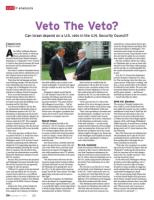
Netanyahu at the
White use in 2012
A
54
President Barack
Obama talks with.
Israeli Prime
Minister Benjam'
• •
that while unlikely, such a scenario is not
entirely unthinkable. "It doesn't seem logical
that they wouldn't use their veto. But I don't
know:'
Netanyahu is indeed worried that the
U.S. will "abandon" Israel at the U.N., Israeli
journalist Ariel Kahane reported Sunday
on the NRG website [Hebrew link], quot-
ing senior ministers. "The prime minister
told colleagues in recent days ... that his
office's understanding of the issue and the
government's take on it is that the Americans
will not cast a veto against a resolution that
reaches the Security Council; Kahane later
elaborated in a newspaper interview.
Shared Values
Officially, Jerusalem has faith in the
Americans. "The U.S. has had a consistent
position of refusing to support one-sided
U.N. resolutions against Israel, and I have
no reason to believe that America's position
is about to change," a senior official in the
Prime Minister's Office told the Times of
Israel this week.
Even Danny Danon, a hawkish Likud law-
maker who doesn't mince words in his criti-
cism of the White House, said Israel could
depend on the support of its biggest ally,
even while anonymous senior U.S. adminis-
tration officials hurl obscenities at the prime
minister.
"Our shared values will ensure that the
American people and the American leaders
will stand with Israel; he said. Preventing
the Palestinians from getting their way at
the U.N. is "in the interest of the American
people he told the Times of Israel. "Our fight
against Islam extremism and terrorism is
their fight:"
Indeed, the recognition of a Palestinian
state in the absence of a negotiated agree-
ment with Israel is against declared U.S. poli-
cy, noted Robbie Sabel, a former legal adviser
to Israel's Foreign Ministry and professor of
international law at Hebrew University.
.
r
Israel can thus be confident that the
administration will not allow the Security
Council to pass a resolution setting a time-
table for an Israel withdrawal, or even one
that would merely call for Palestine to be
admitted to the U.N. as a full member state
(without deadline for an Israeli withdrawal),
he asserted.
At the same time the U.S. will use [the
question of] its veto as leverage to pressure
Israel to restart another round of peace nego-
tiations with the Palestinians:' Sabel said.
There is also speculation in Jerusalem that
the administration, unwilling to use its veto
(which would be needed if nine Security
Council members vote in favor), will propose
to the Palestinians an alternative version
of the draft resolution — one that would
condemn Israeli settlement activity as illegal
under international law. In the past, the U.S.
blocked such resolutions, but in the current
climate it might well support one. Rumor has
it that Washington and Ramallah are already
in close contact regarding the wording of
such a draft resolution.
No U.S. Comment
Israeli and American officials refused to
comment on these rumors. Asked about the
veto, State Department spokesperson Jen
Psaki last week did not want to predict how
the U.S. will act when the Palestinians turn to
the U.N., merely saying that the administra-
tion doesn't "have information yet on what
the plan is."
Not everyone is sure that the U.S. would
put the kibosh on the Palestinians' maneuver
at the U.N. "I wish I could say the veto is in
our pocket, but I don't think that's the case
said Oded Eran, a retired former Israeli top
diplomat. "A lot will depend on the language
of the draft resolution and other issues:'
If the Palestinian draft resolution calls for
the creation of a Palestinian state within the
1967 lines with east Jerusalem as its capi-
tal, Israel can be sure of an American veto,
assessed Eran, a former deputy director gen-
eral at the Foreign Ministry and deputy chief
of the Israeli embassy in Washington. "The
Americans cannot accept, nor can anyone
else, that the Security Council decides on bor-
ders and what the capital of a new member
state would be, especially not in this region"
But if the resolution calls for the creation
of a Palestinian state, or even an Israeli with-
drawal from the West Bank, without getting
into the specifics, it is indeed plausible that
the current administration would support it,
he said.
True, the U.S. thwarted the Palestinians'
previous attempts at enhanced U.N. status,
but "that was during a time when there was
a peace process. Today, there is nothing; said
Eran, a senior research fellow at the Institute
for National Security Studies. The sorry state
of personal relations between the president
and the prime minister — and between
individual top ministers in the two countries
— doesn't help either, he added.
2016 U.S. Elections
The outcome of Tuesday's midterm elec-
tions could be crucial. Should Democrats
have pulled off a surprise win, they could be
emboldened to shun Israel at Turtle Bay. But
if the Democrats did poorly, as they were
expected to, Secretary of State John Kerry
or Defense Secretary Chuck Hagel might be
replaced, which could change Washington's
Middle East policy in Israel's favor, according
to Shmuel Sandler, an expert on American
foreign policy and U.S.-Israel relations at Bar-
Ilan University.
Plus, if the Democrats were defeated, they
will immediately start to plan for the 2016
presidential elections and therefore refrain
from anything that would anger the pro-
Israel community, he predicted.
"That's why we're not going to see another
slap in the face of Israel; he argued. After the
"chickensh*t" insults and the expected Iran
deal, the Americans will not also abandon
Israel at the U.N., Sandler surmised. "They
can't slap Israel three times."
On the other hand, Washington will keep
all options on the table regarding a veto at
the Security Council in order to threaten
Jerusalem as long as possible, he suggested,
and he admitted that a lame duck president
could indeed be dangerous to Israel.
After six years during which Obama had
to restrain himself despite all his grievances
about what he considers Israeli recalcitrance,
after the midterm elections there is very little
that could hold him back. And yet, Sandler
said, "Obama doesn't want to go down in
history as person who destroyed relations
between the U.S. and Israel"
❑