

arts & entertainment
Welcome To Polin (Poland)
New museum is ready to illuminate the millennium-long
Jewish history of Poland.
Michele Alperin
JNS.org
G
iven that half of the 6 million
Jews who died in the Holocaust
came from Poland (Polin in
Hebrew), many descendants of Polish Jews
may be surprised to learn about the current
hospitable environment for the Jewish popu-
lation of their ancestors' country.
Poland experiences far less anti-Semitism
than the typical European country and is
home to a burgeoning — albeit relatively
small — Jewish community (estimates sug-
gest 10,000-20,000, but no definitive figures
are available).
At the same time, young non-Jewish Poles
are increasingly curious about Jews and the
Jewish religion.
Recognizing that this environment was
fertile ground for a museum highlighting the
history of Polish Jewry, a group of Warsaw-
based organizers invited emigre scholars
and cultural activists in New York to help
promote the museum concept and iden-
tify funding sources for what two decades
later became Polin: Museum of the History
of Polish Jews, which opened its Core
Exhibition on Oct. 28.
The museum, located on the site of the
Warsaw Ghetto uprising directly across
from the Monument of the Warsaw Ghetto
Heroes, has received more than $60 mil-
lion from the Municipality of Warsaw and
Poland's Ministry of Culture and National
Heritage.
The rest of the needed funding was raised
by the Association of the Jewish Historical
Institute of Poland, a nonprofit that has
served as a caretaker of the country's Jewish
heritage for more than six decades.
As a civic initiative and state-funded
institution, the museum's target audience "is
much broader than the Jewish community in
Poland," says Barbara Kirshenblatt-Gimblett,
program director of the museum's Core
Exhibition, which traces the 1,000-year his-
tory of Jews in Poland.
"It is intended for a much broader public:
Poles, including Jews; the world Jewish com-
munity; and the European and world public:'
she says.
From the perspective of Polish-born phi-
lanthropist Tad Taube, honorary consul for
the Republic of Poland in San Francisco, the
significance of the museum's content goes
beyond Polish Jewish history
"In portraying 1,000 years of Jewish
culture and history in Greater Poland, the
museum traces the foundations of Judeo/
Christian Western culture he says, refer-
44
November 6 • 2014
ring to the contribution of Polish Jews to the
various spectrums of Jewish and Christian
faith in addition to significant Jewish cultural
influence in philosophy literature, theater,
music and the physical sciences.
Taube is the chairman of Taube
Philanthropies and president of the Koret
Foundation, which together provided signifi-
cant funding for the museum.
Retired Polish diplomat Krzysztof (Kris)
W. Kasprzyk, who has been an enthusiastic
promoter of the project for more than two
decades, sees the museum as particularly
important to the Poland of today.
"Our national cultural heritage is really
impoverished without all that Jewish history
in Poland over for centuries:' he told JNS.org .
"This museum is like bringing fresh water
to the desert — maybe that is an overblown
metaphor, but we needed this venue badly"
The museum's goal of reaching out to both
the Polish Jewish and broader Polish com-
munities stems from the country's increas-
ingly welcoming environment for Jews.
Chief Rabbi of Poland Michael Schudrich
suggests two reasons for that trend: first,
the papacy of Polish-born John Paul II, who,
he notes, was "the first pope to ever say
that anti-Semitism is a sin according to the
Catholic Church:'
The second factor is the fall of
Communism, which created not only politi-
cal and economic change but also a social
upheaval.
"People are willing to be more open to
change than under normal circumstances:'
Schudrich says, adding that younger Poles
are curious about Jews, who had been largely
absent or secretive about their identity in the
country for 50 years after the Holocaust.
The fall of Communism, adds Kasprzyk,
gave people the gift of free speech, which has
allowed them to explore painful events from
the past.
One of these was the 1941 murder of Jews
in Jewabne, a small town in northeast Poland
where a Polish mob, encouraged by German
Nazis, burned Jews from several surrounding
communities in a barn.
This incident was revealed to the larger
Polish public in the book Neighbors by
Tomasz Gross (published in 2000) and was
widely and openly discussed — a process
Kasprzyk says "heals the wounds:'
Although Kasprzyk had strong Jewish
connections from an early age and today
cooks gefilte fish and Jewish sweets, the
definitive moment in his lifetime devotion
to Polish-Jewish relations came during his
sophomore year at the University of Krakow.
That year, during the "1968 Polish political
crisis:' Kasprzyk recalls that he "witnessed
the expelling from Poland of many col-
leagues from my high school and from the
university [because of the anti-Semitic cam-
paign sponsored by the Communist govern-
ment], and I also witnessed labeling them
simply as 'Jews: as somebody who would be
outside of the Polish community.
"Ever since that time, the subject of Polish
Jewry was always very dear to my heart:' he
says.
About two decades after the political cri-
sis came the fall of Communism, which, in
Rabbi Schudrich's estimation, marked "the
first time in 50 years people [could] now
think about, 'Do I feel safe telling my chil-
dren and grandchildren that they are really
Jewish?'
"Since 1989, thousands and thousands,
perhaps tens of thousands of Poles, have dis-
covered they have Jewish roots," Schudrich
says.
Schudrich, whose job is to create pathways
back to Jewish identity for Poles, says the
museum can play a role in that process.
"For Poles with Jewish roots, it can be an
entry point into some kind of connection
with their Jewish identity; they can learn
more about their past and what Judaism is
about:' he says.
Kirshenblatt-Gimblett says the museum
"can support the renewal of Jewish life" by
showing to "Jews in Poland, who kept their
Jewish roots a secret, that they have nothing
to be ashamed of, nothing to be afraid of and
much to be proud of:'
But the museum goes beyond a sense of
pride, offering a tangible resource for Polish
Jews to learn about their history.
"[The museum's creation] says that Jewish
roots are not enough — you also need
to know who you are says Kirshenblatt-
Gimblett.
"And who you are is not simply genetic.
It is also historical and cultural. While the
chain of transmission may have been broken,
because of the Holocaust and Communism,
there is an opportunity to restore that chain
of transmission, and the museum can play a
very important role:'
Kirshenblatt-Gimblett suggests that Jews
today are not aware that their co-religionists
lived in the Polish territory continually for
1,000 years.
"It's quite baffling, because they assume it
was one unmitigated story of anti-Semitism
that led to the Holocaust," she says, explain-
ing that if this was true, Polish Jewry would
never have become a center of the Jewish
world and also, for some of its history, the
world's largest Jewish community.
"We place the Holocaust within the 1,000-
year history of Polish Jews, not a 1,000-year
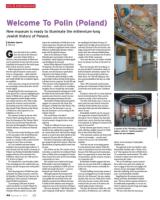
A portion of the "Paradisus Iudaeorum"
gallery, Latin for "Jewish paradise,"
within the Core Exhibition
history of anti-Semitism:' Kirshenblatt-
Gimblett says.
The approach of the Core Exhibit is what
Kirshenblatt-Gimblett calls a "theater of his-
tory" that organizes the story of Polish Jewry
"as a continuous visual narrative:' The exhib-
it intends to explore more than instruct,
empowering the visitor.
"We are not offering a master narrative
but a rather more open story, asking visi-
tors to engage in that story and engage with
primary sources and engage with debates
and with conflicting views on particular sub-
jects:' says Kirshenblatt-Gimblett.
Regarding how the museum presents
Poland and Poles, Kirshenblatt-Gimblett
says, "We are a history museum and have to
be intellectually responsible, so it is not our
intent to improve anyone's image and engage
in any kind of polemic.
"We never start from the misconcep-