

oints of view
>> Send letters to: letters@thejewishnews.com
Commentary
Editorial
0
Israel's Higher
Level Of Ethics
I
E
2052 CM!
srael's continued construction of housing in Jewish
sectors of east Jerusalem is an international flashpoint
but is rooted in the city's longstanding reunification
under Jewish control. A Jewish nonprofit's use of stealth
to move Jews into apartments in Arab neighborhoods
within east Jerusalem, meanwhile, borders on incitement.
Ateret Cohanim, an Israel group dedicated to strength-
ening Jerusalem's Jewish soul, encourages moving Jews
into east Jerusalem after dark to avoid potential clashes
with angered Arab neighbors. The deception contributes
nothing toward peaceful conditions between Jews and
Arabs in the Israeli capital. It's not the Jewish way.
At a time when seemingly every Jewish or Arab pub-
lic act draws headlines in the wake of collapsed Israel-
Palestinian peace talks, such move-ins should bear the
glare of public scrutiny, not enjoy the cover of darkness.
a...Kw* rpsivarwas
-m mots
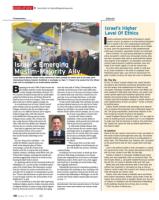
Israeli Defense Minister Moshe Ya'alon (pictured at right) unveiled the Israeli stall at the Adex 2014
International Defense Industry Exhibition in Azerbaijan on Sept. 11. Ya'alon's trip marked the first official
state visit to Azerbaijan by an Israeli defense minister.
B
eginning in the early 1990s, Turkey became the
one Muslim-majority country that maintained
a robust strategic relationship with Israel. The
two countries developed strong trade ties. Israel helped
update the Turkish air force and Turkey allowed the
Israeli air force to train in its airspace. There were major
plans underway to further upgrade strategic ties.
In an unfortunate turn of events, Turkey's elected
prime minister (and now president), Recep Tayyip
Erdogan, decided to take the once highly secular
country in a very different direction and re-aligned
Turkey's foreign policy with other interests
in the Middle East. Not long into his tenure,
Erdogan became a public critic of Israel, driv-
ing a wedge between Turkey and Israel in the
wake of the 2010 Gaza flotilla crisis. Relations
between the two countries remain strained.
Israel and its supporters have never fully
recovered from the loss of the country's
Muslim ally and the potential it had to trans-
form Israel's broader relationships in the
region.
But now, along comes Azerbaijan — the
world's first Muslim-majority democracy,
which is fast taking the place of Turkey
in becoming a crucial ally of Israel in the
Muslim world. It's no surprise that of all Muslim-
majority countries, Azerbaijan would fill the void. Like
Turkey before Erdogan, Azerbaijan has proudly and
sometimes aggressively reinforced its secular society,
banning the hijab (veil) in schools.
In a gathering with the Jewish community held in the
Washington, D.C., area last month, Azerbaijan's ambas-
sador to the United States, Elin Suleymanov, recoiled
from the criticism his country received from the U.S.
and others for its tough line on maintaining its secular-
ism. "We are criticized because our girls are not forced
to wear the hijab, and this is the worst problem in the
Middle East?" he said.
The U.S. should keep in mind that while suppressing
traditional religious practices violates American notions
of religious freedom, it's meant to keep radical religious
forces in check and to prevent Azerbaijan from going
48
October 30 • 2014
down the same path as Turkey. Unfortunately, in that
culturally conservative part of the world, Jeffersonian
democracy is not yet on the menu and trying to impose
our cultural ideals may make these countries less, not
more free. Let us not forget that France, a well-estab-
lished liberal democracy, has also banned the hijab.
To date, Israel's relationship with Azerbaijan has taken
an almost identical trajectory as its early ties to Turkey.
As it had with Ankara, Israel has steadily ratcheted up
defense ties with Baku. Last month, Israeli Defense
Minister Moshe Ya'alon visited Azerbaijan, one of a num-
ber of such recent defense-oriented visits.
As it had with Turkey, Israel has
established a vital economic lifeline to
Azerbaijan, which provides the Jewish state
with 40 percent of its imported oil.
As with Israeli-Turkish relations, bilat-
eral ties between the two countries signal
Azerbaijan's desire to strengthen its connec-
tions to the U.S. and the West. The country
has become an invaluable NATO supply
line to Afghanistan and has joined NATO
war efforts.
When much of the rest of the world
interrupted flights to Israel during the con-
flict with Hamas last summer, Azerbaijan
continued flying.
According to one recent report, an Israeli spy drone
shot down while doing reconnaissance over Iranian
nuclear sites originated from an air base in Azerbaijan's
Nakhchivan enclave. If this report is true, they suggest
that Israel's ties to Azerbaijan are much further along
than originally understood.
Undoubtedly, Israel sees the tremendous potential in
its relationship with Azerbaijan as does Azerbaijan with
Israel. American supporters of Israel must do their part
to reinforce that relationship in Washington. As was dis-
covered with Turkey, Muslim-majority allies don't grow
on trees.
❑
David Bernstein is the former executive director of The David
Project and a former senior official at the American Jewish
Committee.
On The Sly
On Oct.19, Ateret Cohanim helped nine Jewish families
recruited by the Yemenite Community Committee move
into the largely Arab neighborhood of Silwan in east
Jerusalem. Yemenites founded the area in the 1880s, but
were expelled in 1938 amid Arab rioting. Last week's new-
comers joined eight Elad Foundation-sponsored Jewish
families who moved nearby in September. Both Ateret
Cohanim and Elad Foundation imagine a Jewish majority in
Arab neighborhoods of east Jerusalem – hardly a climate
for getting along.
Clearly, Ateret Cohanim took advantage of an opportu-
nity; it acquired the properties from a Palestinian eager to
sell. The group exacerbated Jewish-Arab relations in the
City of Gold by furtively moving in the families.
Israeli President Reuven Rivlin is right: "It is our right to
insist on building around Jerusalem, but it is our obligation
to make sure that the decision is made by the authorities.
Our capital city cannot be built by stealth apartments in
the dead of night."
In Context
Some of the new Jewish construction in east Jerusalem is
the result of plans Israel approved years ago. The prevail-
ing belief brands such construction as an impediment to
peace talks. The Palestinians eye, however, east Jerusalem
as the government seat for their sought-after sovereign
state.
Lost in the political shuffle is that Jerusalem is a united
city governed by Israel. The Jewish state gained control of
the city from Jordan in the 1967 Six-Day War.
Tension is highest in Jerusalem neighborhoods where
Arabs and Jews separately claim an ancestral stake. The
list includes Silwan, a Jerusalem neighborhood just outside
the Old City. It's home to 50,000 Arabs and 700 Jews.
While Jews and Arabs should be able to live freely and
without fear anywhere in Jerusalem as long as the pur-
chase or rental is legal, this scenario isn't always practical.
Time will expose any culture clash.
Clearly, Jews who choose a midnight move into Silwan
don't inspire coexistence. Neither would Arabs if they dis-
rupted Jews moving there in daylight. Bluntly put, any sort
of violence in retaliation, like the Palestinian firebombing
of the buildings housing the arriving Jews, is wrong.
That's the price of democracy.
❑