
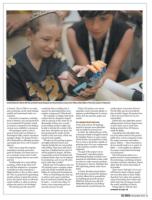

Israeli Nathanel is fitted with the prosthetic hand designed and 3D printed by a team at the Tikkun Olam Make-a-Thon this summer in Nazareth.
is formed. There is little to no waste
and a prototype can be made cheaply,
quickly and customized easily on a
computer.
Automotive companies, including
those in Detroit, were among the first
to use industrial 3D printers, which
are massive compared to the desktop
versions now available to consumers.
"3D printing is used in a lot of
areas at Ford," said Lon Zaback of
Farmington Hills, creative operations
manager, design. "In design, the ben-
efit is being able to efficiently produce
a prototype part from a 3D computer
data set.
"We've been using 3D computer
modeling to develop automotive
parts for decades, but those parts are
on a computer screen and we need
to create real parts that we can touch
and feel.
"Traditionally we've used milling
machines, which at the basic level
are drill bits attached to a computer-
controlled arm that reproduces a
digital surface in clay or other materi-
als. This is a great tool for generating
outside surfaces of parts like exterior
forms, but doesn't work as well when
a part is hollow or when an interior
surface also needs to be developed.
"3D printing uses the same 3D
coordinate data as milling, but is
superior for generating those more
complex components," Zaback said.
"For example, we design radio knob
surfaces that are doughnut-shaped
with an opening in the center for an
illuminated volume icon. A tradi-
tional milling machine might only
be able to develop the outside of the
part, but a 3D printer can 'grow' the
part producing the inside and the
outside at the same time, which was
not previously possible.
'We also use 3D printing to gener-
ate highly detailed textures and
intricate details that are not possible
with milling. That same radio knob
may have a detailed texture where it
will be gripped by fingers. All these
components must be developed and
evaluated before they can be released
for production, and we use 3D print-
ing to make that a reality"
Zaback says Ford engineers also use
3D printing to grow complex engine
parts, like intake manifolds that are
hollow, for testing and development.
"Prior to 3D printing, the only way
to achieve such a part would have
been to mold and machine the part
by hand — a much more labor-in-
tensive, time-consuming and less-
accurate process," he said.
Today's 3D printers use various
materials, most commonly plastic or
polymer spooled filaments in various
colors, but also powders, paper and
metals.
3D DEMOCRATIZATION
In the 21st century, 3D printing
started to become more affordable
and accessible for personal use.
In 2005, Dr. Adrian Bowyer of the
University of Bath in England started
the RepRap Project, an open-source
(freely shared, not proprietary) initia-
tive to create a 3D printer capable of
printing most of its own components
so the machines could be widely
replicated.
The goal of the project was to
"democratize" manufacturing by
distributing RepRap machines inex-
pensively to individuals so they could
use them to make common products
by themselves. Darwin, RepRap's first
self-replicating printer, came out in
2008.
In 2009,
Brooklyn-based Maker-
Bot Industries (acquired by Stratasys
in 2013) offered do-it-yourself kits
for building personal 3D printers.
Hillel Day School uses a $2,000
MakerBot Replicator 2X desktop
model and has several 3D pens for
small projects. Innovation Director
Trevett Allen says he and students
plan to build a larger 3D printer from
a kit in the near future for an esti-
mated $900.
Earlier this year, MakerBot started
selling printers at Home Depot stores
in three states, and a small Cube
desktop printer from 3D Systems
retails for $999.
Coinciding with affordable desk-
top 3D printers aimed at the general
public from various companies comes
the maker movement and maker-
spaces. Makers — those interested in
do-it-yourself creation in a variety of
fields — work together in collabora-
tive spaces using shared technology
and equipment.
3D printing and makers are a
perfect storm for democratization of
this technology, combining entrepre-
neurship, creativity, education, shared
ideals and the science that makes it
all possible.
Open-source "fab labs," do-it-your-
self factories where ordinary people
can turn their ideas or those widely
shared for free online into products
using 3D printing, laser cutters and
other tools, have sprung up around
the world, including in Detroit.
Fitting right in with the city's
continued on page 44
RED mum I November 2014 43