

Our Choices from page 28
extend civil rights protections to les-
bian, gay, bisexual and transgender
(LGBT) persons, is rooted in sound
business sense — Michigan's economy
needs the most qualified and talented
work force it can find. Period. The
governor surely understands this but is
unwilling to buck socially conservative
segments of his party.
Democratic gubernatorial candidate
Mark Schauer is personable, knowl-
edgeable and provides voters with a
choice in determining the state's direc-
tion. He correctly understands that
Michigan needs to put more money
in its public schools and colleges, its
neglected roads and infrastructure and
its distressed cities. He is also correct
that a shift in the state's tax burden
is now taking a bigger bite out of the
paychecks of many middle-class fami-
lies. And unlike Snyder, he feels unen-
cumbered in articulating his positions
on social issues.
Merely shifting the tax burden will
not generate the substantial revenue
needed to fund the programs and
initiatives articulated by Schauer.
An expanding economy — and tax
increases — will.
While there are bones to pick
with Snyder, we believe he has put
Michigan — and Detroit — on a path
to economic recovery and has earned
our endorsement for re-election.
Gary Peters, Terri Lynn Land
During his six years in Congress,
Democrat Gary Peters has distin-
guished himself as an active, visible
and engaged representative who has
tirelessly sponsored and supported leg-
islation that strengthened Michigan's
economy and its vital manufacturing
sector. In his current campaign to
replace retiring U.S. Sen. Carl Levin,
he has received the support of both
organized labor and chambers of com-
merce.
No stranger to the Detroit area
Jewish community, Peters has worked
to support and strengthen the special
and strategic relationship between the
U.S. and Israel.
With the retirement of Levin, Peters
would be a worthy successor in the
U.S. Senate and is deserving of our
endorsement.
Peters' challenger for the seat,
Republican Terri Lynn Land, estab-
lished a credible record as Michigan's
secretary of state. However, there
is significant uncertainty — fueled
by her decision to largely campaign
through paid media messages — about
her ability to articulate positions on an
array of subjects vital to the security
and well-being of our country.
❑
Commentary
From Opera House To House Of Commons,
Diaspora Jews Are The Target
T
his week, the opera The Death of Klinghoffer opened
in New York. Rightly castigated for its invocation of
unpleasant Jewish stereotypes and its apologia for
the Palestinian terrorists' murder of an elderly Jewish tourist
in a wheelchair, its staging for the umpteenth time since it
was first produced at the Brooklyn Academy of Music in 1991
has been interpreted by some in the Jewish community as
signaling a "normalization" of anti-Semitism.
Indeed, this was the focus of a panel last week, organized
by the Institute for the Study of Global Anti-Semitism and
Policy (ISGAP) in New York, in which I was privileged to par-
ticipate. Inevitably, our exchange wasn't simply restricted
to the content of Klinghoffer, but spanned a range of issues
from the perilous situation in the Middle East, presently
caught in the pincers of Islamic State atrocities and rising
Iranian power, to the explosion of anti-Semitic violence in
Europe over the summer.
It's clear to me that the issues that animate our side of
the debate are utterly removed from the concerns of the
opera's defenders. Our awareness that the source of the
savage attacks on Israel is the same genocidal ideology that
has caused such appalling suffering to Christians,
Kurds and Yazidis forces us to confront how anti-
Semitism is an integral element of the global
assault on human rights. By contrast, for the
other side, there's only one issue that matters,
only one obsession that imposes itself on all of
us: "Palestine" and the Palestinians.
It's an obsession that manifests itself far
beyond the hallowed halls of the Metropolitan
Opera. Look at the House of Commons, Britain's
parliament, which voted overwhelmingly in favor
of recognition of a Palestinian state after a
debate that kept the honorable members up until
the wee hours. I doubt that they would have paid
the same courtesy to the Yazidis,10,000 of whom remain
stranded on Iraq's Mount Sinjar, surrounded on all sides by
Islamic State terrorists and without food, clothing or proper
shelter.
Similarly, not a single British parliamentarian issued a
word of condemnation of Turkey's bombing of Kurdistan
Workers Party (PKK) positions in Iraq, despite the enormous
contribution this socialist organization has made to the
war against Islamic State barbarism. Much the same can
be said of the U.S. State Department and the White House,
both of whom go apoplectic whenever Israel builds so much
as a bathroom extension in eastern Jerusalem, but are
largely silent in the face of Turkish President Recep Tayyip
Erdogan's atrocities.
It seems as if our declining western civilization can sum-
mon the courage to speak loudly on foreign policy only if
the policy question involves our ally, Israel, supposedly pun-
ishing innocent Palestinians. But is this anti-Semitism? In
my view, yes, it is.
At the ISGAP panel, I made the point that what attracts
the western intelligentsia to the Palestinian cause is the
same dramatic point upon which Klinghoffer hangs. It used
to be said by the anti-Semites that the "Jews are our mis-
fortune." Now that has been twisted – the Jews are the
cause of their own misfortune as well. Since they "dispos-
sessed" the Palestinians – I'm not quoting the historical
record of the 1948 War of Independence here, but one of
•■
IOW .ER
IF
GI
)13
',MEW
61SAIIT
►
\
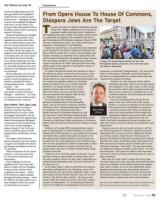
On Sept. 22, demonstrators protest the New York
Metropolitan Opera's production of the anti-Israel opera
The Death of Klinghoffer.
its tenuous, yet dominant, interpretations – the Jews bring
misery on themselves. Klinghoffer was killed because he
was seen as a representative of a people whose state was
created at the expense of another.
Similarly, the Jews attacked in Paris, Malmo,
Manchester and other cities in the last few months
were targeted for the same reason. In other words,
the purported victims aren't actually innocent and
that's as sexy a theme for a dramatist as it is for
a Palestine solidarity activist burning with hatred
for the Jewish state.
Here's my overriding point, though: We can
expect much more of the same in the coming
months. In January, for example, we will mark the
70th anniversary of the liberation of Auschwitz.
I confidently predict that Twitter, Facebook and
other social media platforms will be awash with
comparisons between Gaza and the death camp
crafted by the Nazis as well as missives from the less
subtle Israel-haters complaining that we're weeping over
dead Jews when we should be helping live Palestinians (and
nobody else).
Diaspora Jews are, when all is said and done, a soft tar-
get, and increasingly the "Palestine" solidarity movement
understands this. A recent article for Middle East Monitor,
a pro-Hamas website, made the point that because the
Boycott, Divestment and Sanctions movement can't hope to
eliminate the vibrant, multi-billion dollar trade between the
West and Israel, its energies would be better spent on con-
fronting the shadowy "Israel lobby," the real power behind
the Middle East policies of western governments – far more
influential than, I don't know, the Qataris, who these days
own half of London and Paris yet somehow have no voice in
policy formation!
What does this really mean? It means pick on the Jews,
stop them lobbying for Israel, stop them even identifying with
Israel. It's a reflection of the attitude that led Arab regimes,
after Israel's creation, to turn on their defenseless Jewish
populations because they were too cowardly and incom-
petent to win on the battlefield. And it's the direction that
the Palestine solidarity movement as well as its Arab and
Islamist backers is heading down. We must be prepared.
❑
Ben Cohen is the Shillman Analyst for JNS.org and a contributor to the
Wall Street Journal, Commentary, Haaretz and other publications.
iN
October 23 • 2014
29