

metro >> on the cover
Reunited
A Holocaust survivor and American soldier share their disparate
yet remarkably similar stories.
Lynne Konstantin I Contributing Writer
CONTINUED FROM PAGE 1
The next day, on April 12 — the day
President Franklin Delano Roosevelt
died — soldiers came walking through
the gates of Buchenwald. Two men wove
a basket with their fingers and carried
Shulman to the roof so he could see.
"Everyone thought, 'Oh, my God, the
Germans are back; they are going to kill
us," Shulman says of the guards and offi-
cers who had fled the camp. But as the
soldiers came closer, Shulman realized
they were not German.
As a young boy in Klimontow, Poland,
Shulman would sneak books — stories
by Jack London and Uncle Tom's Cabin,
translated into Yiddish, were his favor-
ites — past his mother, who would warn
him that the Germans would kill him if
they found a Jew reading.
"I knew from my books that in
America there were people with brown
skin," Shulman says. "And I knew that
the Germans would never accept a
negres [French for black] into their
force, so this must be the American
army. When I saw him, I knew it was
over. I knew I would be free."
The Other Side
Leon Bass now calls the prisoners he
saw "the walking dead:'
"I saw human beings who had been
tortured, beaten, starved and denied
everything that would make life worth
living;' Bass says. "But they did live."
The black soldier, whom Shulman
had recognized as American, asked his
Polish escort what these people had
done that was so terrible that anyone
would treat them this way.
"I really didn't know the answer," says
Bass, who was 20 at the time.
A member of Gen. George Patton's
Intelligence Reconnaissance section,
Bass, along with the rest of his battal-
ion, had never heard of a concentration
camp when a lieutenant told them they
were going to visit one.
"When I entered the camp that day, I
knew nothing;' he says. "I was a young,
angry black soldier, fighting for my
country, but suffering discrimination by
it at the same time. As a soldier, I had
seen death and dying, but the things I
saw here were so horrible that I couldn't
8
October 16 • 2014
{
%
,4, • -.....4,10 .4" .,
,.::'
le,
..
1
i
i
it
.144
•,
t
..liwoo..w.• '...
•
1,
.1
.
■
..
..
i;
.
Shulman and his. %nige, Passie, shown
S; theipgrandson's;par mitzvah,
recently celebrated\their 56th wed-
,
clittg anniversary. :
%
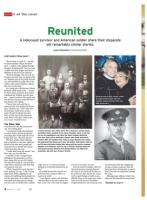
A family portrait, circa 1929, shows Perry Shulman's mother, Bayla,
and father, Motle, standing in the center. Shulman, about a year old,
sits on his grandfather's lap. When the Nazis invaded, Motle had
been shot while still in Klimontow, Poland. After being deported in
October 1942 and shuffled from camp to camp, Shulman was eventu-
ally separated from Bayla and 3-year-old brother Salik (Saul), while he
and 10-year-old brother Moshe Mair, along with two uncles, remained
together up to Birkenau. After he was in Detroit, Shulman found out
that Bayla had been liberated from Bergen-Belsen and Salik from
Auschwitz, and both were living in Toronto.
really react to it. I was just shocked.
Nothing in my life had prepared me for
this?'
He walked around the camp for the
next four hours, trying to take in as
much as he could.
"I saw bigotry, racism, anti-Semitism.
I had felt these in my own country. But
here, I saw it all. I saw what can happen
if we turn our backs," he says.
Over the next few months, while the
liberated prisoners awaited plans for
the camp to be closed and for them to
be moved out, Bass and the U.S. Army
tried to make things as livable as pos-
sible for them. At the same time, under
order of newly sworn-in President
Dwight Eisenhower, the American army
was determined that the neighboring
German civilians would see what the
Nazis had done, forcing them to march
from town and escorting them through
the camp.
Although many soldiers in Bass' bat-
talion saw Buchenwald, he never heard
Reunited on page 10