

health & wellness
0.1'
Cure In The
Future?
Israeli researcher's
concept to use
liver cells to create
a patient's own
insulin is close to
testing.
Ruthan Brodsky
I Contributing Writer
I
t takes chutzpah for a company to
announce that its goal is to cure Type
1 diabetes, especially when the com-
pany is relatively new and small. It shows
enormous confidence when the announce-
ment made by this company is basing its
research on cellular trans-differentiation,
an innovative process that helps restore a
patient's natural insulin production and
blood sugar regulation by enabling the
patient's own liver cells to create insulin.
The company is Orgenesis, a small devel-
opment-stage company positioned at pre-
clinical research (excluding research on liv-
ing humans) that is incorporated in the U.S.
with roots in Israel. Professor Sarah Ferber,
a Technion-Israel Institute of Technology
graduate who studied biochemistry under
the supervision of Avram Hershko and
Aharon Ciechanover, winners of the Nobel
Prize in Chemistry in 2004, is the originator
of this concept that it is possible to convert
liver cells into a functioning pancreas.
When her father was diagnosed with
diabetes, she changed her research direction
from protein degradation at Technion to
finding a therapeutic resolution for diabetes.
Following her postdoctoral fellowship at
Harvard Medical School's Diabetes Center,
Ferber continued her work on diabetes at the
University of Texas Southwestern Medical
Center at Dallas and then at the Sheba
Medical Center, Tel Hashomer in Tel Aviv, a
major medical-scientific research facility that
collaborates internationally with the bio-tech
and pharmaceutical industries to develop
new drugs and treatments. Her research has
been funded for more than 10 years by the
Juvenile Diabetes Research Foundation (four
grants totaling about $2.5 million), the Israel
Academy of Science Foundation (twice),
D-Cure and the Israeli Ministry of Health.
Her father died from diabetic complica-
tions before she could complete her work
44 October 16 • 2014
•
(
7:71
do., ■ 11...
a/040h P..
'4'.
:74
el■•■■■■■•■•■■ ••
Pt' MoksulJr cntzincering hilln7 itcputucyks into pancreatic
tacdh for diabdes I hemp.
Revolutionary Approach
After more than 13 years of research,
Ferber, currently head of the Molecular
Endocrinology Research Unit at Sheba
Medical Center, is succeeding in the
revolutionary medical approach in which
diabetic patients will be their own organ
donors to cure diseases by taking a part of
their liver and converting it into a func-
tioning pancreas producing insulin.
This concept of cell therapy for diabetic
treatment will eliminate the shortage of
donated organs for transplants and the need
to avoid transplant rejection with powerful
immunosuppressant drugs that lower resis-
tance to other diseases.
Much of Ferber's research techniques
are geared to creating a short cut in which
mature cells can be redirected by artificially
inserting into the cells specific transcrip-
tion factors, prompting new and different
characteristics than they originally had.
Transcription factors are proteins in the cell
nucleus that help determine which genetic
material (DNA) is expressed and determine
the cell's designation.
When she published her new concept
in Nature Medicine 2000, there was much
criticism because current theory postulated
that it was impossible to change the traits
and function of mature cells. The following
10 years of research demonstrated that cell
transdifferentiation can be performed.
Ferber has already applied this technology
of injecting a specific transcription factor in
liver cells of lab rats and found that it gener-
ates the production of insulin just as the
pancreas.
Among different forms of cell therapy,
autologous cell replacement therapy provides
many benefits: It is safer than other options
because it doesn't alter the genetic material
(DNA) of the host organism but only changes
the genetic information. It also provides a
good source of therapeutic tissue because
it isn't rejected by the patient who doesn't
require immune suppressants. It is also high-
ly ethical because no human organ donations
or embryo derived cells are needed. Using
Orgenesis technology, individuals can use
their own tissue at any age. Ferber had cre-
ated autologous insulin-producing cells.
The concept of harvesting stem cells and
implanting them into the patient's body to
regenerate organs and tissues has been prac-
ticed and researched in animal models. An
example of this technology already in clinical
use is the autologous cell replacement proto-
col used for autologous implantation of bone
marrow stem cells for patients undergoing
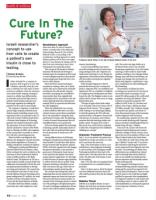
Professor Sarah Ferber in her lab at Sheba Medical Center in Tel Aviv
massive chemotherapy.
A more recent published case reports
successful cartilage growth in human knees
using autologous stem cells. Orgenesis cell
replacement technology is a new therapy for
regeneration of functional insulin-producing
cells that enable normal glucose-regulated
insulin secretion.
Ferber founded Orgenesis in 2010 to
promote the discovery into a commercial
product. Orgenesis SPRL was established and
registered in 2013 as a subsidiary in Belgium
to complete process development and manu-
facture the cells. The Belgium location is cen-
trally located in Europe with access to a large
biotech talent pool.
"We hope to begin clinical trials within
12 to 16 months," says Scott Carmer, CEO of
Orgenesis North America. "We are aggres-
sively working on our technology, keeping
in mind the questions the FDA will want
answered before it will approve clinical trials
with humans. For instance, some of these
questions deal with toxicology studies and
quality control. The good news is that to
date much of our work has been replicated
in other labs. Principle has been established
validating our concept:'
Orgenesis Treatment Process
Step 1: As an out-patient, the patient has a
standard liver biopsy procedure at a clinic
and is sent home the same day.
Step 2. Part of the biopsy is sent to a cen-
tral laboratory where Orgenesis technology
is used to produce AIP (Autologous Insulin
Producing) and delivers them back to the
clinical center. This takes about five to seven
weeks. The other part of the biopsy is used
for bio banking.
Step 3: The AIP cells are transplanted back
to the patient's liver in a standard infusion
procedure.
Step 4: In those cases in which the patient
may need additional treatment, those AIP
cells could be produced from the bio-banked
specimen.
Diabetes Threat
Diabetes is an insidious disease. In type 1
diabetes, the body does not produce insulin
and the body cannot let glucose into the
cells. The result is the sugar builds up in
the blood stream where it can cause life-
threatening complications. Even with insulin
and drugs, it often results in major health
problems resulting in nerve damage, kidney
damage, heart and blood vessel disease, eye
damage, foot damage, skin and mouth con-
ditions and pregnancy complications. Long-
term complications are often disabling and
life-threatening.
The prevalence of diabetes has been
increasing at an annual rate of 5 percent per
year and the trend is increasing. An esti-
mated 285 million people of the world's adult
population are living with diabetes. These
numbers are expected to expand to 438
million by 2030. In the U.S., the direct and
indirect costs of type 1 diabetes are about
$15 billion annually. Type 2 diabetes, though
less expensive per patient, costs about 10
times that amount because of the increasing
number diagnosed with the disease.
By transforming a patient's own liver cells
into new insulin producing cells, Orgenesis
hopes to develop a breakthrough therapy for
people living with type 1 diabetes.
In his new role, Carmer will oversee the
Orgenesis drug development and commer-
cialization strategy in North America, focus-
ing on the near-term initiation of Phase I and
Phase II clinical trials in the United States.
As the father of a child who is living with
type 1 diabetes:' Carmer said. "I am person-
ally motivated to help bring the innovative
science pioneered by the Orgenesis team into
the clinic. The technology of cellular trans-
differentiation has established pre-clinical
proof-of-principle that human adult liver
cells can successfully be transformed into
glucose responsive and functionally mature
insulin producing cells.
The company's technology has been
developed following extensive animal safety
testing and the research has matured to the
stage of clinical development. There are more
than 50 centers in the world that are highly
qualified for pancreatic islet transplantation.
It is Orgenesis' intention to work closely with
such leading centers in order to enable AIP
cell transplantation as a therapeutic approach
in the treatment of diabetes at those
centers.
❑