

travel
Jewish Berlin
•
The capital city where hip meets history.
Susan R. Pollack
Special to the Jewish News
p
ack plenty of tissues if you're bound
for Berlin, ground zero for the
Holocaust that extinguished the
lives of 6 million European Jews and oth-
ers deemed unworthy of life by the German
Nazis during World War II.
But don't let the likelihood of tears stop
you from visiting this vibrant German capital
whose current ethos on the cutting edge of
hipness is overlaid with a heavy sense of his-
tory.
I was struck by that duality on a recent trip
focused on the approaching 25th anniversary,
Nov. 9, of the fall of the Berlin Wall. Despite
Berlin's fascinating past as a divided and now
reunified city, I was even more intrigued by
its tragic World War II Jewish history — and
how Berliners have chosen to deal with it.
The most haunting moment came late
on a Saturday night at Pauly Saal, a stylish,
Michelin-starred restaurant in the Mitte
district, the historic heart of Berlin that was
home before the war to many thousands of
Jews. Relaxing with travel colleagues, I had a
chilling flashback to the late 1930s when the
chic building in which we sat thrived for a
time as Berlin's first Jewish Girls' School. That
is, until the girls disappeared, deported with
their families to Nazi concentration camps.
I'd learned their disturbing story that
morning on a Jewish Heritage walking tour
with historian Chaja Baebl, a guide with Milk
and Honey Tours. Strolling through the now-
gentrified old Jewish quarter, she pointed
out historic sites including the onetime girls'
school where the restaurant today shares
space with a New York-style deli, art galleries
and, in a quirky twist, a museum devoted to
President John E Kennedy, who won German
hearts by declaring himself a "Berliner" in his
famous 1963 speech at the Brandenburg Gate.
History Broken, Changed
"History was broken here ... and history has
changed:' Baebl said, as we passed hidden,
graffiti-splashed courtyards filled with reno-
vated apartment buildings, boutiques and
cafes. "It's overwhelming, even when you live
here. You always have to juxtapose the past
and present:'
Bicycles and Segway tours zipped past as
we viewed the park-like remains of Berliris
first Jewish cemetery, which dates to 1672 but
was destroyed by the Nazis. We paused at the
nearby memorial to 55,000 murdered Berlin
Jews and admired the Moorish-style gilded
dome on the New Synagogue, consecrated in
42
October 16 • 2014
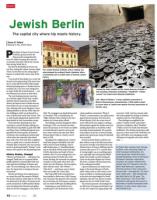
The Jewish Museum of Berlin, with a striking new
wing designed by architect Daniel Libeskind, offers
a fascinating look at 2,000 years of German Jewish
history.
Among the many exhibits at the Jewish Museum of Berlin is
this haunting, interactive installation, "Shalekhet" ("Fallen
Leaves") by Israeli artist Menashe Kadishman.
Left: "Block of Women," a large sandstone monument in
Berlin's Rosenstrasse, commemorates a 1943 public protest
by Aryan wives of Jewish men against the Nazi persecution of
German Jews.
1866. The synagogue was attacked but spared
in November 1938, on Kristallnacht, the
"Night of Broken Glass:' thanks to the inter-
vention of a German police official.
The building, seriously damaged by Allied
bombing in 1943, was restored years later,
minus the sanctuary. It now houses an exhibit
on Jewish life and is open for services and
tours where visitors may learn that Albert
Einstein played violin in a charity concert
there in 1930.
Throughout the neighborhood, I noticed
small brass plaques embedded in the side-
walk in front of many buildings. They're
called Stolpersteine, or "stumbling blocks:'
and are inscribed with the names and dates
of birth, deportation and death of former
residents. Part of a once-underground, now
sanctioned project by Berlin-born artist
Gunter Demnig, the memorials are poignant
reminders of real people whose lives were
wiped out in the Holocaust. Each inscription
starts with the words, "Hier Wohnte" —
"Here lived" — and tissues come in handy
when you ponder the victims' fates.
More than 6,000 of the memorials have
been installed in Berlin since 1996, Demnig
said. The project has spread to 964 communi-
ties in Germany and 18 European countries
and now totals 47,000-plus stumbling blocks.
Continuing our tour, Baebl led me to
a small square in the Rosenstrasse where
a large sandstone monument, "Block of
Women:' commemorates a rare public protest
against Nazi persecution of German Jews.
In late February 1943, the Aryan wives of
some 2,000 Jewish men staged a weeklong
demonstration against the sudden arrest and
pending deportation to Auschwitz of their
previously exempt husbands. The women's
noisy defiance in the face of armed Gestapo
guards and machine gun-toting SS ultimately
was successful.
No look at Jewish Berlin would be com-
plete without a stop at the Holocaust memo-
rial, known formally as the Memorial to the
Murdered Jews of Europe. Walking amid the
cemetery-like maze of 2,711 concrete slabs
of varying heights was an unsettling experi-
ence, especially upon learning that Hitler's
bunker lies beneath a nearby parking lot.
Check out the photo displays and victims'
life stories, complete with haunting music,
in the underground exhibit.
I spent an afternoon, but wished I had
longer, at the Jewish Museum of Berlin,
where visitors enter an 18th-century court-
house and follow an underground passage
to the steel-clad wing designed by Daniel
Libeskind, who later was chosen as master
planner for the new World Trade Center.
The museum presents a fascinating look
at 2,000 years of German Jewish history, but
it is the new wing's bold, zigzag design with
cavernous "voids" and bare concrete walls
that make palpable the feelings of isolation,
emptiness and loss of the Holocaust.
Those feelings are amplified by the
outdoor "Garden of Exile" and another
interactive installation called "Shalekhet"
("Fallen Leaves") by Israeli artist Menashe
Kadishman. The echoing sounds from walk-
ing across a floor strewn with 10,000 flat, iron
faces with hollow eyes and gaping mouths
will haunt you long after your trip to Berlin
ends. ❑
Air Berlin flies nonstop from Chicago
to Berlin, with continuing flights to
other European destinations. My
travel group also visited the glass-
domed Bundestag, home to Germany's
Parliament (advance registration
required); an outdoor weekend flea
market near the Tiergarten; and the
Berlin Wall Memorial, a preserved,
200-foot portion of the Communist-
erected wall – and adjacent "no man's
land" death strip – that divided East
and West Berlin for 28 years. The
25th anniversary "Fall of the Wall"
celebration will feature the launch in
November of 8,000 illuminated white
balloons. To learn more, check www.
wall.visitBerlin.de .