

travel
Jews In
Germany
Holocaust conference in Berlin
shows progress, but raises
European anti-Semitism alarm.
Dr. Charles Silow
Special to the Jewish News
Editor's Note: Dr. Charles Silow is director
of the Program for Holocaust Survivors and
Families a service of Jewish Senior Life. The
following story chronicles his experience
at the Conference of the World Federation
of Jewish Child Survivors of the Holocaust
and Descendants held Aug. 24-27 in Berlin,
Germany. Of the more than 400 attendees,
15 were from Detroit.
I
t was with some ambivalence that I
decided to travel to Berlin to attend
the annual conference of the World
Federation of Jewish Child Survivors of the
Holocaust and Descendants (www.
holocaustchild.org). I was curious to
see what Germany was like today, "the
Fatherland:' the land where Nazism and
anti-Semitism took hold and spread like
wildfire through Europe, destroying 6 mil-
lion Jews, 11/2 million children, in its path.
The millions meant the extermination
of real people, the parents and families
of so many child survivors, victims that
also included my grandparents, aunts and
cousins — this was reason for my ambiva-
lence.
Coming to Berlin, I half expected to see
Nazis marching in the streets. But this was
2014. What would Berlin really be like?
Despite the Holocaust, the Jewish people
have survived.
Before the conference began, I met with
several good friends at our hotel in the
former East Berlin. On Friday afternoon,
we left the hotel to walk and encountered
some Stolpersteine, or stumbling blocks,
placed in the sidewalk. They are copper
plates implanted in the sidewalks that
mark the local areas where Jews were
rounded up by the Nazis and sent to their
deaths. There were also fuller explanations
on nearby buildings of what happened to
the Jews who lived there.
We also saw, imprinted on the steps of
a subway station, the names of Jews who
lived in the area, who had been killed by
the Nazis.
It was impressive to me that Germany
seemed to be coming to terms with its
past.
On Shabbat, we walked to the New
Synagogue, dedicated in 1866. After ser-
vices, at the Kiddush, I spoke to several
young Jews who were born and grew up
in Berlin. They felt very comfortable in
the city that is their home. Many were
40 October 16 • 2014
-
■
,....,,..-....__
. r . . .. . . . ..... ,.....
„...
'.1 i'l°4.1
„ 6 S
--* 'C-
•
• - •
,.----
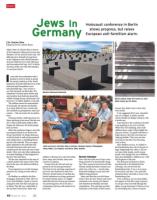
Berlin's Holocaust Memorial
Berlin subway steps list names of Jews
killed nearby by the Nazis.
ik. . 104*
Child survivors: Detroiter Rene Lichtman, Stefanie Seltzer, Philadelphia,
Daisy Miller, Los Angeles, and Steve Adler, Seattle.
children of Russian Jews who had settled
there; many were Israelis; many were
converts to Judaism.
Overall, they also felt safe and sup-
ported by the German government.
They had not, by and large, experienced
any overt anti-Semitism in their lives.
However, Jewish houses of worship and
Jewish institutions are always protected
by armed German police. It is highly
admirable that the German government
was protecting Jews, but it was also a
commentary that Jews still needed to be
protected.
Recent Changes
Now, with the recent war in Gaza, every-
thing seemed to be dramatically chang-
ing. These young German Jews said that
German media portrayed a biased, one-
sided view of the war — Israeli tanks,
destroyed buildings in Gaza and Arab
children being harmed.
Many said that they now felt threat-
ened as they saw how intense anti-Israel
sentiments were turning into blatant
anti-Semitism by Muslims and their
sympathizers. They said they put their
mezuzahs on the inside of their houses
because they didn't want to show they
were Jewish.
It was suggested that I wear a baseball
cap, not a kippah, in public and that
women should not display necklaces with
a Jewish star.
Some friends at the conference decided
to go kayaking on the river in Berlin.
While they were kayaking, some Arab
children threw rocks at them, lightly hit-
ting one of them. The guide told them to
forget about it, that they were kids just
"playing Intifada." They may not have
even known that they were throwing
rocks at Jews.
After Shabbat services, we walked to
the Brandenburg Gate, site in the past of
huge, frightening Nazi rallies. I did not
see many older people, mostly young
people. Even though this was a different
time and, thankfully, a different era, I still
felt the ghosts of the past.
The Holocaust memorial in Berlin,
the Memorial to the Murdered Jews
of Europe, was not far from the
Brandenburg Gate. It was a very power-
ful structure, and also a very powerful
statement that it was built so close to the
Brandenburg Gate.
From a distance, you see many pillars
that appear to look like a large cemetery.
As you get closer and walk through the
pillars, you go downward. It feels as if you
are descending into a forest of cement