

metro
Shabbos from page 22
The concert will begin at 8 p.m. at Young
Israel of Oak Park on 10 Mile Road east
of Greenfield. Visit the website for more
information or to register.
Project Origins
The Shabbos Project started last year in
South Africa, the brainchild of Dr. Warren
Goldstein, the country's chief rabbi.
After a short but intensive publicity
campaign, the majority of South Africa's
75,000 Jews, in eight communities
throughout the country, observed the des-
ignated Sabbath together. Some attended
communal Friday night dinners. Others
shared meals in private homes. For many,
it was their first experience of a Jewish
Sabbath.
The community-wide open-air
Havdalah service in Johannesburg attract-
ed an audience of 50,000.
During the concert, stories started to
pour in from people who said they'd had
the most inspiring, uplifting, wonderful
day, Goldstein said. The experience elec-
trified the entire community, he said.
This year, Goldstein has taken the proj-
ect global, enlisting committees to plan
similar events in Jewish communities
around the world.
"The beauty of the Shabbos Project
is that it's for every Jew. It doesn't mat-
ter what denomination you are or
whether you're affiliated or not affiliated,"
Goldstein said. "Shabbat belongs to the
entire Jewish people. This was a Jewish
unity project."
❑
For more information and registration, visit
www.shabbosprojectmi.com or call the local
office at (248) 583-2476, ext. 26Z
Funding Squeeze
Jackie Headapohl
I Managing Editor
T
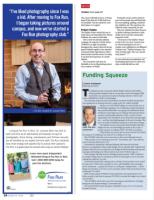
—Fox Run resident Dr. Leonard Stein
Living at Fox Run in Novi, Dr. Leonard Stein has time to
work full-time as an optometrist and develop his eye for
photography. Since dining, maintenance and 24-hour security
are all handled by our expert full-time staff, Fox Run residents
have more energy and opportunity to pursue their passions.
Fox Run is a great place for seniors who enjoy an active lifestyle.
Learn more about independent
retirement living at Fox Run in Novi.
Call 1-800-989-0293 today for
your free brochure.
Fox Run
Add more Living to your Life'
he Oakland County Community Mental Health Authority (OCCMHA),
which provides funding for direct-care providers such as Farmington Hills-
based JARC, has announced a 6 percent funding reduction, which could
mean a $400,000 hit to JARC's annual budget.
The reductions stem from state and Medicaid cuts that OCCMHA absorbed last
year, tapping into its financial reserves to make up the $21 million shortfall.
Another cut to OCCMHA's budget was expected this year, as
the Michigan Legislature was considering re-apportioning how
state mental health dollars were going to be distributed, which
would have meant big losses for Oakland, Macomb and Wayne
counties' mental health authorities. JARC, as well as Jewish
organizations JVS and Kadima, knew about this looming budget
cut — and have been fighting against it all year in Lansing. They
were successful in lobbying Lansing not to make these changes.
,„.
The Oakland County Community Mental Health Authority's
JARC CEO Rick budget was not cut in this budget go-round. In fact, it got a 1
Loewenstein
percent increase, according to JARC CEO Rick Loewenstein.
"What bothers me most is that we went to bat for [OCCMHA]
in Lansing so it wouldn't get cut, and now it is cutting us," he said.
The OCCMHA claims the cuts are necessary to shore up its financial reserves.
"Why are they so set on shoring up reserves?" Loewenstein said. "They still have
reserves that they almost never use."
Loewenstein is hoping that continued lobbying will restore the lost funds.
However, in anticipation of the possible budget cuts, he said that JARC implemented
changes earlier this year to make up for the budget shortfall including reducing start-
ing wages, eliminating some office positions and a top-to-bottom wage cut.
These changes will help; however, if budget pressures persist, "JARC would have
to consider scaling back on community activities for the people we serve and some
training for employees," he said.
Loewenstein stressed that cutting back on activities for the people it serves would
be a last resort. "JARC exists so people we serve with disabilities can be included
in the community— going to the movies, to a ball game, visiting friends — all the
things everyone likes to do. How can you monetize quality of life and inclusion in the
community?" he asked.
JARC hosted a group of Oakland County lawmakers and commissioners at its
offices recently to ask them to pressure OCCMHA to rescind the budget cuts to direct
care providers.
"The OCCMHA can do this at any time by passing an amendment to its budget
during one of its board meetings," Loewenstein said.
The next OCCMHA board meeting is scheduled for 6 p.m. Oct. 21 at Common
Ground in Pontiac.
❑
24 October 16 • 2014